Best Dual Lens 3D Camera Options for Immersive VR and 3D Imaging
Dual lens 3D cameras deliver stereoscopic depth for VR, AR, and live streaming. This guide highlights five well-suited options for buyers seeking true 3D capture, wide angles, and easy sharing. The best picks target creators, developers, and hobbyists who want reliable 3D footage without complex rigs. Below is a quick comparison table to help you decide at a glance.
| Product | |||
|---|---|---|---|
| KanDao QooCam EGO | VR enthusiasts and mobile-first creators | 65mm stereo base, 8K photo, 4K60 video, instant VR view | May require compatible VR headset for full experience |
| MMlove USB Stereo Camera (1080P 60FPS) | Indoor face detection and streaming setups | Synchronous dual lenses, 115° wide view | Basic features; not a high-end standalone VR device |
| Fujifilm FinePix Real 3D W3 | Budget 3D photography with built-in display | Dual 10MP CCD sensors, autostereoscopic 3D LCD | Older model; limited modern video features |
| SVPRO 1080P Dual-Lens Camera Module | Robotics and computer vision projects | 3D sync, 3840×1080, USB-C plug-and-play | Module form factor; needs compatible host system |
| MMlove USB Stereo Camera Synchronous Dual Lens | VR facial recognition and conferencing | 1080P/60fps, 117° wide angle | Basic consumer-grade option; integration varies by platform |
Introduction: The best dual lens 3D cameras provide clear depth perception, reliable synchronization, and straightforward connectivity. This guide focuses on five models that offer practical depth-sensing and broad compatibility for American buyers building VR scenes, 3D photo libraries, or real-time face recognition setups. The product sections below explain who each camera is best for and why it was chosen.
KanDao QooCam EGO — Viewer-Integrated 3D VR Camera

Best for immersive 3D content with easy sharing. The QooCam EGO uses a 65mm stereo baseline for natural depth and captures 8K-equivalent photo resolution (8000×3000) and 4K at 60FPS video. Its built-in IMU sensor and stabilization enable smooth footage without a separate gimbal. The QooCam APP lets you edit, export side-by-side videos, and share to major VR platforms.
Who it’s for: creators seeking high-quality 3D visuals for VR headsets and large displays, and those who want quick in-device playback. Limitation: large files can require substantial storage and processing power for 8K photos and 4K video.
MMlove USB Stereo Camera 1080P 60FPS

Best for streaming and indoor biometric tasks. This dual-lens module captures synchronized 1080p footage at 60FPS with a 115° wide view, making it suitable for face detection, live detection, and VR streaming on compatible platforms. It’s plug-and-play with USB interfaces, reducing setup complexity.
Who it’s for: developers and hobbyists building VR or biometric demos on PCs or Raspberry Pi. Limitation: lacks built-in field upgrades for high-end 4K VR capture.
Fujifilm FinePix Real 3D W3

Best for budget 3D photos with a built-in 3D display. The W3 uses dual 10MP CCD sensors and a glasses-free 3D LCD to instantly view 3D content. It offers basic 3D recording in 720p, making it a simple entry point into stereoscopic imaging.
Who it’s for: photographers who want a classic, affordable 3D camera with immediate on-device viewing. Limitation: video capabilities are limited by older technology and lower resolutions.
Canon RF5.2mm F2.8 L Dual Fisheye Lens

Best for professional VR capture with EOS R5. This dual fisheye lens enables 180° stereoscopic VR shooting when paired with compatible firmware and software. It supports immersive head-tracking experiences and wide VR viewpoints, ideal for advanced productions.
Who it’s for: videographers and studios needing high-quality VR-ready optics. Limitation: requires compatible camera and software ecosystem; not standalone.
ANNKE 5MP Dual-Lens Security Camera

Best for surveillance with wide-angle dual lenses. This 5MP add-on camera offers 180° coverage, 3D noise reduction, and IP67 weather resistance. It’s designed to connect to specific ANNKE DVR systems and is ideal for panoramic security views in challenging lighting.
Who it’s for: security setups needing broad, synchronized dual-lens footage. Limitation: compatibility is limited to select ANNKE DVR models.
Canon RF5.2mm F2.8 L Dual Fisheye Lens (Canon EOS R5 Compatible)
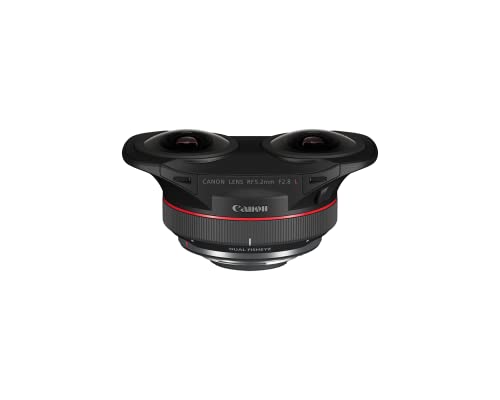
Best for immersive 3D capture with Canon ecosystems. This dual fisheye lens supports VR-ready workflows with head-mounted displays and VR software. It’s a strong choice for EOS R5 users seeking 3D VR capabilities with a single, compact lens system.
Who it’s for: Canon users who want a dedicated VR-ready optic for 180° stereoscopic VR. Limitation: requires compatible firmware and software tools for full VR workflow.
Buying Guide
What to consider when choosing a dual lens 3D camera:
- Intended use: VR viewing, 3D stills, live streaming, or surveillance. Match the device to your primary workflow.
- Stereo base and alignment: A larger baseline (distance between lenses) offers stronger depth but may affect portability.
- Resolution and frame rate: Higher resolutions and 4K/8K outputs are ideal for large displays and VR headsets but require more storage and processing power.
- Connectivity: Look for USB-C, USB 3.0/3.1, or wireless options that fit your hardware ecosystem.
- Software and sharing: On-device editors and export formats (side-by-side, VR-ready MP4) simplify publishing to VR platforms and social media.
- Compatibility: Ensure compatibility with your target VR headsets, computers, or DVR systems. Some products are ecosystem-specific.
- Portability and power: Battery life and weight influence field use and travel readiness.
Comparison tips: If you need quick VR playback without extra gear, prioritize models with built-in displays or immediate VR export options. For developers, modules and lenses that offer easy integration into existing hardware setups can save time and money.
FAQ
- What is a dual-lens 3D camera?
- Do I need special software to view 3D content from these cameras?
- Can these cameras be used for live streaming?
- Is a larger lens baseline always better?
- Are dual-lens cameras compatible with all VR headsets?
- What should I consider for security or surveillance use?
It uses two cameras to capture left and right images simultaneously, creating depth and a stereoscopic 3D effect for VR or 3D displays.
Yes. Many models provide side-by-side or VR-ready exports, which require compatible viewers or software to render properly.
Some models support live streaming through USB or wireless connections, but capabilities vary by device and software.
Not always. A larger baseline increases depth perception but can complicate stabilization and alignment in small form factors.
No. Compatibility depends on the camera’s output format and the headset’s supported input. Check headset requirements before purchasing.
Look for weather resistance, low-light performance, and DVR compatibility if you plan to integrate with security systems.