Best Thermal Camera for Drone: Find the Right Heat-Sensing Drone Imaging System
Answering the question with practical, buyer-focused guidance, this guide highlights five top thermal camera options for drones. These selections suit different users—from hobbyists seeking simple heat detection to professionals conducting inspections and searches. The overview below helps you compare capabilities, compatibility, and practical use cases to pick the right thermal drone camera for your missions.
Below is a quick summary table of the chosen products to aid quick comparison.
| Product | Best For | |
|---|---|---|
| Autel EVO Lite 640T Enterprise Bundle | Professional missions with portable setup | 640×512 thermal, 30 Hz, 16x digital zoom |
| Autel EVO II Dual 640T V3 | High-detail thermal with visible camera integration | 640×512 thermal, 50 MP visible sensor |
| Autel EVO Lite 640T Enterprise Basic Combo | Mitigated budget without sacrificing thermal depth | 640×512 thermal, 30 Hz, AI target recognition |
| ZZYJPTFZ Thermal Camera FPV | FPV drones needing CVBS output | Multiple resolutions up to 640×512 |
| ANXTECH Mini Thermal Camera | Compact inspections and quick checks | Pocket-sized, no app required, quick scans |
Autel EVO Lite 640T Enterprise Bundle

The Autel EVO Lite 640T Enterprise Bundle provides a high-resolution thermal imaging sensor (640×512) with 30 Hz refresh and a standard 9mm lens. This configuration supports up to 16x digital zoom, aiding precise heat signature detection during critical operations. Best for professional field missions where portability and fast deployment matter, such as search-and-rescue or industrial inspections. Caution: larger missions may require extra batteries or spare parts for extended field work.
Who it’s best for: professional operators needing reliable thermal detail with portable form factor, and teams that value built-in AI targeting and robust flight integration. Why selected: it balances resolution, bandwidth, and ease of use in a single package, enabling efficient data capture in real-world environments.
Limitation to note: remote operation and flight planning may require additional Autel software setup; ensure compatibility with your ground station before flights.
Autel EVO II Dual 640T V3

This model combines thermal imaging with a high-resolution visible camera. The thermal sensor reaches up to 640×512 at 30 Hz, enabling detailed heat mapping and temperature assessment. The 0.8″ CMOS visible sensor with 50 MP resolution supports crisp stills and video. Best for operators who need both thermal insight and superior visible footage for documentation and analysis. Caution: higher-end features require familiarity with Autel’s ecosystem and software updates.
Who it’s best for: professionals who require robust dual-sensor capabilities for precise documentation and audit trails. Why selected: it delivers strong thermal acuity together with a high-quality visible image, ideal for complex inspections and investigations.
Limitation to note: the learning curve may be steeper for new users, and field battery life should be planned for longer missions.
Autel EVO Lite 640T Enterprise Basic Combo
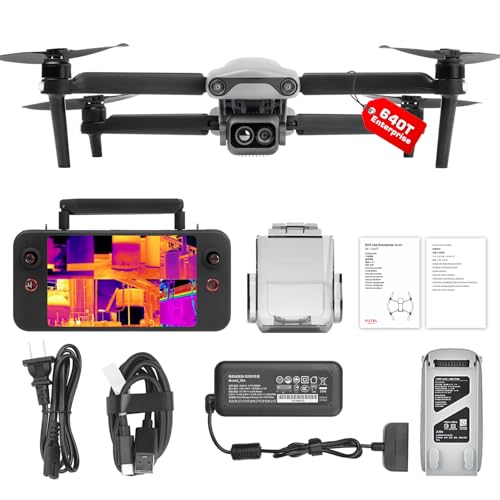
The Basic Combo keeps the core thermal capability at 640×512 resolution with 30 Hz, and adds AI target recognition to assist in quickly identifying heat anomalies. This option suits users who want strong thermal performance with guided analysis tools. Best for field technicians who need a straightforward workflow and reliable data capture without the extras of higher-tier bundles. Caution: fewer accessories than higher-tier bundles could limit deployment versatility in some scenarios.
Who it’s best for: technicians and field crews wanting strong thermal imaging with practical analytics. Why selected: it offers essential enterprise-grade thermal performance at a more accessible price point.
ZZYJPTFZ Thermal Camera FPV

This FPV-oriented module delivers multiple resolution options, up to 640×512, with a standard CVBS output for easy integration with FPV transmitters and goggles. A compact, lightweight design makes it suitable for weight-sensitive UAV platforms, enabling real-time thermal feedback during flight. Best for FPV pilots seeking straightforward integration and heat mapping during low-altitude or field operations. Caution: CVBS output may offer lower image processing flexibility than digital interfaces in some setups.
Who it’s best for: FPV enthusiasts and drone professionals needing an economical, easy-to-integrate thermal option. Why selected: its CVBS compatibility and compact form factor suit fast-moving FPV use cases where weight and simplicity matter.
ANXTECH Mini Thermal Camera with Touchscreen

This ultra-compact thermal camera provides an 80×60 infrared resolution and a responsive touchscreen with no app required. It is designed for quick spot checks, home inspections, and on-the-go heat monitoring. Best for homeowners, DIYers, or technicians who want a pocket-sized option for fast inspections without the complexity of larger drone thermal systems. Caution: limited professional-grade features compared to full-sized drone thermal modules.
Who it’s best for: users who need immediate, simple thermal detection in a compact form. Why selected: easy-to-use, no-setup operation makes it ideal for rapid checks and casual use in the field.
Buying Guide
What should I consider when choosing a drone thermal camera?
- Resolution and refresh rate: Higher resolution (e.g., 640×512) with faster refresh rates (e.g., 30 Hz) yields clearer thermal detail and smoother live feedback.
- Sensor and lens: Consider whether you need a visible camera in addition to thermal. Lens focal length affects field of view and detection range.
- Output interface: CVBS is common for FPV setups; HDMI/SDI/USB options may offer richer data handling but require compatible receivers.
- Weight and form factor: Heavier cameras impact flight time and payload limits. Compact mini modules suit lightweight drones and FPV builds.
- Power and compatibility: Check battery life implications and ensure compatibility with your drone’s flight controller and software ecosystem.
Which features deliver the most value for different users?
- Professional fieldwork: prioritize thermal resolution, 30 Hz or higher, durable airframe integration, and AI-assisted analysis (examples: Autel EVO Lite 640T Enterprise Bundle, EVO II Dual 640T V3).
- FPV and quick inspections: prefer lightweight, CVBS output, and easy setup (examples: ZZYJPTFZ FPV module).
- Home or DIY inspections: compact, no-app options with quick usability are ideal (examples: ANXTECH Mini Thermal Camera).
How to plan for field use?
- Assess mission duration and carry extra power sources to avoid mid-mission drops.
- Ensure firmware and software alignment with your drone platform for accurate temperature readings.
- Prepare storage for thermal data and clear labeling to keep heat signatures organized for analysis.
What are common limitations to expect?
- Higher-end models may require more sophisticated training or software integration.
- Some FPV modules use CVBS which may limit advanced analytics compared to digital outputs.
- Thermal data interpretation often depends on environmental conditions; always verify readings with contextual cues.
FAQ
Q: What is the main advantage of a 640×512 thermal sensor?
A: It provides greater detail for identifying heat patterns and anomalies, improving detection accuracy in complex scenes.
Q: Do I need a separate license or license plate for using thermal cameras on drones?
A: Most thermal camera use on consumer drones does not require a separate license, but local regulations for drone operations should be followed, including any remote ID requirements if applicable.
Q: Can I use a thermal camera for night searches?
A: Yes. Thermal imaging excels in low visibility conditions, making it effective for night-time searches and heat signatures in darkness.
Q: Is a dual-camera setup preferable for professional work?
A: A dual-camera system that combines thermal and visible imaging can enhance situational awareness and documentation by providing both heat data and high-detail visuals.
Choosing the right thermal camera for a drone depends on your mission profile, weight tolerance, and data needs. The options above cover a spectrum from compact FPV-friendly modules to full enterprise bundles designed for professional operations. Use the buying guide questions to narrow the choice to a model that fits how you work and where you fly.