Best Phones With Flir Cameras for Clear Thermal Imaging on the Go
Answers to common buyer questions: which phone-based thermal imaging option fits your field, budget, and workflow? This guide compares five top picks that integrate FLIR thermal cameras with smartphones, helping electricians, HVAC pros, and DIY enthusiasts choose the right one. Each option includes real-world use cases, strengths, and a practical drawback to consider before you buy. Use the quick table below to compare core details at a glance.
| Product | Best For | Key Strength | Limitation |
|---|---|---|---|
| Flir One Android | Android users needing USB-C compatibility | Native MSX integration, super resolution upscaling | Requires USB-C port; limited to Android ecosystem |
| Flir One iOS (USB-C) | iPhone users with USB-C | High-detail with 480×360 resolution in later models | Requires iPhone with USB-C; similar app limitations |
| Flir Edge | Pro technicians needing wireless use | Wireless connectivity, compact form | Bluetooth reliance; may require app setup |
| Blackview Rock 3 | Rugged field work with built-in FLIR | Integrated thermal camera in rugged device | Heavier device, battery life trade-offs |
| Flir One Pro | iOS/USB-C users seeking higher resolution | Higher native and upscaled resolution | Higher price tier than base models |
Flir One Android Thermal Imaging Camera

Best for Android users needing direct USB-C compatibility. The camera plugs into the phone’s charging port and connects with all USB-C Android devices, including Samsung Galaxy and Google Pixel. It upscales thermal images from 80×60 to 240×180 using Vivid IR, with MSX technology blending thermal and visual data in real time for added detail. The Flir One app includes step-by-step inspection guides for identifying air leaks, moisture buildup, and other common faults. This makes it suitable for home inspections and quick on-site assessments.
Who it’s best for: contractors and DIYers who work with Android devices and want portable, real-time heat data. Why selected: strong balance of portability, detail, and guided inspection workflows. Caution: the app’s usability and features depend on the specific Android device and OS version; expect occasional compatibility considerations with newer security updates.
Flir One Pro for iOS Smartphones
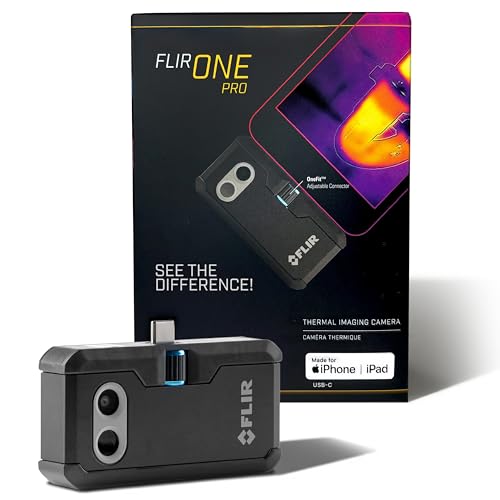
Best for iPhone users seeking higher thermal resolution. The Flir One Pro connects to iOS devices with USB-C (iPhone 15 and newer). It provides 480×360 super resolution (160×120 native IR) and uses Flir MSX to merge thermal and visual images for enhanced detail. The app offers a guided inspection workflow to identify leaks and moisture buildup. This option is well-suited to professional inspections where higher detail improves fault detection. Caution: costs are higher than base models, and earlier iPhone models may not support all features.
Flir Edge Wireless Thermal Camera

Best for technicians who need wireless operation across iOS and Android devices. The Flir Edge uses Bluetooth to connect to phones and tablets, offering 240×180 upscaled imagery (80×60 native IR) and MSX for real-time detail enhancement. Its wireless nature makes it practical for accessing tight spaces or corners without cables. Best for quick surveys and fieldwork that requires mobility. Limitation: wireless reliability can vary by environment and device compatibility, so verify Bluetooth pairing in advance.
Blackview Rock 3 Thermal Imaging Rugged Smartphone

Best for field technicians who need a rugged, all-in-one device with built-in FLIR. The Rock 3 integrates a 160×120 FLIR thermal sensor, AI-enhanced image optimization, and the ability to generate PDFs on-device for electrical or HVAC inspections. It supports multiple color palettes and temperature alarms to simplify heat-pattern interpretation. Choose this if you require a robust, do-it-all device with thermal capability built into the phone. Caution: it is heavier and bulkier compared to slim, dedicated thermal dongles, which may affect one-handed use on ladders or in tight spaces.
Buying Guide: Key Considerations For Choosing A Phone With FLIR
- Determine whether you prefer a device that plugs directly into a USB-C or Lightning/USB-C port, or a wireless attachment. This affects ease of use and cable management on job sites.
- Look for higher native resolution and MSX-enabled upscaling for better detail in thermal images. Higher resolution helps identify small temperature anomalies.
- If you frequently inspect tight spaces, a wireless solution or rugged all-in-one device may reduce setup time and equipment load.
- Some models include guided inspection checklists and reporting tools. These can save time on documentation and improve consistency of findings.
- Consider weight, grip, and durability based on your work environment. Rugged phones or compact dongles suit different job sites.
- Higher-resolution cameras cost more but provide clearer diagnostics. Assess whether the added detail justifies the investment for your typical tasks.
- Thermal imaging can be power-intensive. If you work all day, ensure the device or phone battery supports extended use between charges.
- If you anticipate upgrading phones, check whether the FLIR module will remain compatible with newer devices or if a new attachment is required.
Frequently Asked Questions
- What is FLIR MSX technology? MSX blends thermal data with a visual image to enhance detail in real time, making it easier to locate faults.
- Can I use FLIR cameras with any smartphone? Most models require specific ports (USB-C or Lightning) or wireless compatibility. Always verify device support before purchase.
- Are these cameras suitable for professional HVAC inspections? Yes, several options include guided inspection workflows and temperature alarms, which aid in identifying leaks and insulation issues.
- Do built-in thermal cameras last longer than external attachments? Built-in cameras are integrated and typically designed for field durability, while external attachments depend on connector integrity and cable wear.
- Is higher resolution always better? Generally, higher native resolution provides clearer diagnostics, but practicality depends on how you analyze the data and your reporting needs.
- Do these devices require special software? Most options use the Flir One app or compatible companion apps to capture, analyze, and generate reports.