Best Night Vision Hunting Camera Options for Safe, Effective Wildlife Monitoring
Answering essential buyer needs: these night vision hunting cameras deliver reliable motion-activated capture, long battery life, and clear night imagery for wildlife surveys, security, and scouting. Best for hunters who want cellular connectivity, solar charging, or non-cellular reliability in rugged environments. The top picks cover cellular and non-cellular models, with strong night-vision capabilities and robust build quality. Below, compare five options to find the right fit for your setup, environment, and budget.
Overview table of selected products
| Product | Best For | Key Night Vision Note | Connectivity |
|---|---|---|---|
| SPYPOINT Flex-M Twin Pack Cellular Trail Cameras | Cellular monitoring on the go | Night Vision with 28MP photos | Cellular (LTE), No WiFi needed |
| WOSODA 2 Pack Trail Camera | Budget dual-pack scouting | 850nm Low Glow IR | Non-cellular |
| MAXDONE Solar Trail Camera WiFi | Eco-friendly long-term installs | 4K/64MP with night vision | WiFi, Solar |
| Meidase P70 (Non-Cellular) | High-resolution non-cellular scouting | 100 ft No-Glow night vision | Non-cellular |
| KJK Trail Camera 36MP 2.7K | Compact, feature-rich field camera | 75 ft night vision | Non-cellular |
SPYPOINT Flex-M Twin Pack Cellular Trail Cameras

Best for ongoing cellular monitoring without manual SIM swapping. The FLEX-M supports cross-carrier coverage, continuous network checks, and test photo capture. It also works with solar panels (sold separately) to extend autonomous operation. This model is ideal for hunters who want immediate setup with minimal risk of connectivity gaps and prefer a plan with free photo transmission up to 100 images per month. Cautious users should note that extra photo plans are available if you need higher transmission volume.
Who it’s best for: Hunters and wildlife managers who want seamless cellular coverage out of the box and low ongoing costs. Choose this if you need easy setup, reliable remote access, and the option to expand power with solar.
Why selected: Combines user-friendly cellular access, ongoing connectivity monitoring, and a historically strong value proposition in SPYPOINT’s line. The included free photo transmission plan is a practical baseline for non-rich data environments.
Caution/limitation: Free transmission is limited to 100 photos per month; higher usage requires paid plans.
WOSODA 2 Pack Trail Camera With Night Vision

Two-pack option emphasizes value for scouting across multiple spots. Features include a 0.3-second trigger speed, up to 60ft trigger distance, 30 MP photos, 1080P videos, and 850nm Low Glow infrared LEDs for discreet nighttime capture. The kit includes two 32GB memory cards, offering immediate use out of the box. Best for: budget-conscious users who need multiple cameras to cover larger hunting areas or security perimeters.
Who it’s best for: Hunters and property managers who want a cost-effective, non-cellular solution with strong night-vision performance across several locations.
Why selected: Excellent balance of image quality, fast trigger speed, and night-vision capability in a dual-pack format, without cellular requirements.
Caution/limitation: No cellular connectivity means you must physically retrieve data or use local SD cards for access.
MAXDONE Solar Trail Camera WiFi – 4K 64MP

Designed for long-term field installs with a 6000mAh rechargeable battery and a detachable solar panel for efficient charging. The camera operates independently of home Wi-Fi, creating its own short-range hotspot for setup and file transfer. It also supports three charging modes (solar, Type-C, battery) for flexible field power. Best for: remote locations where power is scarce, and you want solar-assisted operation with high-resolution imagery. No cloud dependency keeps data local and private.
Who it’s best for: Outdoor enthusiasts and professionals who prioritize self-contained power, high resolution, and straightforward local data management.
Why selected: Combines impressive image quality with flexible power options and a built-in self-contained network, reducing ongoing costs and complexity in hard-to-reach sites.
Caution/limitation: This model does not support direct remote viewing over traditional home Wi-Fi; setup requires local connectivity to its hotspot.
Meidase P70 Non-Cellular Trail Camera
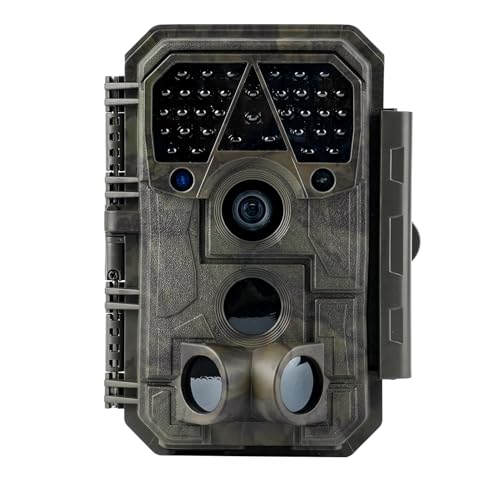
Non-cellular but featuring 64MP photos and 1296p video, this camera emphasizes high detail for daylight and nighttime captures. It uses no-glow 940nm infrared LEDs and a fast 0.1-second trigger to minimize missed moments. Best for: users who need high-resolution stills and videos without cellular connectivity. This model is well-suited for security, scouting, and wildlife observation in fixed locations.
Who it’s best for: Those who prefer high-resolution, reliable non-cellular monitoring with quick trigger speeds and discreet night vision.
Why selected: Combines extremely high image quality with instant trigger action and a robust no-glow night-vision system, ideal for sensitive wildlife or security contexts.
Caution/limitation: Limited remote access due to lack of cellular or Wi-Fi connectivity.
KJK Trail Camera 36MP 2.7K

Compact, feature-rich non-cellular camera with 36MP stills and 2.7K video. It features 850nm low-glow LEDs for night vision, a 130-degree wide-angle view, and a 0.1-second trigger time. Best for: hunters who want sharp day and night captures in a portable form factor and a large field of view.
Who it’s best for: Players needing a balance of image clarity and field coverage in a compact package, where data is retrieved via SD card rather than cellular networks.
Why selected: The wide angle, fast trigger, and strong night-vision performance make it a versatile option for scouting and property surveillance in open terrain.
Caution/limitation: No built-in cellular data transfer; you must plan for SD card data retrieval and local storage management.
Buying Guide: Night Vision Hunting Camera Considerations
What kind of buyer are you? Cellular cameras suit remote locations and rapid data access, while non-cellular models excel in simple setups with local data retrieval. Define your primary goals: wildlife monitoring, security, or both.
Night vision range and image quality—Look for high megapixel totals (64MP or higher helps day and night detail) and a longer infrared range. No-glow LEDs reduce animal disturbance but can affect image brightness in dense vegetation.
Trigger speed—Faster triggers (0.1–0.3 seconds) reduce missed actions, especially with fast-moving wildlife. Consider field conditions (thick brush vs. open terrain) when evaluating triggers.
Power and connectivity—Solar compatibility extends uptime for outdoor installs. If you need remote access, cellular cameras simplify data retrieval; otherwise, non-cellular designs with SD cards can be cost-effective and private.
Durability and weather resistance—IP rating, water resistance, and rugged housings protect against rain, dust, and cold. For exposed locations, prioritize IP65 or higher and robust mounting options.
Data handling and plans—Cellular models often require data plans. Free or low-cost transmission plans vary by brand; ensure the plan aligns with your monthly activity and budget.
Frequently Asked Questions
- Do I really need cellular access for night-vision cameras? Cellular cameras provide remote data access and faster decision-making. Non-cellular cameras are cheaper and rely on local SD cards for data retrieval.
- What is a good trigger speed for wildlife cameras? A speed of 0.1–0.3 seconds is generally fast enough to capture quick movements without excessive false triggers.
- How important is night-vision range? Longer range helps in open spaces; shorter ranges can suffice in dense forests but may require closer placement to targets.
- Can solar panels fully power a trail camera? Solar panels extend uptime, but battery capacity and sun exposure determine total runtime. Some cameras also support Type-C charging for flexibility.
- What should I consider for data plans? Free transmission limits are common but modest. If you need more transmission, ensure the plan options fit your seasonal scouting schedule.
- Are these cameras suitable for security as well as wildlife monitoring? Yes, many units provide motion-activated alerts and clear night imagery, which helps in property or perimeter monitoring.