Best Film Scanners for Mac: Top Picks for Preserving Your Memories
Looking for the best film scanners for Mac to convert negatives and slides into high‑quality digital images? This guide identifies five strong options, explains who they’re best for, and highlights key reasons to choose each one. It’s ideal for scrapbookers, family historians, educators, and photographers who want a standalone, easy-to-use solution without a computer dependency. The table below summarizes the five recommended models and their standout strengths.
| Product | Best For | Key Benefit | Unique Limitation |
|---|---|---|---|
| KODAK Slide N SCAN | Families and casual archivists | 5” LCD gallery view; quick‑feed tray | May require separate storage for large libraries |
| Magnasonic All‑in‑One 24MP | General nostalgia projects | Built‑in memory and HDMI output | Smaller internal storage may necessitate cards |
| DigitPro Photo Scanner | Non‑tech users and seniors | Standalone operation with one‑touch controls | Limited bundled memory |
| Plustek OpticFilm 8200i SE | Serious hobbyists and small studios | Infrared dust/scratch removal | Requires setup with software |
| Pacific Image PrimeFilm XE Plus | Mac users needing high resolution | Up to 10,000 dpi scanning | Manual feed may slow large batches |
KODAK Slide N SCAN Film & Slide Scanner
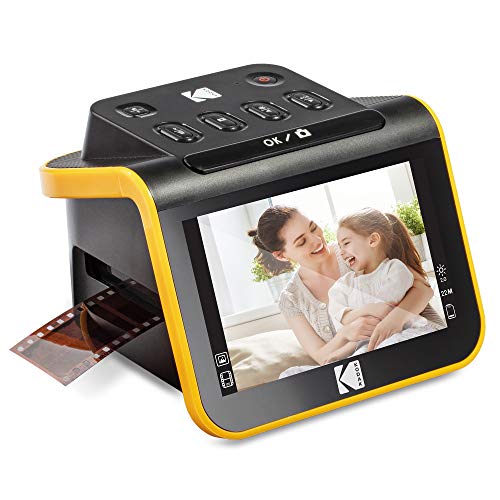
The KODAK Slide N SCAN is designed for converting 135, 110, and 126 film and slides into digital files using a built‑in 5” LCD display for direct viewing. It’s positioned for buyers who want an all‑in‑one unit with a simple workflow—great for families digitizing old color and monochrome negatives without a computer. The device includes a slide holder set and adapters, plus flexible output via USB and HDMI connections. Best for casual archivists who value quick previewing and direct sharing on a gallery screen.
Best for: families and casual archivists who want a standalone scanner with an easy viewing screen. It supports multiple film formats and provides an immediate way to preview and save to an SD card (card not included). A potential limitation is the need for an SD card and the reliance on a built‑in display for initial review, which might not suit users who require full‑resolution work on a larger monitor.
Magnasonic All‑in‑One 24MP Film Scanner

Magnasonic’s All‑in‑One scanner converts 35mm, 110, 126, and Super 8 film and converts slides to 24MP JPEGs. It stands out for buyers who want a compact, standalone device with a built‑in display and optional external viewing via HDMI. The unit includes internal memory and supports SD cards up to 128GB, making it a convenient choice for preserving a lifetime of film memories. It’s well‑suited for home users who want direct playback on a TV or monitor without a PC.
Best for: general nostalgia projects and users who value an integrated display plus external TV/monitor viewing. Choose this if you prefer a self‑contained workflow with optional HDMI output. A potential limitation is its fixed internal memory and card storage reliance for larger collections, which might require frequent card swapping or upgrades.
DigitPro Photo Scanner With 5” Screen
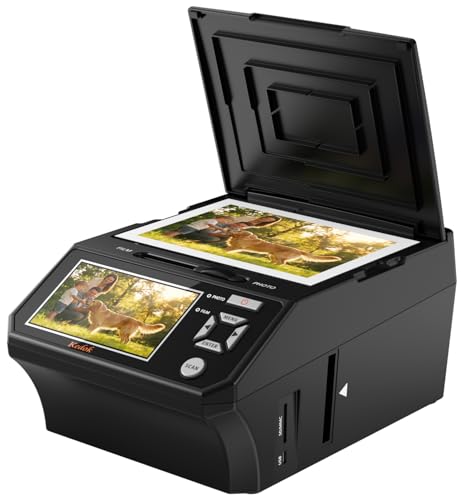
DigitPro’s all‑in‑one solution is tailored for quick digitization of 35mm/110 negatives, slides, and even physical photos. The 5” LCD provides immediate viewing, and the device emphasizes easy, driver‑free operation—an advantage for users who want a straightforward, computer‑free workflow. It includes an 8GB (example) SD card for immediate saving. Best for parents and grandparents digitizing family slides with minimal setup.
Best for: non‑tech users who want a simple, one‑button experience without software. It’s a strong pick when you value comfort and simplicity over ultra‑high resolutions. Limitation: the data suggests reliance on a bundled SD card and built‑in processing; not ideal if you require extensive color management or RAW outputs for professional projects.
Plustek OpticFilm 8200i SE

The Plustek OpticFilm 8200i SE is a high‑resolution 35mm film and slide scanner offering infrared dust and scratch detection, with 7200×7200 dpi output and 48‑bit color depth. It’s designed for serious hobbyists who need robust post‑processing capabilities and high image quality. The integrated infrared channel helps pre‑clean imperfections, while the 64‑bit hardware/software support facilitates advanced workflows. Best for photographers who want precise dust removal and high resolution in a Mac or PC environment.
Best for: serious hobbyists and small studios seeking professional‑grade restoration and high‑fidelity scans. A caution: this model typically requires more setup and compatible software (often bundled or separate), which may slow down absolute beginners or those who want a plug‑and‑play option.
Pacific Image PrimeFilm XE Plus Manual Film Scanner

The PrimeFilm XE Plus is a manual film scanner that handles 35mm film and slides with a high resolution of up to 10,000 DPI and a 3.9 dynamic range. It uses a genuine RGB linear array CCD for color accuracy and detail. It’s aimed at Mac and PC users who want high‑end scanning capability with flexible film formats. The manual feed gives precise control for archiving precious negatives and slides, suitable for researchers or archivists who prefer careful handling over automatic batching.
Best for: Mac users needing high scan resolution and color fidelity. Choose this if you want detailed, high‑quality scans of a diverse film collection. Limitation: manual feeding can slow processing on large libraries, making it less suitable for bulk digitization tasks.
Buying Guide: How To Choose The Right Film Scanner For Mac
- Working workflow: Do you want a standalone device with its own screen, or a scanner that integrates with your Mac via software? Standalone units are quicker and simpler for casual use; software‑driven scanners suit color management and archival accuracy.
- Typical film formats: Ensure the model supports your formats (35mm, 110, 126, 135, slide holds, Super 8). If you have diverse media, consider a model with broad format support like 35mm, 110, and slides.
- Resolution and color: For archival quality, higher DPI (e.g., 7200–10000) and a wide color depth (24/48-bit) improve detail and color accuracy. Note that higher DPI increases file sizes and scan times.
- Dust and scratch handling: Infrared dust removal can save time in post‑processing. Models like the Plustek 8200i SE provide this feature, which is valuable for older negatives.
- Storage and expandability: Check SD card capacity, internal memory, and optional external storage options. This matters if you have large collections and limited computer storage.
- Mac compatibility: Confirm driver support or compatibility with macOS versions you use. Standalone units often require no drivers, while computer‑based scanners rely on compatible software.
FAQ
- Can I use these film scanners without a computer on a Mac?
Yes for standalone models like multiple 5” display units, which preview directly and save to SD cards. - Which scanner is best for the oldest negatives?
Models with infrared dust removal and high DPI, such as Plustek 8200i SE and PrimeFilm XE Plus, are typically favored for restoration quality. - Do all these scanners support 35mm only?
No — several support 35mm, 110, 126, and slides; verify the exact formats listed in the product features. - Is 10,000 DPI necessary for family slides?
It’s ideal for large prints and archival work; for casual sharing, 7200 DPI is often sufficient. - What’s the advantage of a built‑in screen?
It enables quick preview, editing, and sharing without connecting to a computer, simplifying immediate archiving.