Best Carbon Fiber Camera Poles for Stable Shots on the Go
For photographers and videographers seeking strength, lightness, and versatility, carbon fiber camera poles offer excellent stability and portability. This guide highlights five top options that balance height, load capacity, and quick setup. Each product is evaluated on materials, adjustability, and compatibility to help you choose the right pole for travel, wildlife, sports, or studio use.
| Product | Brand | Max Load | Height Range | |
|---|---|---|---|---|
| NEEWER Upgraded 80.7″ Carbon Fiber Tripod Monopod | NEEWER | 26.5 lb / 12 kg | 26.8″ to 80.7″ (inverted center column for low angles) | Tripod/Monopod hybrid with 2-section center axis |
| IFOOTAGE Carbon Fiber Camera Pole, EP1-C105 | IFOOTAGE | Not listed | 37 cm to 108 cm | Extension tube with 1/4″ and 3/8″ screws |
| NEEWER 67.7″ Camera Monopod TP71 | NEEWER | 13.2 lb | 28.3″ to 67.7″ | Monopod with detachable base |
| K&F CONCEPT 60″ Carbon Fiber Tripod | K&F CONCEPT | 17 lb | 18″ to 60″ | Tripod with detachable monopod and 360° head |
| Manbily Carbon Fiber Camera Monopod, 61″ | Manbily | 15.4 lb | 15.7″ to 61″ | Monopod with reinforced mounting platform |
NEEWER Upgraded 80.7″ Carbon Fiber Tripod Monopod

The NEEWER model combines carbon fiber strength with a versatile center column system. It supports up to 26.5 lb (12 kg), offering stability for cameras, lenses, and small video rigs. A sandbag hook on the inverted center column adds balance for windy shoots. Quick-release twist locks along four leg sections enable rapid height adjustments from 68 cm to 213 cm. The unit can convert to a monopod by removing the center column and pairing a leg segment, expanding its use for travel, vlogging, and fieldwork.
IFOOTAGE Carbon Fiber Camera Pole, EP1-C105

This carbon fiber extension tube is designed to support DSLR cameras, fluid heads, and related gear. It extends from 37 cm up to 108 cm and uses standard 1/4″ and 3/8″ screws for seamless compatibility with most tripod heads, cameras, and accessories. Its compact form makes it ideal for mounting as a lightweight pole on a main tripod or as a standalone support for handheld or studio applications. The design emphasizes ease of length adjustment with simple buckles to secure the desired length.
NEEWER 67.7″ Camera Monopod TP71

Built for travel and dynamic shooting, this monopod uses carbon fiber for strength with a detachable base for added stability when a full tripod is not practical. The monopod extends to 172 cm (67.7 inches) and folds down to 72 cm for storage. Quick-release flip locks keep height adjustments tight and reliable. A standard 1/4″ mount ensures compatibility with most DSLR and mirrorless cameras, as well as action cameras and gimbals. When used with the base, it can stand on its own for low-angle or desk-top work.
K&F CONCEPT 60 inch Carbon Fiber Camera Tripod

Designed for portability and rugged use, this tripod features aerospace-grade carbon fiber legs offering strength with light weight. It telescopes from 18″ to 60″ and folds to 13.8″ for airline travel, a boon for on-location shoots. The 360° panoramic ball head allows smooth, precise framing, especially for panoramic stills or video. The quick-release plate is compatible with Arca-Swiss systems, and the top plate accepts standard 1/4″ screws for cameras and projectors, making it versatile for various rigs.
Manbily Carbon Fiber Camera Monopod, 61″
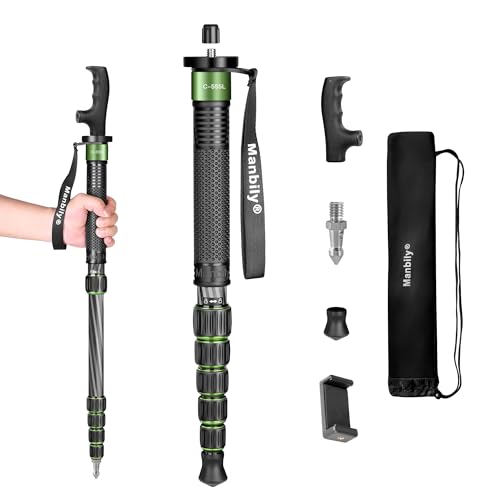
The Manbily monopod emphasizes lightweight travel with a 0.93 lb body and a 61-inch maximum height. Its 8-layer carbon fiber construction delivers stiffness and load capacity up to 15.4 lb, aiding stability for mid-to-long telephoto work. The reinforced mounting platform uses rivets to strengthen the top plate, and it includes a reversible 1/4″ and 3/8″ screw for broad compatibility with cameras, camcorders, or ball heads. This model suits hikers and field shooters who require compact gear that still supports robust setups.
Buying Guide: Key Purchase Considerations
- Material and weight: Carbon fiber offers high strength-to-weight ratio, reducing fatigue during long shoots. Compare grams per meter and overall weight to suit your travel needs.
- Height range and portability: Assess maximum height for overhead or elevated shots and collapsed length for backpacking or airline travel. Quick-lock systems speed setup in changing environments.
- Load capacity: Ensure the pole can safely support your heaviest camera and lens combination. Consider future upgrades to heavier bodies when choosing max load specs.
- Monopod vs. tripod versatility: Monopods are lighter and more portable but provide less stability; tripods offer steadier support with pan/tilt functionality. Some models convert between the two.
- Center column design: Inverted or multi-section center columns enable low-angle and macro work. Check whether inversion is possible or if the column detaches for walking-stick use.
- Head compatibility: Look for Arca-Swiss compatibility or universal 1/4″ and 3/8″ screws. Your choice should match existing heads or plates for quick swaps.
- Base stability: Removable bases or feet can enhance stability on uneven terrain or convert the pole into a more compact desk or table setup.
- Accessories and warranty: A carrying bag, extra clamps, and manufacturer warranty can influence long-term value and usability in different environments.