Best Boom Arm for Thick Desk: Stable, Low-Profile Microphone Stands for Heavy Mics
Choosing the right boom arm for a thick desk involves balancing stability, reach, and space. This guide highlights five solid options designed to handle heavier mics, tight under-monitor setups, and busy gaming or streaming desks. Each selection focuses on low-profile designs, strong build quality, and cable management to keep your setup clean. Whether you’re podcasting, streaming, or recording vocals, these arms offer dependable performance without desk damage or wobble. Review the featured models, compare their strengths, and find the best match for a sturdy, clutter-free workstation.
Summary of chosen products
| Product | Brand | Key Benefit |
|---|---|---|
| BM88 Low Profile Boom Arm | FIFINE | Low profile, sturdy metal build, cable management |
| InnoGear Boom Arm (Medium) | InnoGear | 360° rotation, long reach, durable springs |
| PSA1+ Studio Arm | RØDE | Parallelogram design, precise mic placement |
| AA AUDIO ACCESSORY Low Profile Arm | AA AUDIO ACCESSORY | Heavy mic support, compact under-screen design |
| Frgyee Overhead Mic Arm | Frgyee | Extra high extension, versatile positioning |
FIFINE BM88 Low Profile Boom Arm

The FIFINE BM88 is designed to stay out of the way on thick desks while supporting heavier microphones. Its all-metal construction provides stability during vigorous use and rapid mic adjustments. The C-clamp is built to grip flat desktops without slipping or scratching, and the low-profile design extends under a monitor to keep the screen in clear view. Cable management channels help maintain a tidy setup, reducing cable pull and tangling for smoother recordings.
InnoGear Boom Arm Microphone Stand

InnoGear’s medium boom arm emphasizes flexibility and durability, featuring full 360° base rotation and a 135° back-and-forth range. It’s designed to support heavier mics with its strong springs and extra positioning holes. The arm folds away smoothly, saving desk space when not in use, and provides quiet, reliable movement during recordings or streams.
RØDE PSA1+ Professional Studio Arm
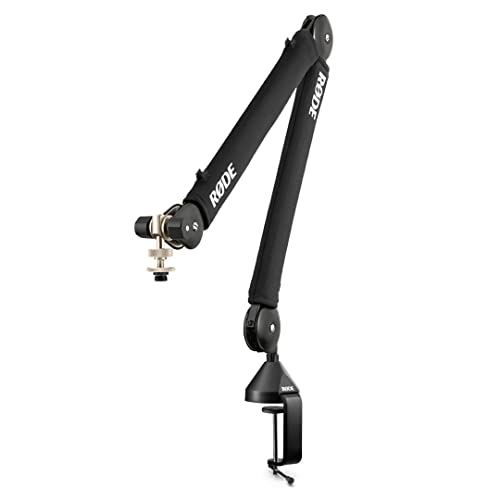
The PSA1+ pairs broadcast-grade design with precise mic placement and cable management. Its parallelogram spring design enables ultra-smooth, controlled movement, while maintaining a stable hold on various mic types. This arm is a reliable choice for podcasters and streamers seeking fine-tuned positioning without desk clutter.
AA AUDIO ACCESSORY Low Profile Boom Arm

This low-profile arm supports heavy microphones up to 6.6 lbs and uses a gear-lock structure to prevent sagging. It’s designed to slide neatly under monitors, keeping screens unobstructed while maintaining a clean, space-efficient look. It includes universal adapters for 1/4″, 3/8″, and 5/8″ connections, making it compatible with a wide range of mics.
Frgyee Mic Boom Arm

Frgyee offers an overhead mic stand with a 31.5-inch high riser, ideal for setups where the mic needs to clear monitors or camera views. The clamp grips desktops up to 4.2 inches thick, delivering a stable hold. Its wide motion range lets users switch between seated and standing positions with ease, making it suitable for flexible recording environments.
Buying Guide: Key Purchase Considerations
- Desk compatibility: Look for clamps rated for thick or multi-layer desktops and a low-profile design that stays clear of the screen and webcam.
- Load capacity: Verify the maximum mic weight supported, especially for heavier mics like the Shure SM7B or Blue Yeti variants.
- Movement and stability: Parallelogram or dual-spring designs offer smoother, more controllable pivots with less drift during long sessions.
- Cable management: Built-in channels or clips reduce tangling and protect cables from wear during extended use.
- Extend and rotate range: Consider arms with wide horizontal reach and multi-axis rotation to position the mic precisely for sitting or standing setups.
- Durability and materials: All-metal constructions tend to provide the best long-term stability and vibration resistance.
- Ease of installation: Kitted arms with simple clamps and common thread adapters (1/4″, 3/8″, 5/8″) ease integration with various mics and mounts.
Comparison Perspectives
- Low-profile vs. overhead design: Low-profile arms save desk space and reduce obstruction; overhead arms offer maximum clearance from monitors but may require more mounting space.
- Heavy-mic readiness: Arms with higher load ratings and reinforced joints perform better with heavier microphones and dynamic mics used in demanding vocal tracks.
- Movement smoothness: Arms with modern spring designs and paralleled arms provide steadier positioning, essential for dynamic video content and live streams.
- Budget vs. endurance: Budget options can handle lighter mics well, but premium metal arms offer long-term stability and less maintenance for frequent use.