Best 4K Video Camera for Filmmaking and Content Creation
Choosing a 4K video camera for filmmaking involves balancing resolution, low-light performance, autofocus, stabilization, and workflow features. This guide highlights five capable models that stand out for creators aiming for cinema-quality footage, vlogging, and professional streams. Each section includes a quick overview, practical strengths, and how it fits different production needs.
| Product | Brand | Key Benefit |
|---|---|---|
| Canon VIXIA HF G70 Camcorder | Canon | Balanced 4K image quality with cinema-like highlights |
| BREGOO 5K Video Camera Camcorder | BREGOO | High-resolution 5K with 64MP photos and bundled accessories |
| ZYDIIE 4K Video Camera Camcorder | ZYDIIE | Solid 4K performance with 64MP stills and rotatable screen |
| FlyFrost 8K Video Camera Camcorder | FlyFrost | Ultra-high 8K capability and USB/UVC streaming |
| Canon XA60 Professional UHD Camcorder | Canon | Compact 4K workflow with strong connectivity |
Use the sections below to compare five strong options and see how each aligns with your filmmaking goals, from run-and-gun shoots to controlled studio projects.
Canon VIXIA HF G70 Camcorder Review

Canon’s VIXIA HF G70 merges a 4K sensor with the DIGIC DV6 processor to deliver crisp UHD imagery and cinema-like out-of-focus highlights thanks to an 8-blade aperture. The device also supports On-Screen Display Time Stamp recording, embedding date, time, and metadata directly into the files, which aids in post-production and archival workflows. For live streaming, UVC compatibility lets you broadcast HD video directly to a PC or Mac, simplifying field-to-stream setups for events or remote shoots. This camera is well-suited for documentary work and event coverage where reliable color and timing data matter.
BREGOO 5K Video Camera Camcorder For Filmmaking
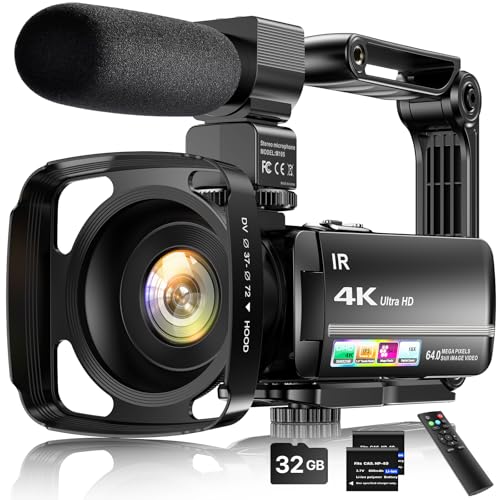
This BREGOO model delivers 5K resolution (also supporting 4K/60fps) with a 64MP stills capability and a 270° rotatable screen. It emphasizes versatility for YouTube creators, travel filmmakers, and interviews, offering a 3.0-inch touch interface and included accessories. An infrared night-vision option broadens shooting windows in dim environments, while the bundled microphone and external features support improved audio capture. The comprehensive accessory bundle makes it a practical all-in-one package for budding filmmakers who want a complete starter kit.
ZYDIIE 4K Video Camera Camcorder Essentials
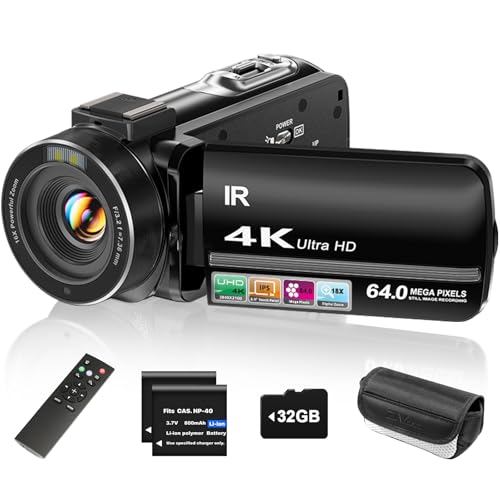
ZYDIIE’s 4K camcorder focuses on a 64MP main capture and a 3.0-inch touchscreen with 270° rotation, making it easy to frame selfies or unique angles. The model is designed for versatile use, including travel vlogs, family events, and interviews. While it emphasizes ease-of-use and portability, its built-in stabilization and night-vision capability help deliver usable footage across lighting conditions. It suits creators seeking a compact, budget-conscious option without sacrificing core 4K quality.
FlyFrost 8K Video Camera Camcorder Performance

The FlyFrost 8K camcorder pushes resolution to 8K with 88MP still images and 18X digital zoom, paired with a 3.0-inch touch panel and 270° rotation for flexible shooting. It supports WiFi for quick file transfers and webcam functionality for live streams or video calls, plus infrared night-vision for low-light environments. This model is designed for creators who need maximum detail, advanced streaming options, and a broader workflow that includes remote control via mobile apps and PC usage.
Canon XA60 Pro UHD Camcorder Overview

The Canon XA60 brings professional-grade UHD 4K capture in a compact package, underscored by a 1/2.3″ CMOS sensor and the reliable DIGIC DV6 processor. It supports multi-format recording and provides robust connectivity with mini-HDMI output, enabling straightforward integration into larger production setups. This camera is aimed at documentary filmmakers, ENG crews, and run-and-gun shooters who require dependable 4K performance with easy sharing to external monitors and recorders.
Buying Guide: Key Purchase Considerations
- Resolution vs. workflow: 4K remains standard, but higher-end options (5K, 8K) offer more flexibility for post-production. Consider whether you need higher still-image resolution or primarily video.
- Sensor size and low-light performance: Larger sensors and modern processing improve dynamic range and color rendition in diverse lighting. Review base ISO and noise performance for your typical environments.
- Stabilization and lenses: In-body stabilization or lens-based systems benefit handheld shoots. Check available stabilization modes and whether you’ll use prime or zoom lenses for your projects.
- Color science and log profiles: Look for cameras offering log profiles or RAW-like outputs for color grading. This impacts how easily you can achieve a cinematic look in post.
- Audio and inputs: Built-in mics are rarely enough for professional projects. Prioritize cameras with external mic input, headphone monitoring, and audio controls on the body.
- Connectivity and streaming: For live-stream work, ensure reliable USB/UVC support, HDMI outputs, and compatibility with your streaming software and platforms.
- Portability and ergonomics: If you shoot on the move, weight, grip comfort, and battery life matter. Consider whether you need a compact form factor or a modular rig.
- Accessory ecosystem: Bundled kits, included memory, batteries, and mics can save time and money. Plan for lenses, tripods, and external recorders if needed.
Across these options, you’ll find a spectrum from compact, cinema-ready devices to versatile, all-in-one kits. Your choice should align with your production style, travel needs, and post-production ambitions, ensuring a smooth path from shoot to final cut.