Best 12mm Wide-Angle Lenses for Every Photographer
Wide-angle lenses at 12mm deliver expansive perspective for landscapes, architecture, interiors, and night skies. This guide highlights five strong choices across Nikon Z, Micro Four Thirds, and Sony E systems, focusing on sharp corners, minimal distortion, and practical handling. Whether you need a versatile zoom or a bright prime for low light, these options cover a range of shooting styles. Each pick is examined for image stabilization, autofocus behavior, build quality, and the kind of situations where it truly shines. The table below offers a quick snapshot to help you compare at a glance.
| Product | Brand | Mount / Format | Focal Range | Notable Strength |
|---|---|---|---|---|
| Nikon NIKKOR Z DX 12-28mm PZ VR | Nikon | Nikon Z DX (APS-C) | 12-28mm | Power zoom with VR for steady framing |
| Rokinon 12mm F2.0 NCS CS | Rokinon | Micro Four Thirds | 12mm | Bright f/2.0, sharp architectural results |
| Samyang SY12M-E-BK 12mm F2.0 | Samyang | Sony E | 12mm | Ultra-wide with fast aperture |
| Sony FE 12-24mm F4 G | Sony | Sony E | 12-24mm | Constant F4, high corner-to-corner resolution |
| OM SYSTEM M.Zuiko 12mm F2.0 | OM SYSTEM | Micro Four Thirds | 12mm | Fast autofocus, compact and sharp |
Nikon NIKKOR Z DX 12-28mm PZ VR Lens

The Nikon NIKKOR Z DX 12-28mm PZ VR is a flexible wide-angle zoom built for APS-C Z-mount cameras. It combines a dramatic 12mm field of view with a 28mm end for more natural framing when you need it. The built-in Vibration Reduction (VR) provides roughly 4.5 stops of stabilization, helping to keep handheld shots steadier in low light or on slower shutter speeds. A power zoom motor offers 11 discrete speeds, letting you frame quickly or smoothly as you shoot video or landscapes. This lens is especially useful for travel, interiors, and cityscapes where you want quick, reliable zoom control.
Key features and notes include versatile ultra-wide coverage, a steady VR system to counter camera shake, and a compact form for a DX-format zoom. The lens maintains good edge-to-edge sharpness and handles distortion well for its class, making it a practical option for creators who shoot both stills and video on Nikon Z DX bodies.
Rokinon 12mm F2.0 NCS CS for MFT

The Rokinon 12mm F2.0 NCS CS is a compact, bright prime designed for Micro Four Thirds cameras. With a 35mm-equivalent focal length of about 18mm, it’s well suited to architectural and landscape subjects where you want a broad scene with minimal distortion. The fast f/2.0 maximum aperture supports low-light shooting and shallow depth of field when desired, while the included front and rear caps and a removable hood add convenience for field use. The lens is designed with a focus on sharpness across the frame and reliable performance in real-world conditions.
As a fixed focal-length lens, it emphasizes optical consistency and a compact profile that’s easy to carry on long shoots. Photographers often choose this lens for travel and city photography, where a bright, wide-field view paired with a lightweight setup makes a noticeable difference in both stills and video work.
Samyang SY12M-E-BK 12mm F2.0 for Sony E
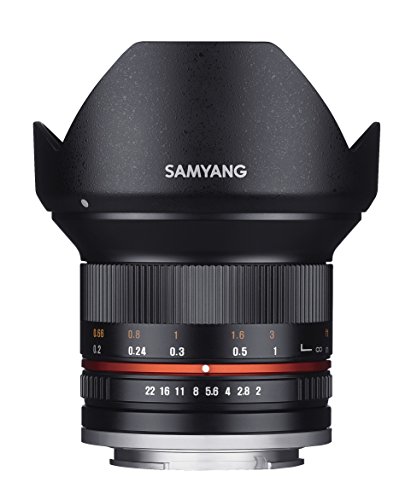
The Samyang SY12M-E-BK 12mm F2.0 for Sony E is a compact prime designed for Sony’s E-mount cameras. It offers a substantial 98.9-degree angle of view, making it a strong choice for expansive landscapes, architecture, and astrophotography where a broad perspective is essential. The bright F2.0 aperture supports night sky work and indoor scenes with limited light. It focuses to about 0.2 meters, enabling close-up subjects while preserving dramatic perspective. The lens also accommodates 67 filters, giving flexibility for creative control in varying lighting conditions.
In practice, this lens balances portability with performance. Manual focus operation gives photographers direct control over focusing precision, while the wide field of view remains appealing for documentary-style shooting and environment portraits where space and composition matter most.
Sony FE 12-24mm F4 G Wide-Angle Zoom

The Sony FE 12-24mm F4 G is a versatile full-frame wide-angle zoom designed for Sony E-mount cameras. Its constant F4 maximum aperture across the 12-24mm range offers predictable exposure and depth of field for landscapes, architecture, and astrophotography. The lens uses a G Design with multiple specialized elements (including aspherical and ED glass) to deliver high-resolution performance from corner to corner. With a durable construction and a relatively compact zoom range, it suits travel shooters who want a broad field of view without sacrificing optical quality.
Autofocus is smooth and reliable, and the design minimizes common wide-angle distortions with thoughtful optical engineering. The lens is a strong all-around option for Sony shooters who need to cover expansive scenes with consistent sharpness and contrast, even in challenging lighting conditions.
Meike 12mm T2.2 Manual Focus Wide Angle for MFT

The Meike 12mm T2.2 is a cinema-focused wide-angle designed for Micro Four Thirds cameras. This manual focus lens offers a wide 92-degree field of view and a bright T2.2 aperture, ideal for landscape videography, interior scenes, and controlled-depth storytelling. The lens employs a 10-group, 14-element optical design to minimize distortion and deliver sharp images with low aberrations. It’s a practical option for independent filmmakers and videographers who prioritize cinematic control over lens characteristics and a compact, affordable package.
Practically, this lens suits projects where precise focus control and consistent image quality across the frame are more important than automated autofocus. The cine lens design favors smooth manual focusing and predictable breathing behavior, which is beneficial for narrative-style shooting and time-lapse work in constrained spaces.
Buying Guide
Choosing a 12mm lens depends on camera system, shooting goals, and whether you prefer a zoom or a prime. Here are key considerations and how the options above stack up.
- Camera format and mount: Full-frame lenses (like Sony E 12-24mm) behave differently from Micro Four Thirds or Nikon DX options. Match the lens to your body’s sensor size and mount to ensure proper coverage and compatibility.
- Zoom vs. prime: Zooms (12-28mm, 12-24mm) offer flexibility for framing on the fly, while fixed 12mm primes typically deliver brighter apertures and potentially sharper edges with lower distortion. Choose based on your workflow and need for speed or light control.
- Aperture and low-light performance: Lenses with wider maximum apertures (f/2.0, or T2.2 on cine lenses) excel in dim scenes and astro work. Primes at f/2.0 (or faster) can outperform slower zooms in darkness, but may require more careful framing due to fixed focal length.
- Autofocus vs manual focus: For action, travel, or video, reliable autofocus is advantageous. For video work and controlled scenes, manual focus (as with several Samyang/Rokinon/Meike options) provides precise, repeatable control.
- Stabilization and handling: Built-in image stabilization (as with the Nikon PZ VR) helps in handheld video and low-light stills. In some cases, stabilization is not present, so rely on tripod or shutter choices to manage camera shake.
- Distortion, optics, and coatings: Wide-angle lenses can exhibit distortion at the edges. High-quality coatings and element design (as seen in Samyang/Sony options) reduce flare and improve contrast in challenging light.
- Size, weight, and weather sealing: If you travel or shoot outdoors, consider the lens’s weight and build quality. Weather sealing and robust matte finishes help in rugged environments.
- Filter compatibility: Some 12mm lenses offer filter threads (e.g., 67mm on certain Samyang/Rokinon variants), enabling longer exposures and creative control. Check filter compatibility before buying.
In summary, for travel and landscapes, a versatile 12-28mm zoom can cover most needs with ease, while dedicated primes like 12mm F2.0 (on Nikon, Sony, or MFT bodies) excel in low light and dramatic perspective. Your choice will hinge on mount compatibility, whether you value autofocus or manual focus control, and how important stabilization and ultrawide performance are to your typical shoots.