Best Wireless Mics for Cameras: Top Picks for Crisp on-Camera Audio
Capturing clear, professional audio is essential for any camera-based project, from vlogs to interviews. The following wireless lavalier microphones are designed to pair with cameras, smartphones, and laptops, delivering reliable range, smart noise reduction, and easy setup. Below you’ll find five strong options with key specs and real-world applicability for filmmakers, content creators, and videographers.
| Product | Brand | Notable Feature | Approximate Range |
|---|---|---|---|
| Hollyland Lark M2 | HollyView | Ultra-lightweight, 48kHz/24-bit audio | Up to 1,000 ft |
| NEWER CM28 | NEWER | Two TX, standalone recording with SD storage | Up to 656 ft / 200 m |
| DJI Mic 2 | DJI | 32-bit float internal recording, ready-to-use | Up to 820 ft / 250 m |
| PQRQP 3 in 1 Wireless Lavalier | PQRQP | 3 in 1 universal receiver, strong noise reduction | 65 ft / 20 m |
| DJI Mic Mini | DJI | Compact, lightweight dual TX with long range | Up to 400 m |
Hollyland Lark M2 Wireless Microphone for Cameras

The Hollyland Lark M2 is a compact wireless microphone system designed for camera use, with a featherweight 9 g transmitter and a capable 48kHz/24-bit recording format. It delivers lossless sound and a wide 1,000 ft line-of-sight range, making it suitable for on-location shoots, vlogs, and documentary work. With a signal-to-noise ratio around 70dB and a maximum SPL of 115dB, the mic handles a broad range of recording environments, from quiet interviews to dynamic outdoor scenes. The included charging case supports multiple full charges, extending field usage to meet longer shooting days.
Key considerations:
- Pros: Very light, long-range transmission, high-resolution audio, good battery life with case.
- Cons: As with many compact systems, line-of-sight range can be affected by obstacles; ENC off improves battery life.
NEWER CM28 Wireless Lavalier Microphone System

NEWER CM28 provides a 2 TX + 1 RX configuration with built-in standalone recording options. Each TX can store up to 4 GB of WAV audio, enabling up to 9 hours of uncompressed 48kHz audio without a live connection. The kit supports 9 hours (TX) and 8 hours (RX) per charge, and the case recharges the system quickly. With an LCD screen showing modes, battery levels, and noise reduction settings, it’s a practical kit for field reporting and on-the-spot interviews.
Key considerations:
- Pros: Standalone recording ensures audio isn’t lost if monitoring drops; clear LCD UI.
- Cons: Dual TX size may require more careful packing for travel.
DJI Mic 2: Wireless Lavalier System

The DJI Mic 2 offers a ready-to-use setup with pre-linked transmitters and a compact receiver. It features USB-C and Lightning adapters to fit a range of devices and environments, plus the option for internal 32-bit float recording in the transmitters, which helps preserve audio integrity when levels spike. The system is designed to be reliable for on-the-go interviews, vlogs, and camera work, ensuring crisp voice capture with minimal post-processing.
Key considerations:
- Pros: Quick setup, robust internal recording, flexible device compatibility.
- Cons: Higher price point compared to some entry-level kits.
PQRQP 3 in 1 Wireless Lavalier Microphone

The PQRQP 3 in 1 system provides a universal receiver and a three-in-one approach that supports different devices, including iPhone, Android, laptops, and cameras. It features a 65 ft range, built-in noise reduction, and an omni-directional pickup pattern suitable for dialogue-heavy scenes. The kit is designed to be a versatile option for livestreams, interviews, and content creation across multiple platforms, with a focus on reducing background noise and delivering clear voice capture.
Key considerations:
- Pros: Broad device compatibility, compact form factor, strong noise reduction.
- Cons: Some users report limited range versus higher-end models in very noisy environments.
DJI Mic Mini: Compact Dual Transmitters
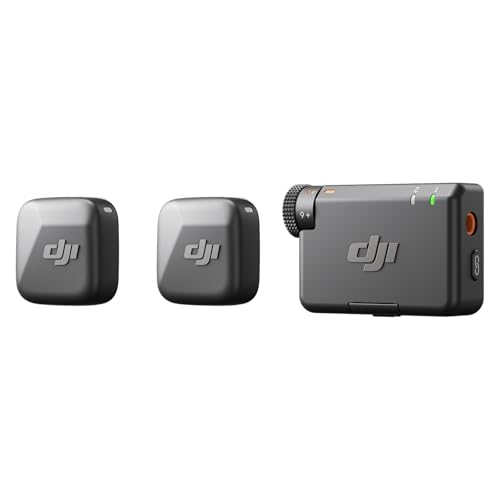
The DJI Mic Mini emphasizes portability without sacrificing sound quality. Weighing around 10 g per transmitter, it remains unobtrusive on camera while offering a substantial 400 m transmission range. This makes it well-suited for two-person interviews, small-team shoots, and on-camera reporting where mobility matters. The DJI ecosystem integration enables direct connections to Osmo Audio devices for streamlined workflows.
Key considerations:
- Pros: Extremely portable, good range, integrates with DJI ecosystem for seamless workflows.
- Cons: May be less feature-rich than larger systems in some advanced control scenarios.
Buying Guide: Key Purchase Considerations For Wireless Mics On Cameras
When choosing wireless lavalier mics for camera use, consider these factors to match your shooting style and devices:
-
<li Compatibility and ecosystem: Confirm compatibility with your camera, smartphone, or laptop. Some brands offer direct Osmo or ecosystem connections that simplify workflows.
<li Range and reliability: Outdoor shoots demand longer ranges and robust signal stability. Consider line-of-sight ranges and obstruction handling in dense environments.
<li Audio quality and format: Look for 24-bit or 32-bit float recording options, high signal-to-noise ratios, and the availability of internal backup recording to prevent data loss.
<li Battery life and charging: For long shoots, battery life and charging case performance matter. Some kits deliver multiple full charges on the go.
<li Noise reduction and wind handling: Built-in noise cancellation, wind protection, and mic pickup patterns influence vocal clarity in varied environments.
<li Ease of use and setup: Intuitive LCD displays, quick pairing, and plug-and-play operation reduce setup time on set.
<li Weight and form factor: Lightweight transmitters and discreet receivers improve on-camera aesthetics and comfort for talent.
<li Price-to-performance: Balance features against budget. Premium kits usually offer longer range, higher fidelity, and more professional features, while entry-level kits cover basics adequately.
In practice, the best choice depends on your use case: documentary and field reporting may favor kits with true standalone recording and extended ranges, while studio-style or two-person vlogs benefit from compact, easy-to-use systems with strong internal processing. For multi-device workflows, consider universal receivers or ecosystem-friendly options to minimize adapters and gear clutter.