Best WiFi Game Camera Range: Top Outdoor Trail Cams for 2026
Answering buyers who need reliable WiFi-enabled trail cameras, this guide highlights the best options for strong range, clear night vision, and easy setup. The top picks are ideal for wildlife monitoring, backyard security, and remote properties. Best for: homeowners wanting direct app control without home WiFi, hunters seeking long-range connectivity, and outdoor enthusiasts needing flexible power options.
Overview table highlights five leading models designed to maximize range, connectivity, and power efficiency. Use this quick reference to compare core strengths and limitations at a glance.
| Product | Main Connectivity | Power Source | ||
|---|---|---|---|---|
| MAXDONE Solar Trail Camera WiFi BT 4K 64MP | Built-in hotspot (not home WiFi) | Solar + 6000mAh rechargeable | Long-range infrared | Eco-friendly field use, long deployments |
| SPYPOINT Flex-M Twin Pack Cellular | Cellular data plans | Battery with solar option | Night vision | Cellular coverage, flexible plans |
| GardePro E6 WiFi Trail Camera | Direct app WiFi (no home WiFi) | Rechargeable battery | No-Glow night vision | Real-time viewing via app |
| XTU 4K 64MP Solar Trail Camera | WiFi & Bluetooth hotspot | Solar + rechargeable | 65 ft infrared | 4K video, long-range range |
| VOOPEAK Trail Cameras WiFi BT | Built-in hotspot (not cellular) | Battery (not specified solar) | Low-glow night vision | Non-cellular wireless setup, easy sharing |
MAXDONE Solar Trail Camera WiFi Bluetooth — 4K 64MP
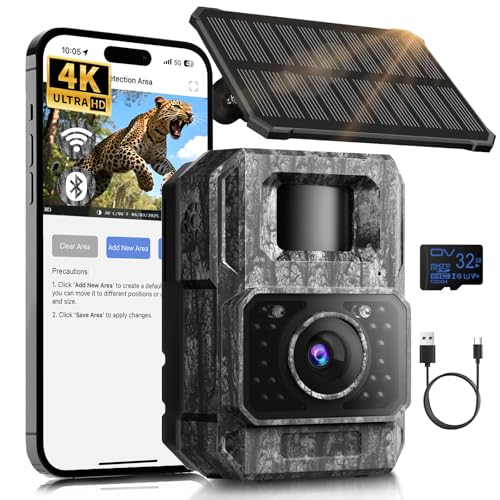
The MAXDONE model is positioned for field reliability without home Wi-Fi. It creates its own short-range hotspot for setup and file download only, with a practical range of 10–15 meters in open areas. This unit is designed for independent operation, recording automatically even when not connected. The 6000mAh rechargeable battery supports solar charging and Type-C power, enabling long deployments. It ships with a 32GB SD card for immediate use. Best for buyers who prioritize independent operation, solar flexibility, and high-resolution captures without subscription fees.
Who it’s best for: wildlife observers and property owners who need a self-contained camera without home network dependency. Why selected: strong battery and solar options, 4K/64MP clarity, and a straightforward local-storage workflow. Caution: the built-in hotspot is not designed for remote viewing or home Wi-Fi integration, which limits real-time remote access.
SPYPOINT Flex-M Twin Pack Cellular Trail Cameras

The SPYPOINT Flex-M is a cellular trail camera set designed for ongoing connectivity through mobile plans. It emphasizes easy setup via on-camera formatting and mobile activation, with free photo transmission included. By pairing with compatible solar panels, users can extend autonomy. It supports cross-carrier operation and continuous monitoring in challenging conditions. Best for: hunters and property managers who want cellular transmission and flexible pricing. Caution: cellular plans and data usage can affect long-term costs, and coverage varies by location.
Why chosen: broad coverage, strong value with a free photo transmission plan, and simple management. Limiting factor: reliance on compatible SIM networks and optional paid plans for higher transmission needs.
GardePro E6 WiFi Trail Camera

The GardePro E6 emphasizes direct app viewing via ultra-low-power WiFi and Bluetooth, with a dedicated mobile app and no home WiFi requirement. It does not connect to home networks or cellular services. The camera delivers 64MP photos and 1296P videos using a 110° lens, with live view for real-time monitoring. Best for: users who want smartphone-only access and a straightforward, non-cellular setup. Caution: limited to a direct device connection; not suitable for remote viewing over the Internet.
Why chosen: strong image and video quality, simple local viewing, and transparent operation without cloud dependence. Limitation: cannot access footage remotely beyond the Bluetooth/WiFi range of the camera itself.
XTU 4K 64MP Solar Trail Camera

The XTU solar trail camera combines 4K video with 64MP stills and a solar-powered design, enabling long-term field operation. It provides a fast trigger at 0.2 seconds and a detection range up to 70 feet, with 65-foot infrared night vision for low-light performance. It supports up to 256GB Micro SD cards (not included). Best for: users who want high-resolution footage and quick capture in remote or sun-exposed locations. Caution: solar charging depends on sun exposure and may require positioning adjustments to optimize charging.
Why chosen: high-resolution media, rapid trigger for wildlife moments, and no subscription requirement. Limitation: memory card not included, so storage must be planned upfront.
MAXDONE Solar Trail Camera — 2 Pack

This 2-pack variant uses split-type solar power and a built-in 6000mAh battery to deliver an independent power solution. It runs on WiFi 6 and Bluetooth for direct app control, ensuring private transfers without cloud dependency. It is designed for point-to-point field connections and excludes home WiFi support. Best for: users who want a pair of cameras with self-contained power and direct device control. Caution: not compatible with home WiFi networks, limiting remote viewing options to the built-in hotspot.
Why chosen: dual-camera coverage with long life and private, offline media transfers. Limitation: no home WiFi compatibility means you must manage footage directly on the camera or via the app’s local transfer.
Buying Guide: Key Considerations for WiFi Game Cameras
Power and range: Look for solar options and rechargeable batteries when you need long deployments. Consider the optical night vision range and trigger speed to reduce missed wildlife moments.
Connectivity: Decide between cellular, non-cellular WiFi hotspots, or direct app connections. Cellular models are great where cellular coverage exists; non-cellular models offer privacy and local transfers.
Storage and media: Check if SD cards are included and maximum capacity supported. High-resolution 4K video and 64MP stills consume more storage; plan for larger cards if needed.
Privacy and data handling: Models with local storage and direct app transfers avoid cloud reliance. Be mindful of how footage is transmitted and stored to protect privacy.
Ease of use: Favor cameras with straightforward app interfaces, quick setup, and clear instructions. Consider whether you need live view, downloadable files, or automated recording in off-grid conditions.
Practical Comparison Questions
- Do you need cellular transmission, or is a local hotspot sufficient?
- Is solar power essential for your deployment duration?
- What is the maximum acceptable trigger time and detection distance?
- Are 4K video and 64MP photos required, or are 1080p and 32MP adequate?
- Is privacy a priority, favoring offline transfers over cloud-based storage?
FAQ
- What is a camera range in this context? It refers to the effective distance over which the camera reliably detects movement and records footage, including night-vision performance.
- Do these cameras require home Wi-Fi? Some models do not connect to home networks and instead rely on local hotspots or cellular plans.
- Can I use solar power for these cameras? Yes, several models include solar charging or split solar panels for extended deployments.
- Is a subscription required for viewing footage? Most listed models offer local storage and app transfers without monthly fees, though some cellular options may require data plans.
- What should I consider when choosing between cellular vs. non-cellular models? Cellular cameras provide remote access and updates where cellular data is available; non-cellular models emphasize privacy and offline operation.
- Are the included SD cards always present? Some models ship with SD cards pre-installed; others require you to provide your own. Verify before purchase.