Best Wide Angle Lenses for Landscape Photography: Expand Your Scenic Reach
Capturing expansive landscapes often hinges on choosing the right wide-angle lens. This guide highlights five top options that balance field of view, image quality, and practical compatibility for both DSLR/mirrorless and mobile setups. Each pick is evaluated on how it broadens perspectives, maintains sharpness, and supports easy handling in outdoor conditions.
| Product | Brand | Key Benefit |
|---|---|---|
| Canon RF-S10-18mm F4.5-6.3 is STM | Canon | Ultra-wide Zoom for APS-C cameras |
| Freewell 16mm Wide Angle Lens | FREEWELL | 105° field of view for landscapes and architecture |
| Moment Wide Angle Lens – 18mm | Moment | High-quality image with minimal distortion |
| Canon RF16mm F2.8 STM | Canon | Compact ultra-wide prime for travel and interiors |
| Altura Photo 58MM 0.43x HD Wide Angle Lens | Altura Photo | Attachable wide-angle with detachable macro |
Canon RF-S10-18mm F4.5-6.3 is STM Ultra-Wide Zoom

The Canon RF-S10-18mm F4.5-6.3 is STM is an ultra-wide zoom designed for Canon EOS R mirrorless bodies. With a 10-18mm focal range (16-29mm equivalent on APS-C), it excels in cramped spaces where both foreground and background matter. The lens supports smooth, quiet autofocus ideal for both landscapes and travel vlogging, and its compact design makes it a practical travel companion for wide vistas and interior shots alike.
Freewell 16mm Wide Angle Lens For iPhone & Samsung

The Freewell 16mm Wide Angle Lens for smartphones delivers a 105° field of view, making it ideal for expansive landscapes and architectural scenes captured with mobile devices. It threads securely into a 17mm mount on a case or rig, ensuring a stable connection while preserving image clarity and close-focus options for striking foreground details. The lens is designed to enhance wide-angle capture without significant distortion, helping mobile photographers achieve cinematic landscapes on the go.
Moment Wide Angle Lens – 18mm

The Moment 18mm Wide Angle Lens provides compatibility with iPhone, Android phones, and tablets, including webcams. It’s designed to minimize fisheye distortion while delivering crisp, wide-angle imagery suitable for landscapes, group shots, and real estate photography. The kit typically includes a protective case, cap, and a carrying bag, enabling quick deployment for travel photography and on-site landscape shoots.
K&F Concept Wide-Angle Lens For DJI Mavic 4 Pro
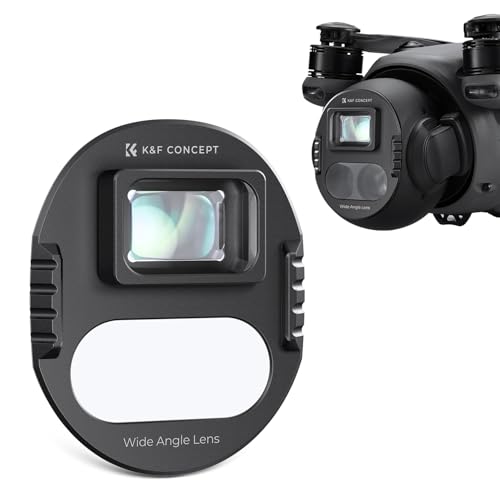
This K&F Concept attachment is designed to enlarge the field of view for the DJI Mavic 4 Pro drone. With a 108° FOV, it enables dramatic landscape and sky photography from the air. The attachment uses a secure clip-on mechanism that preserves gimbal mobility and includes a built-in UV filter for lens protection. It’s a practical tool for aerial landscape photographers who want sweeping perspective without compromising on drone protection.
Buying Guide: Key Considerations For Landscape Wide-Angle Lenses
- Camera compatibility and mount type: Ensure the lens fits your camera system (Canon RF, Sony E, Micro Four Thirds, etc.) or is a universal smartphone attachment. Consider whether you need an attached macro option for close-up landscape details.
- Focal length and field of view: Ultra-wide lenses (roughly 8-24mm for full-frame, or 10-18mm for APS-C) provide expansive scenes. Prime ultra-wides offer sharpness across the frame, while zooms provide flexibility for changing compositions on location.
- Distortion and image quality: Distortion is common with ultra-wide designs. Look for lenses with good edge-to-edge sharpness and minimal vignetting. Modern coatings and multi-element designs improve image quality in bright landscapes.
- Weight, size, and portability: Landscape photography often involves long shoots outdoors. Lighter options reduce fatigue and gear burden, especially for hikers and travelers.
- Macro capabilities and versatility: Some wide-angle lenses include detachable macro elements for close-up landscape details. Decide if macro support fits your creative goals.
- Mount protection and weather sealing: Outdoor use benefits from weather-resistant construction and protective filters or UV coatings to guard against dust and moisture.
- Mobile vs. mirrorless/dslr use: Smartphone lenses are convenient for on-the-go landscapes, while dedicated camera lenses generally deliver higher image quality and more control over exposure and depth of field.
- Budget and value: Compare build quality, included accessories (lens caps, carrying pouches, filters), and compatibility with your existing kit to determine overall value.
- Practical testing: If possible, test a lens in a real landscape setting to evaluate corner sharpness, color rendition, and distortion in your typical shooting environment.
Landscape photography benefits from deliberate lens choices that pair field of view with image quality. The selections above cover a range of setups—from compact smartphone attachments to robust mirrorless and drone-compatible options—allowing photographers to capture sweeping vistas, dramatic skies, and expansive interiors with confidence.