Best Wide Angle Lenses for Full-Frame Cameras: Top Picks for Sharp, Expansive Shots
Photographers seeking dramatic perspectives and expansive landscapes often turn to wide angle lenses for full‑frame cameras. This guide highlights five strong options across popular brands, focusing on sharp optics, fast autofocus, and versatile framing. Whether you shoot interiors, astro, or sweeping landscapes, these lenses help you capture more of the scene with crisp detail and minimal distortion.
Summary of selected products:
| Product | Brand | Focal Length / Max Aperture | Mount / System |
|---|---|---|---|
| VILTROX 14mm F4.0 FE | VILTROX | 14mm F4.0 | Sony E-mount (Full Frame) |
| VILTROX 20mm F2.8 FE | VILTROX | 20mm F2.8 | Sony E-mount (Full Frame) |
| VILTROX 16mm F1.8 FE | VILTROX | 16mm F1.8 | Sony E-mount (Full Frame) |
| Rokinon 14mm F2.8 Ultra Wide-Angle | Rokinon | 14mm F2.8 | Pentax (Full Frame) |
| TTArtisan 14mm F2.8 L | TTArtisan | 14mm F2.8 | L-Mount (Full Frame) |
VILTROX 14mm F4.0 FE for Sony E-Mount
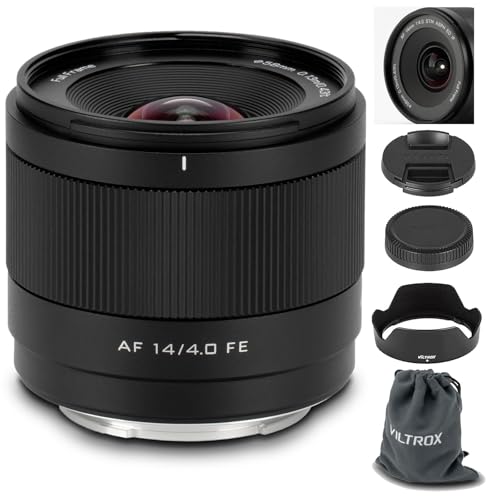
The 14mm F4.0 is designed for full-frame Sony cameras with an ultra-wide 112° field of view. It excels in landscapes, interiors, and group photography, where capturing context matters. A minimum focus distance of 0.13 m enables close, creative compositions, while Eye/Face Autofocus helps maintain sharpness on moving subjects. Its compact form makes it a practical travel option for Sony shooters seeking a lightweight wide angle with reliable performance.
VILTROX 20mm F2.8 FE

The 20mm focal length offers a broader perspective than standard lenses without overwhelming distortion, making it ideal for expansive landscapes and cityscapes. Features include fast autofocus, near-silent operation, and lightweight design (about 157g), which makes it a convenient companion for street photography and travel. The lens supports EXIF information transmission and USB upgrades, facilitating firmware improvements and feature refinements over time.
VILTROX 16mm F1.8 FE

The 16mm F1.8 delivers a bright, fast aperture on full-frame Sony bodies, enabling strong low-light performance and shallow depth of field for a wide-angle look. With a 105.6° field of view, it captures sweeping scenes, interiors, and architectural shots with dramatic perspective. Built-in STM AF provides precise focusing with subject recognition for reliable tracking in dynamic shooting scenarios.
Rokinon 14mm F2.8 Ultra Wide-Angle for Pentax

This manual-focused 14mm ultra-wide offers a dramatic perspective with a wide 115.7° angle of view on full-frame cameras, tailored for landscapes, real estate, and astrophotography. It includes a built-in hood and UMC coating to minimize flare and ghosting. While manual focus demands hands-on control, it delivers sharp edge-to-edge clarity and minimal distortion for wide scenes.
TTArtisan 14mm F2.8 L for L-Mount

The TTArtisan 14mm F2.8 L provides a bright F2.8 maximum aperture with a 114° ultra-wide field of view for full-frame L-mount systems. The design emphasizes a compact, full-metal body and portability for travel, street photography, and architectural shooting. Its wide field encourages expansive compositions and dramatic spatial depth, with a focus on sharp, near-edge performance.
Buying Guide: Key Considerations For Choosing A Wide Angle Lens
- Sensor coverage and mount: Ensure the lens is designed for your camera’s full-frame sensor and mount system (e.g., Sony E, Canon RF, Pentax, L-mount).
- Focal length and field of view: Ultra-wide angles (14–20 mm on full frame) deliver expansive scenes but can exaggerate perspective. Consider your typical shooting environment.
- Aperture and low-light performance: F/2.8 and faster give better performance in dim light and can yield creative depth of field, though many ultra-wides are f/4 or f/4.5.
- Autofocus vs. manual focus: Some lenses offer fast AF with eye/face detection; others are manual focus only. Decide based on subjects and shooting style.
- Distortion control and optical quality: Look for multi-element designs with low distortion, good edge-to-edge sharpness, and coatings to reduce flare and ghosting.
- Weight, size, and handling: Portable wide angles are ideal for travel, but balance weight with your camera body for comfortable handling during extended shoots.
- Build quality and weather sealing: Consider rugged builds for outdoor use, especially in landscapes or astro photography.
- Future compatibility: Firmware upgradeability may extend the lens’s usable life, particularly for autofocus performance and compatibility with newer camera bodies.
Choosing a wide angle lens for full-frame cameras involves balancing field of view, image quality, autofocus performance, and portability. For Sony users, the VILTROX 14mm and 16mm options pair well with modern bodies for landscapes and interiors. For those shooting on Pentax or L-mount systems, the Rokinon and TTArtisan choices offer compelling image quality and unique characteristics. Ultimately, selecting a lens that matches your typical subjects, shooting style, and travel needs will yield the most consistent results across a variety of full-frame scenarios.