Best White Balance Cards for Accurate Color in Photography
Color accuracy is essential for professional-looking images, whether you shoot landscapes, portraits, or product photography. A reliable white balance card helps you set true colors quickly and consistently across different lighting. Below are five top white balance cards that are popular for both beginners and seasoned shooters, chosen for versatility, portability, and dependable results. The summary table highlights key at-a-glance details to help you compare fast.
| Product | Brand | Key Feature | Size |
|---|---|---|---|
| Lightdow White Balance 18% Gray Reference Reflector | lightdow | Gray side with 17.8% reflectance, low exposure error | 12 x 12 in |
| Anwenk Grey White Balance Card 18% | Anwenk | Scratch-resistant, non-reflective, compact | 3.3 x 2.125 in |
| Genuine Whibal G7 Neutral White Balance | Michael Tapes Design | High precision for Photoshop/Lightroom | 2.1 x 3.35 in |
| Macolink White Balance Grey Cards | Macolink | Durable, waterproof, matte finish | 3.35 x 2.2 in |
| JJC White Balance Card Set (PVC) | JJC | Includes gray, white, and black cards | 4 x 5.2 in |
Note: Each option is designed to deliver a neutral reference for camera calibration. The following sections provide deeper insights into each product’s strengths, supported by their listed features and typical use cases.
Lightdow White Balance 18% Gray Reference Reflector

The Lightdow card provides a gray reference with an 18% reflectance standard and a density of 0.74. It is designed to minimize exposure error to about 1/8 of an F-stop and reduce the maximum deviation in reflectance to 2%. This makes it a solid choice for on-location shoots where lighting conditions vary. The folded version with a carry bag enhances portability for fieldwork, and the gray side supports consistent color balance during post-processing when using common tools like Adobe Lightroom or Photoshop.
Anwenk Grey White Balance Card 18% Exposure Calibration
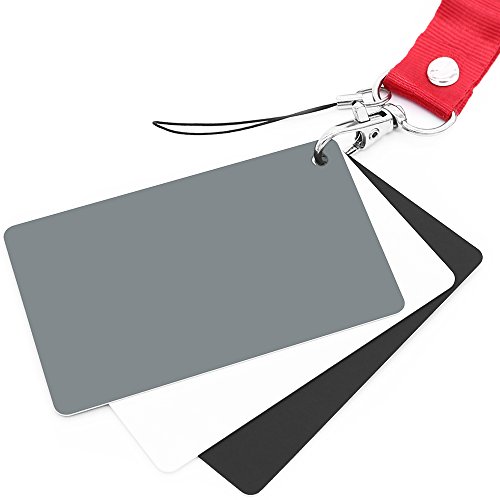
The Anwenk 18% gray card offers a matte, scratch-resistant finish with non-reflective and waterproof properties. It is compatible with any digital camera and suitable for DSLR, video, film, and general photography. Its compact size makes it easy to carry in a pocket or on a keychain, making it convenient for quick color calibration in the field, studio, or on location. This card supports precise color balance and reliable exposure settings across various shooting scenarios.
Genuine Whibal G7 Neutral White Balance Card

The Whibal G7 is designed for high precision with a focus on achieving dependable neutral color in post-production workflows. It is positioned as compatible with popular editing tools like Adobe Photoshop and Lightroom, helping photographers achieve consistent white balance across different lighting setups. This compact reference card is widely used by professionals who require reliable color calibration without complex steps, and its neutral performance is suitable for portraits and product photography alike.
Macolink White Balance Grey Cards

The Macolink grey cards emphasize durability and water resistance with a matte finish to minimize reflections. The neutral 18% gray is suitable for DSLR photography and video work, helping ensure accurate exposure and color balance across scenes. The cards are compact enough for travel and field use, while still delivering reliable calibration results for studio shoots or on-location projects.
JJC White Balance Card Set

The JJC set includes a neutral 18% gray card, a white card, and a black card, all made from durable PVC material. With a practical size of 4 x 5.2 inches for easy handling, this set serves as a versatile tool for achieving precise color balance across color-critical shoots. It’s particularly useful for studios or on-location sessions where multiple reference tones may be needed quickly for consistent results.
RENIAN Mini Grey White Balance Card Kit

The RENIAN kit features small, portable reference cards with a compact set for travel. It includes a gray/white pairing with a durable, wipe-clean surface and a sewn steel rim. The compact size makes it ideal for fieldwork and quick calibration on-location, supporting accurate exposure and color balance without adding bulk to your camera bag.
Anwenk Grey Card White Balance Card 18% 5×4
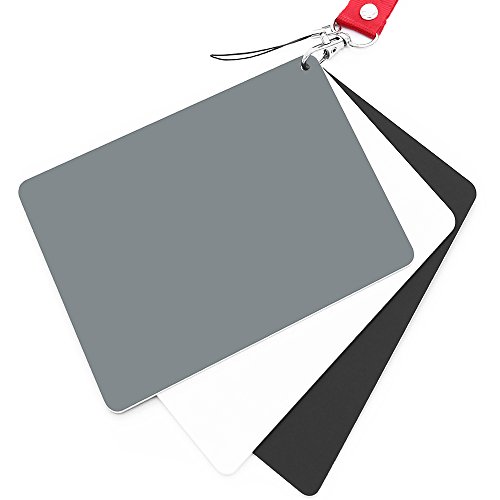
The Anwenk 5×4 inch gray card provides a medium-sized reference for easier handling during shoots. It shares the brand’s typical matte, scratch-resistant finish and waterproof design, making it suitable for use with various camera systems. The card supports consistent white balance and exposure calibration for both stills and video, with a landyard included for convenient carrying.
Buying Guide: How to Choose a White Balance Card
- Size and portability: Smaller cards fit in pockets, while larger cards offer easier handling in the studio or on set. Consider whether you need on-location travel-friendly options or studio-centric cards.
- Material and finish: A matte, non-reflective surface minimizes glare and ensures stable color readings. Look for scratch resistance and waterproof properties if you shoot outdoors or in challenging environments.
- Accuracy and calibration: Cards with a defined 18% gray reference help set correct exposure and white balance across lighting conditions. Some products emphasize low deviation in reflectance and exposure error; weigh how critical this is for your workflow.
- Set composition: Some cards come as sets with white, gray, and black cards, or multiple sizes. Sets can be convenient for quick calibration under varying lighting or when matching different cameras.
- Compatibility: Ensure the card works with your camera type (DSLR, mirrorless, video) and support for downstream editing tools like Photoshop and Lightroom if you rely on post-processing.
- Durability: Waterproof and rugged builds are advantageous for outdoor shoots, studio locations with dust or moisture, and frequent handling by clients or assistants.
- Portability vs. readability: Larger cards are easier to read in bright light and on set, but bulkier to carry. Balance legibility with convenience for your typical shooting scenarios.
- Budget and value: While professional-grade cards offer high precision, many hobbyist or budget options deliver reliable results for standard color calibration. Choose based on your required accuracy and frequency of use.
In practice, for most photographers, a compact 3.3 x 2.125 inch card provides convenience for quick calibrations, while a larger 5×4 inch option offers more surface area for easier on-camera reference in bright environments. For remember: consistent lighting conditions and disciplined white balance routines yield the most reliable color across your portfolio.