Best Video Recorder for Car: Top Dash Cams for 2026
Direct answer: the best car video recorders combine wide coverage, reliable night vision, easy smartphone access, and strong parking mode features. This guide highlights five standout dash cams that balance image quality, ease of use, and value for common buyers such as daily commuters, rideshare drivers, family car owners, and road-trippers. Each pick is explained with who it’s ideal for and why, plus practical caveats to consider before buying.
Summary of selected products
- IIWEY N5 — Best for all‑around 360° coverage with interior view, strong night vision, and a bundled 128GB card.
- ROVE R2-4K DUAL — Best for dual-channel 4K front and 1080p rear with fast app downloads.
- REDTIGER F7NP — Best for day‑to‑night clarity with STARVIS 2 sensor and robust WiFi app control.
- AXB Dash Cam V3 — Best for 4K+2.5K front/rear with 5G WiFi app control and broad compatibility.
- TERUNSOUl 4K+4K — Best for two 4K channels and large storage expansion with long 24H parking mode.
IIWEY N5 4 Channel Dash Cam

The IIWEY N5 records front, rear, interior, and left-right sides with 360° coverage at 1080P per channel, plus an optional 2.5K mode for higher detail. It uses a 3″ IPS screen and includes a free 128GB microSD card. A wired rear camera is required, and the device relies on a car charger rather than USB power. Best for drivers who want interior cabin footage and broad situational awareness in a single setup.
Best for: those who want comprehensive interior and exterior coverage in one drive‑protective package. It is especially suitable for rideshare drivers or families who need interior records for safety or liability documentation.
Caution: This model does not include GPS or OBD connection. Powering strictly via the provided charger is recommended to ensure stable operation.
ROVE R2-4K DUAL Dash Cam
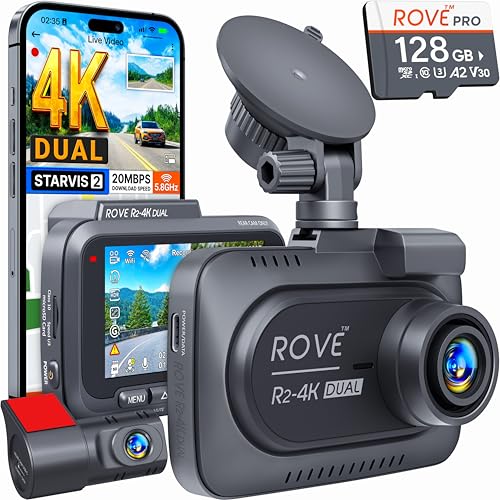
ROVE R2-4K offers dual-channel recording with a 4K front camera and a 1080P rear camera. It uses a Sony STARVIS 2 sensor and a fast 5G WiFi connection that enables quick video download via the app (up to 20 MB/s). It includes a 128GB card, a generous 150° front and 140° rear field of view, and 24-hour parking mode. Best for: drivers who want high-resolution front footage with reliable wireless sharing and easy firmware updates.
Limitation: While the 4K front provides excellent detail, the rear is 1080P, which may be less crisp in some lighting compared to the front. Also, GPS data is not listed here, so location tagging may be limited unless added via an accessory.
REDTIGER F7NP 4K Dash Cam

REDTIGER F7NP captures 4K front and 1080P rear with STARVIS 2 sensor and WDR night vision. The lens setup includes a 170° front and 140° rear field of view, delivering broad coverage with balanced exposure. Built-in 5.8GHz WiFi enables fast app downloads, sharing, and firmware updates. Best for: drivers needing crisp daytime footage plus reliable night recording and straightforward wireless management.
Limitation: The data notes do not mention GPS, so location tracking via the camera alone may be unavailable without an external module.
AXB Dash Cam V3: 4K+2.5K Dual
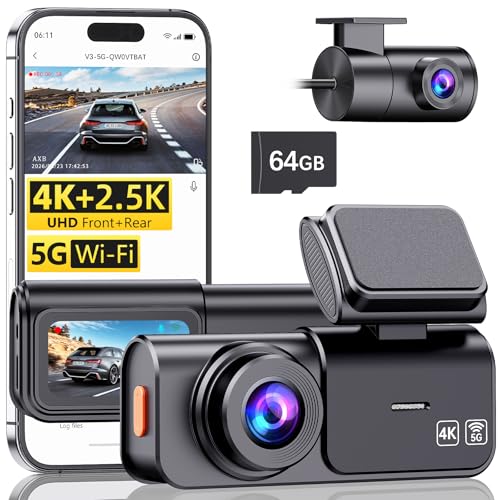
AXB V3 combines front 4K and rear 2.5K with a broad 170° front and 165° rear angle. It features 5G WiFi app control and a bundled 64GB card, with 24H parking mode and emergency lock. It suits larger vehicles where high-resolution evidence from both ends is valuable. Best for: drivers who want superior front detail and strong rear coverage with easy sharing through the app.
Limitation: The included card is 64GB; expandability is supported but check card compatibility and app behavior for large video files on your device.
TERUNSOUl 4K+4K Dash Cam
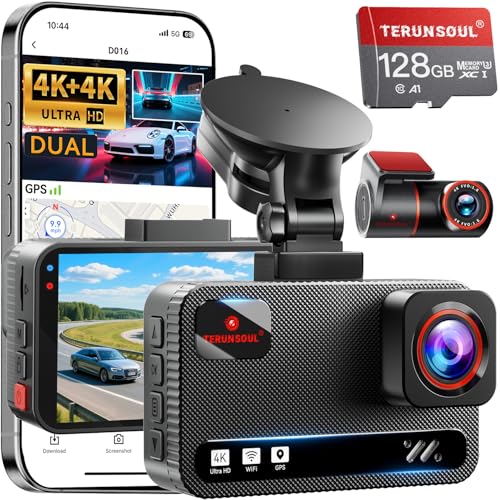
The Terunsoul system records dual 4K channels (front and rear) with a 170° wide‑angle front lens, plus a 3″ IPS screen for direct playback. It ships with a 128GB card and supports memory expansion up to 512GB. It also features 24H parking mode and a built-in GPS, making it well-suited for long trips or rideshare use. Best for: travelers and fleet operators who require consistent, high-resolution evidence and location tagging on the go.
Limitation: The data indicates a strong feature set but potential setup complexity with GPS and parking mode integration may require careful configuration.
Buying Guide
What should you consider when choosing a car dash cam?
- Video quality and coverage: Do you want front-only, or full 360° with interior views? Consider the number of cameras and each lens angle.
- Low-light performance: Night vision features, WDR, and sensor type (e.g., STARVIS) affect clarity after dark.
- Power and wiring: Some models require dedicated power sources or hardwiring for Parking Mode and continuous recording. Check if USB power is supported and if a hardwire kit is needed.
- Storage and memory: Look for included cards and max supported capacity. Ensure reliable loop recording to avoid overwriting critical clips.
- Connectivity: Built-in WiFi or 5G WiFi app control enables quick downloads, sharing, and firmware updates. GPS availability matters for location tagging.
- Ease of use: A larger display or app-based controls can simplify live viewing and playback. Consider screen size vs. distraction while driving.
- Vehicle compatibility: Some cameras are designed for larger vehicles or fleet use; verify mounting options and size.
Frequently Asked Questions
- Is GPS necessary in a dash cam?
GPS is useful for tagging speed and location. If you need this data for evidence or insurance, choose a model with built‑in GPS or plan to add a module.
- What storage capacity do I need?
That depends on video resolution, loop length, and how long you want to keep clips. Higher resolutions consume more space; look for cameras that support larger cards or cloud/app backups.
- Can I power a dash cam from USB?
Some models support USB power, but many require a dedicated car charger or hardwire for reliable operation, especially with Parking Mode.
- Is 4K front camera worth it?
Yes for clearer license plates and details in daylight; however, 4K files are larger and may strain storage and processing on some devices.
- How important is night vision?
Very important for safety and evidence. Look for STARVIS sensors, F1.5/1.8 apertures, and good WDR performance for best results after dark.