Best Video Camera Rail System for Smooth Shots and Easy Setups
Achieving professional-looking footage often starts with a reliable camera rail system. These setups provide smooth sliding, stable mounting, and flexible configurations for a wide range of cameras and accessories. Below, you’ll find five top picks that balance lightweight design, sturdy construction, and versatile mounting options. Each product focuses on stable motion, ease of use, and compatibility with common gear used in filmmaking and vlogging.
| Product | Brand | Rail Length | Key Benefit |
|---|---|---|---|
| Zecti Camera Slider | Zecti | 16 in / 40 cm | Carbon fiber, quiet movement, portable |
| NEEWER 16in/40cm Carbon Fiber Slider | NEEWER | 16 in / 40 cm | 4 bearings, versatile mounting, adjustable legs |
| Fotodiox Pro SlideCam 600 | Fotodiox | 24 in / 60 cm | Heavy-duty stability, adjustable legs |
| Fotodiox Pro SlideCam 800 | Fotodiox | 32 in / 80 cm | Longer reach, multiple mounting options |
| NICEYRIG LWS Baseplate | NICEYRIG | Baseplate with 15mm rods | Lightweight, multiple mounting points |
Note: This guide highlights five products chosen for their balance of portability, stability, and compatibility with common camera rigs. Each item is suitable for travel or studio shoots and supports various mounting configurations to fit different production workflows.
Zecti Camera Slider 16″ Carbon Fiber

The Zecti slider uses a carbon fiber build with four precision bearings and a double interior rail system to deliver stable, quiet movement. It can connect to standard photographic accessories like ball heads, enabling flexible setups for pans, tracking shots, or time-lapse sequences. The 16-inch, 600-gram design prioritizes portability for travelers and location shoots, and it ships with a scratch-resistant carrying bag for protection in transit. Its compatibility spans Canon, Nikon, Sony, Panasonic, and other DSLR and mirrorless cameras, as well as smartphones with a suitable holder.
NEEWER 16in/40cm Carbon Fiber Slider

NEEWER’s slider combines carbon fiber with aluminum for robust yet lightweight performance. It supports up to 2 kg horizontally, with a 45-degree tilt rated at 1 kg, and up to 2.2 kg vertically. The 360° adjustable legs provide flexible setup on uneven terrain, while a bubble level helps confirm horizontal alignment. Four high-precision bearings ensure smooth, quiet sliding on the 16″/40 cm rail. It includes mounting threads at the bottom and ends for tripod or light-stand compatibility and supports 1/4″ and 3/8″ accessories for Canon, Nikon, Sony, and others.
Fotodiox Pro SlideCam 600-24″ Slider

This professional slider from Fotodiox offers a heavy-duty, ball-bearing slide mechanism for stable footage. It supports horizontal and vertical use and includes adjustable legs with non-skid feet. A bubble level on the sliding platform simplifies alignment, and multiple 1/4-20 and 3/8″ holes provide flexible mounting options. The system is designed for DSLR and mirrorless rigs, delivering smooth motion without camera shake during dynamic tracking shots. It integrates with tripods and flat surfaces for versatile shooting scenarios.
Fotodiox Pro SlideCam 800-32″ Slider

The longer 32-inch version extends the same professional-grade features to capture longer tracking shots. It provides a smooth ball-bearing glide for stable motion in horizontal and vertical configurations, aided by a built-in bubble level. Like the 600 model, it supports a range of mounting options with multiple 1/4-20 and 3/8″ screw holes, making it compatible with tripods, light stands, and various rigs. It is suitable for heavier camera setups needing extended track length for cinematic movement.
NICEYRIG LWS Baseplate
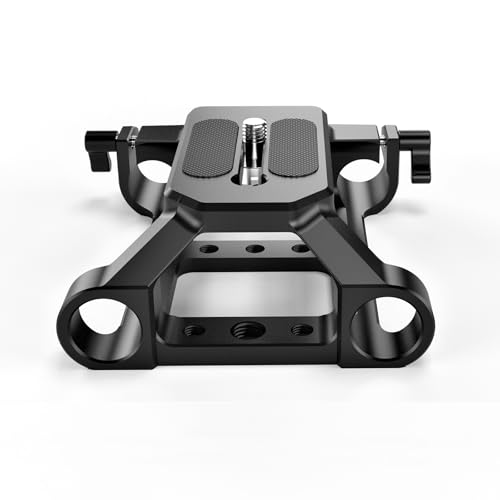
The NICEYRIG LWS Baseplate is a lightweight foundation for DSLR and mirrorless rigs. It features a 15mm rod rail system and multiple 1/4″ and 3/8″ mounting points for attaching a range of accessories like matte boxes, follow focus, or support gear. The arch-shaped design reduces overall weight while maintaining rigidity, and the baseplate can serve as a stable anchor for other rail-based components in a larger shoulder rig or camera rig system.
Buying Guide: Key Considerations For A Video Camera Rail System
Choosing the right rail system depends on your shooting style, camera payload, and environment. Consider these perspectives:
- Rail length and payload: Short rails are portable and ideal for travel, while longer rails support expansive tracking shots. Check the maximum supported weight and whether a system can handle your camera and lens combination.
- Materials and build quality: Carbon fiber offers light weight and rigidity, while aluminum provides durability at a lower cost. For on-location shoots, lighter rigs reduce fatigue but ensure sufficient stiffness against vibrations.
- Bearings and sliding: Ball-bearing slides deliver smoother, quieter movement; ensure the bearings are rated for the required travel length and load.
- Mounting versatility: Look for multiple 1/4″ and 3/8″ threads, ball heads, adapters, and compatibility with tripods, light stands, or rigs to adapt to different setups.
- Legs and leveling: Adjustable legs and bubble levels help maintain level shots on uneven surfaces or on terrain where the tripod may be unstable.
- Portability and setup time: For frequent travelers or fast-moving shoots, a compact, easy-to-assemble system saves time and reduces wear on gear.
- Accessory ecosystem: Ensure the system supports your existing gear like matte boxes, follow focus, and lens supports, either via standard threads or dedicated adapters.
In practice, a carbon fiber 16-inch slider paired with a lightweight LWS baseplate provides a compact, modular setup suitable for run-and-gun filmmaking. For longer sequences or studio shoots, pairing a 24–32 inch slider with adjustable legs and a ball head enables more dynamic tracking and angled shots while preserving stability. Systems with multiple mounting points and compatibility across brands offer flexibility to scale your rig as your projects evolve.