Best Video Camera for Car Recording: 5 Top Dash Cams for Complete Vehicle Safety
Answering your search for a reliable video camera for car recording: these dash cams provide clear front, rear, and interior footage, strong night vision, and useful parking modes. This guide highlights five top options, each suited to different drivers—from daily commuters to rideshare operators and road-trippers. Below, compare features, ideal use cases, and potential limitations to help you choose.
| Product | Video Quality | Coverage | Best For |
|---|---|---|---|
| ROVE R2-4K DUAL | 4K Front / 1080p Rear | Front, Rear | All-around safety with fast app access |
| REDTIGER F7NP | 4K Front / 1080p Rear | Front, Rear | Sharp detail in any light |
| FAIMEE Dash Cam | 4K Front / 2K Rear | Front, Rear | High-resolution, strong night vision |
| WANLIPO 4K + 2.5K | 4K Front / 2.5K Rear | Front, Rear | Extensive wireless features and GPS |
| PRUVEEO 360° 4 Ch | 1080p All-Around | Front, Rear, Left, Right | Complete vehicle coverage |
ROVE R2-4K Dual Dash Cam
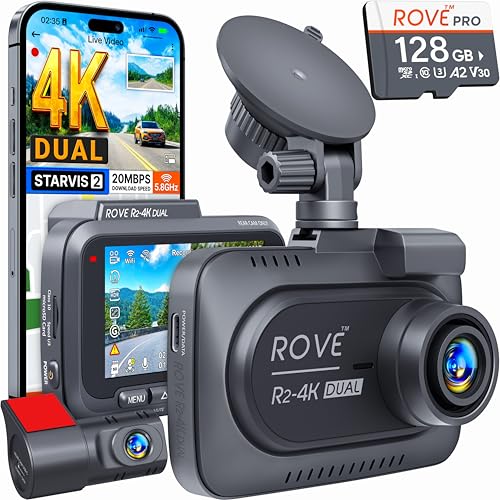
The ROVE R2-4K Dual Dash Cam records front at 4K and rear at 1080p, offering a sharp, detailed view of critical road moments. It uses Sony STARVIS 2 technology for improved low-light performance and features a 150° front and 140° rear wide angle to minimize blind spots. This setup is best for drivers who want top-tier daytime detail and reliable night capture, plus a quick, app-based workflow. A built-in GPS logs speed and location, and the device supports fast 5G WiFi for fast video transfer.
Who it’s best for: daily commuters and rideshare drivers who value precise front-end detail and easy video sharing.
Caution: High-resolution footage can fill memory quickly; plan for a larger memory card and use loop recording to manage storage.
REDTIGER 4K Dash Cam Front Rear F7NP

The REDTIGER F7NP uses a STARVIS 2 sensor with a 170° front and 140° rear wide-angle lens and 4K front recording paired with 1080p rear. WDR and HDR improve contrast in varying lighting, making this option strong for daytime clarity and nighttime detail. Built-in GPS and reliable WiFi enable easy app-based review and data access.
Who it’s best for: drivers who want crisp, high-resolution front footage and dependable night performance, with efficient wireless review.
Caution: Some advanced cloud or membership features may require additional setup or services beyond the basic app usage.
FAIMEE Dash Cam Front and Rear

The FAIMEE model delivers 4K front and 2K rear recording with a 170° wide-angle front lens, WDR, and enhanced night vision. It supports 24/7 parking monitoring with a 64GB card included, and it’s expandable up to 256GB. This setup is advantageous for users who want strong daytime clarity and reliable incident capture during parking hours.
Who it’s best for: drivers seeking robust front detail and reliable rear coverage, with continuous parking surveillance.
Caution: Hardwiring for full-time parking monitoring may require a separate installation kit.
PRUVEEO 360° 4 Channel Dash Cam

The PRUVEEO system provides complete 360° coverage with four 1080p cameras that cover front, rear, left, and right angles. An adjustable front camera allows targeted viewing of specific areas, which is helpful in busy parking areas or during tight maneuvers. Time-lapse recording helps save storage, and parking mode ensures ongoing monitoring when the vehicle is idle (ACC kit sold separately).
Who it’s best for: users who want full vehicle coverage and flexible angle adjustments for focused evidence.
Caution: All-around coverage at 1080p may be less detailed than higher-resolution front cameras in 4K setups.
Buying Guide
What to consider when choosing a car dash cam:
- Video resolution and sensor: Higher front camera resolution (4K) improves license plate readability and detail, especially in daylight. If budget or storage is a concern, a strong 2K/1080p rear can still provide solid evidence.
- Field of view: A wider front angle (between 150° and 170°) reduces blind spots, but extremely wide lenses can cause distortion at the edges. Balance with rear coverage for complete protection.
- Parking mode and power: Parking surveillance is valuable for parked-car security. Some models require a hardwire kit or an external power supply. Consider your installation constraints and local power options.
- GPS and speed logging: Built-in GPS adds location and speed data, aiding incident review. This is especially useful for fleet drivers and rideshare operators.
- Storage and card compatibility: Check the recommended card type and capacity. Time-lapse modes help conserve space, but you’ll still need room for long trips or continuous recording.
- App experience and data transfer: Fast, reliable apps improve daily use, allowing quick downloads, playback, and sharing of footage.
- Ease of installation: Some cameras are simple windscreen mounts, while others may require professional installation or hardwired power solutions for 24/7 monitoring.
FAQ
- What is the difference between 4K and 1080p dash cams?
4K front cameras offer higher detail, which helps identify license plates in daylight; 1080p rear cameras still provide clear evidence but with lower resolution. - Is parking mode worth it?
Yes, for parked-car security, but it may require a constant power source and larger storage; plan accordingly. - Do dash cams require an internet connection?
Many have built-in WiFi for local transfer; cloud features may require a subscription and a stable connection. - What is GPS used for in dash cams?
GPS logs speed and location, aiding incident reconstruction and providing route history. - Can I install a dash cam myself?
Most units are designed for DIY installation, but some configurations (like hardwired parking mode) may benefit from professional help. - What should I look for in a dash cam for rideshare?
Focus on front and interior coverage, clear night vision, reliable parking mode, and easy app-based review for quick documentation.