Best Thermal Overlay Night Vision Devices for Every Situation
If you’re shopping for thermal overlay night vision, you want clarity, reliability, and versatility across low-light, smoke, fog, and total darkness. This guide highlights five top options that blend thermal imaging with night vision or deliver strong thermal performance for hunting, surveillance, and outdoor operations. Each pick targets a different buyer type—from tactical professionals to outdoor enthusiasts—so you can choose based on how you’ll use it most. Below, you’ll find concise comparisons, who each product suits best, and practical buying considerations.
Summary Table of Selected Products
| Product | Best For | Key Benefit |
|---|---|---|
| AGM Global Vision F14-3APW Fusion Tactical Night Vision Monocular | Tactical teams and dual-field ops | Gen 3 white phosphor NV with thermal overlay |
| Night Operators Heat Thermal Vision Monocular | Budget-conscious heat detection | Adjustable focus with solid thermal range |
| Thermal Imaging Night Vision Scope for Hunting | Hunting in varied terrain | 2-in-1 aiming system, rugged build |
| TNV30i Thermal Monocular (MiLESEEY) | Smartphone/tech integrations | Super-resolution AI processing |
| Pulsar Symbion DXT50 LRF Thermal Binoculars | Long-range detection | Multispectral with built-in laser rangefinder |
AGM Global Vision F14-3APW Fusion Night Vision Monocular

The AGM F14-3APW combines Gen 3 white phosphor night vision with a 640×512 thermal overlay, delivering visibility in total darkness, smoke, or low-contrast environments. This dual-channel fusion supports detection, recognition, and engagement in challenging conditions. It’s helmet-mountable and adaptable for handheld, head, or weapon use, making it a strong choice for law enforcement, special operations, and search-and-rescue teams. Best for users who need rapid situational awareness across multiple modalities.
Who this is best for: tactical operators who require a compact, versatile optic that merges thermal with classic night vision. Why selected: its fusion capability provides comprehensive situational awareness, offering a clear edge in low-visibility environments.
Caution: The device is compact; extended operation may require comfortable mounting solutions to prevent fatigue during long missions.
Night Operators Heat Thermal Vision Monocular
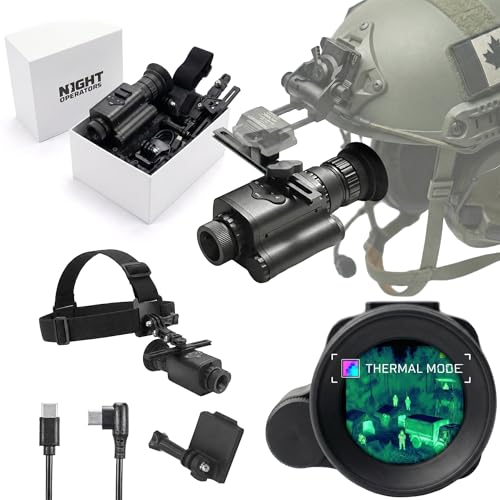
This monocular emphasizes heat signatures in complete darkness with an adjustable-focus thermal sensor and a diopter system for binocular-like clarity. Its effective detection ranges—up to about 100 meters for humans and 200 meters for larger targets—make it suitable for rapid perimeter checks and close-quarters surveillance. Best for those who want a straightforward, affordable thermal option with dependable performance.
Who this is best for: entry- to mid-level users seeking a cost-effective, quick-to-use thermal solution. Why selected: reliable heat detection with practical focusing features for everyday field use.
Caution: Range is weather and target-size dependent; performance may vary in adverse conditions like heavy fog or rain.
Thermal Imaging Night Vision Scope for Hunting

This hunting-focused scope pairs high-resolution thermal imaging with a 2-inch display and 320×240 thermal camera. It offers real-time 50Hz refresh, 3x digital zoom, and a dual aiming system that combines a red laser with a crosshair overlay. The rugged aluminum body supports IP66 weather sealing and operates across extreme temperatures, making it a solid choice for varied outdoor environments. Best for hunters who want reliable heat signatures with an integrated aiming system.
Who this is best for: hunters and outdoor operators who need an all-weather thermal scope with precise targeting. Why selected: dual aiming aids streamline target acquisition in dim conditions.
Caution: The field of view and zoom options are digital; users should account for potential image distortions at higher magnifications.
TNV30i Thermal Monocular (MiLESEEY)

The TNV30i uses MiLESEEY’s Matrix IV AI engine to deliver 12 µm pixel size and 512×384 resolution with superior thermal sharpness. It features a 10–15 mm lens for flexible ranging from wide scanning to precise identification and can reach up to 1,600 yards in detection with a fast F-number. Best for tech-savvy buyers who value enhanced image processing and long-range thermal capability.
Who this is best for: professionals and enthusiasts who want AI-assisted clarity and flexible focal ranges. Why selected: strong image processing helps in discerning targets in challenging backdrops.
Caution: AI processing requires pairing with the Mileseey app for optimum results; standalone use may feel less intuitive to casual buyers.
Pulsar Symbion DXR50 LRF Thermal Binoculars

The DXR50 pairs a 1280×1024 thermal sensor with digital night vision and a built-in laser rangefinder (LRF). It supports multiple viewing modes—thermal, digital, Picture-in-Picture, and overlay. The 50 mm F/1.0 lens and <40 mK NETD enable strong contrast in fog, rain, or dense vegetation. Best for long-range, mixed-mode observation where distance measurement is essential.
Who this is best for: professionals needing an integrated system for heat detection, visual identification, and ranging. Why selected: multifaceted viewing modes with a capable LRF for precise targeting.
Caution: Higher-end features require acclimation to complex controls; ensure you’re comfortable switching between modes in-field.
Buying Guide
What to consider when buying a thermal overlay night vision device:
- Fusion vs. standalone: Fusion devices pair thermal with night vision for enhanced situational clarity. Choose fusion if you need both modalities in one unit.
- Resolution and NETD: Higher resolution and lower NETD (thermal sensitivity) improve target detection and detail. Look for at least 320×240 or better and NETD under 40 mK where possible.
- Lens and range: Larger apertures and longer focal lengths extend detection distance and improve image quality in challenging weather.
- Weight and mounting: Helmet-mountable or weapon-mount options increase versatility. Ensure mounting hardware suits your use case and battery life expectations.
- Durability and weather sealing: IP ratings and rugged construction matter for outdoor reliability in rain, dust, and cold.
- Software and processing: AI-assisted or enhanced image processing can improve clarity in low-contrast scenes. Consider app compatibility and ease of updates.
- Power and battery life: Check promised endurance under typical field usage. Weight and heat management influence comfort during extended sessions.
Frequently Asked Questions
- What is thermal overlay night vision?
It’s a device that combines thermal imaging with traditional night vision to display heat signatures alongside amplified light-level imagery, improving target detection in darkness or obscurants.
- Who should buy a fusion thermal-NV device?
Users needing rapid multi-sensor awareness in unpredictable environments, such as tactical teams, hunters, and search-and-rescue operators.
- What determines the best range for these devices?
Sensor resolution, lens focal length, NETD, and atmospheric conditions all influence detected and recognized distances.
- Are these devices suitable for hunting?
Yes, many models offer hunting-friendly features like crosshair overlays, red lasers, or long-range detection, but verify local regulations first.
- What maintenance is required?
Keep optics clean, store away from extreme heat, and update firmware when available to maintain performance and compatibility.
- Can these units be used with smartphones?
Some models support app-based enhancements or data transfer; check each product’s compatibility and pairing steps.