Best Thermal Binoculars With Rangefinder for Clear Long-Range Viewing
If you need thermal binoculars with an integrated rangefinder, you’re seeking gear that combines heat-detecting imaging with precise distance measurement. This guide highlights five top options, each with a built-in laser rangefinder and strong low-light performance. These are best for search-and-rescue teams, wildlife researchers, hunters, security professionals, and outdoor enthusiasts who require accurate distance data alongside thermal visibility.
Buyer note: Each product below is chosen for its balance of thermal sensitivity, range capability, and practical field features. The summary table after the introduction provides quick comparisons to help you decide which model fits your needs.
| Product | Best For | Key Feature |
|---|---|---|
| AGM Global Vision ObservIR LRF 25-256 Fusion | All-around tactical and outdoor use | Dual-spectrum imaging with 1,000 m rangefinder |
| ATN Binox 6 Dual Multispectral | Versatile day/night hunters and rescuers | 4K day/night plus built-in 1,000 m LRF |
| AGM Global Vision ObservIR LRF 35-384 Fusion | Long-range tactical surveillance | 38x high-res thermal with 1,800 m detection |
| ATN Binox 6 Dual Multispectral (64GB) | General use with rugged IP67 | 4-in-1 multispectral with 1,000 m LRF |
| Pulsar Merger LRF XT50 | High-detail thermal with range up to 1,640 yards | 1280×1024 thermal, long-range LRF |
AGM Global Vision ObservIR LRF 25-256 Fusion Thermal Imaging & CMOS Binocular

This dual-spectrum device combines thermal imaging with digital day/night vision in a single binocular. It includes a built-in laser rangefinder with a practical 1,000-meter range, making it suitable for long-range assessments in varied environments.
- Best for: outdoor patrols, wildlife surveys, and search tasks where both heat signatures and standard daylight clarity are useful.
- Why selected: Strong core thermal sensor (256×192) and laser rangefinder provide reliable distance data for field decision-making.
- Caution: Data indicates 12 μm VOx thermal sensor; performance may vary in extreme weather conditions.
ATN Binox 6 Dual Multispectral Binoculars
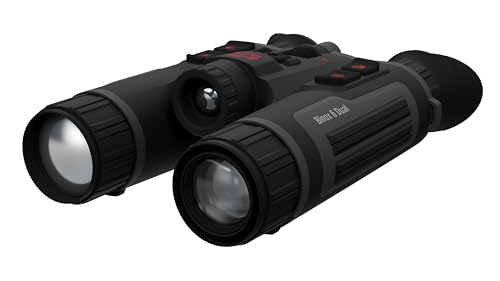
This multispectral binoculars system offers Day, Night, Thermal, and Twilight viewing in one device, with 4K daytime imaging and a built-in laser rangefinder up to 1,000 meters. It’s a flexible choice for users who need reliable performance across multiple viewing modes.
- Best for: wildlife observation, security, and field operations requiring a single optic for various lighting conditions.
- Why selected: The combination of 4K daytime imagery and thermal plus a robust LRF makes it versatile in diverse scenarios.
- Caution: Some users may prefer the 256×192 thermal core for ultra-detailed heat signatures in dense brush.
AGM Global Vision ObservIR LRF 35-384 Fusion Thermal Imaging & CMOS Binocular

This model increases thermal sensor resolution to 384×288 with a digital day/night channel, offering long-range detection with enhanced standoff capability and a built-in 1,000 m laser rangefinder.
- Best for: tactical operations and high-visibility field scouting where heat signals must be detected from farther away.
- Why selected: Higher thermal resolution improves contrast and target discrimination in challenging environments.
- Caution: Heavier weight may affect prolonged carry comfort for some users.
ATN Binox 6 Dual Multispectral Binoculars 256×192 Sensor
This variant emphasizes multispectral viewing with a 256×192 thermal core, delivering day/night/thermal modes and an IP67-rated build for rugged use. The built-in 1,000 m LRF supports accurate rangefinding during field operations.
- Best for: rugged outdoor work where weather resistance is a priority and a single device must handle multiple modes.
- Why selected: The all-weather design complements reliable lens performance in varied environments.
- Caution: Check battery life expectations for extended field sessions; high-performance modes can consume power quickly.
Pulsar Merger LRF XT50 Thermal Binoculars

The Merger LRF XT50 delivers 1280×1024 thermal imaging with 12 μm detectors and 2–16x magnification, plus long-range laser rangefinding up to 1,640 yards. This model is designed for high-detail observation at extended distances.
- Best for: professional surveillance and long-range reconnaissance where image stability and range accuracy matter most.
- Why selected: High megapixel thermal sensor and advanced stabilization improve target recognition at distance.
- Caution: Higher optical zoom may require steady handling to prevent motion blur in dynamic scenes.
Buying Guide: Thermal Binoculars With Rangefinder
What to consider when choosing a thermal binocular with a rangefinder:
- Sensor resolution and NETD: Higher resolution (e.g., 384×288) and lower NETD (under 20 mK) yield clearer heat signatures, especially in challenging conditions.
- Rangefinder range: Longer measurement capability (up to 1,800 m or more) supports better distance assessment for distant targets.
- Multispectral capability: Day, Night, Twilight, and Thermal modes add versatility across lighting and weather scenarios.
- Field of view and optics: Consider lens size (e.g., 25 mm vs 50 mm) and zoom range to balance detection distance with image brightness and edge clarity.
- Ruggedness and water resistance: IP ratings and robust housing matter for outdoor or duty use.
- Image stabilization: Helps maintain a steady image during movement or at higher magnifications.
- Storage and data capture: Built-in recording and memory capacity can be important for documentation and review.
- Weight and ergonomics: Heavier models deliver more capability but may reduce comfort for extended wear.
FAQs
- What is the benefit of a laser rangefinder in thermal binos?
It provides precise distance data to targets, improving range estimation and aiming decisions in the field. - Which thermal binocular is best for hunting at night?
Look for models with strong low-light performance, a comfortable fit, and a reliable 1,000 m LRF for long-range shots. - How important is thermal sensor resolution?
Higher resolution (e.g., 384×288) improves detail and target discrimination, especially through brush or fog. - Should I prioritize IP rating or thermal sensitivity?
Both matter; IP ratings protect against weather, while sensitivity determines heat-detection quality. - Can these devices record footage?
Some models include built-in recording; check memory capacity if you need to store video or photos.