Best Telescope Lenses and Accessories for DSLR Enthusiasts
Answer: For DSLR users seeking to expand their reach in astronomy and astro-imaging, the best options include telephoto lenses, dedicated telescope eyepieces, and essential cleaning and maintenance gear. This guide highlights five relevant products that pair well with DSLR bodies, explaining who each item is best for, why it’s a solid pick, and any notable limitations. The selections cover versatile zoom lenses, long-range telephotos, affordable accessory kits, and practical cleaning tools to keep optics clear.
| Product | Why It’s Useful | Best For |
|---|---|---|
| Canon EF 75-300mm f/4-5.6 III Telephoto Zoom | Affordable entry telephoto with moderate reach for lunar and planetary shots. | Beginner to intermediate DSLR users exploring basic astro-imaging. |
| JINTU 420-800mm Manual Telephoto Lens | Long focal length for distant celestial targets with manual control. | DSLR users seeking higher magnification without a motorized setup. |
| 1.25 Inch Plossl Eyepiece Set (4mm/10mm/25mm) with 2X Barlow | Easy upgrade to improve magnification and field of view. | Astronomy hobbyists adding eyepieces for different power levels. |
| Celticbird Astronomical Telescope Accessory Kit | Comprehensive accessory set including eyepieces, filters, and a Barlow lens. | Telescope owners who want versatility and expandability. |
| K&F Concept Air Blower | Simple, non-contact dust removal for lenses and sensors. | Any DSLR or telescope setup needing quick cleaning without liquids. |
Canon EF 75-300mm Telephoto Zoom Lens

Best for entry-level DSLR users who want extra reach for lunar details or wide-field sky scenes without a specialized telescope. This Canon telephoto offers a 75-300mm focal length and a maximum aperture of f/4-5.6, giving a flexible zoom range suitable for capturing brighter planets, the Moon, and some deep-sky targets under dark skies. The lens construction includes 13 elements in 9 groups to help control aberrations at shorter and longer focal lengths.
Why chosen: It’s a cost-effective first step toward astrophotography with a DSLR, especially for buyers who already own a Canon body and want a native, compatible option with reliable, proven optics.
Best for: Beginner to intermediate DSLR shooters who want immediate telephoto capability without investing in a dedicated telescope setup. Choose this if you already shoot with Canon and need a versatile all-purpose zoom for night sky subjects.
Caution: Its maximum aperture is modest for faint deep-sky objects, so exposure settings and sky conditions matter more for faint targets.
JINTU 420-800mm Telephoto Lens
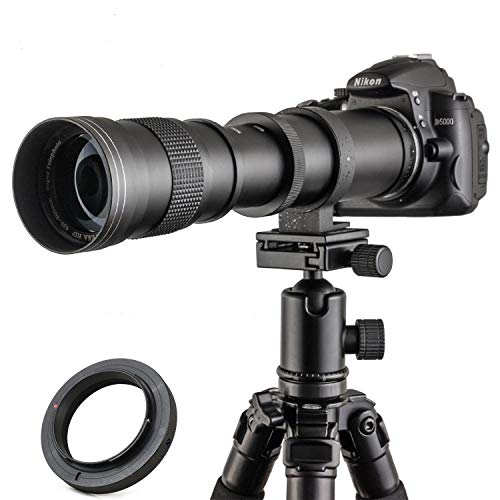
Best for users seeking higher magnification without a heavy telescope setup. The JINTU 420-800mm manual telephoto lens provides a long focal range and a compact form factor, making it a practical choice for planetary and Moon imaging with a DSLR. The lens is described as having a solid metal body and high-definition optics with multi-coated low-dispersion glass to improve image quality at longer focal lengths.
Why chosen: It offers greater reach than typical consumer telephotos, enabling closer views of brighter celestial targets. The included free Canon adapter broadens compatibility for Canon EOS bodies, which is helpful for photographers who want to maximize lens variety.
Best for: Intermediate enthusiasts who want more magnification and planet/ Moon detail without a heavy, purpose-built telescope. Better for static setups than fast, on-sky tracking.
Caution: It is a manual focus design; users must manage focus by hand, which can be challenging for dim or fast-moving targets.
1.25-Inch Plossl Eyepiece Set

Best for adding flexible magnification options to a telescope or telephoto adapter used with a DSLR. This four-piece Plossl set includes 4mm, 10mm, and 25mm eyepieces plus a 2X Barlow with a T adapter, enabling low, medium, and high-power views suitable for planetary, lunar, and some deep-sky observations. The kit promotes compact, multi-coat optics and compatibility with standard 1.25-inch fittings.
Why chosen: This kit provides essential, affordable upgrades to your viewing options, letting you tailor magnification to the target and sky conditions. It helps avoid buying single pieces piecemeal, which can be costlier in the long run.
Best for: Beginners and hobbyists expanding their eyepiece library. Choose this if you want quick, versatile power options while using a DSLR with a telescope or a telephoto adapter.
Caution: The 2X Barlow can amplify optical aberrations if the rest of the optical system isn’t well-matched or properly aligned.
Celticbird Accessory Kit

Best for telescope owners who want a ready-to-use enhancement bundle. This kit includes 3 Plossl eyepieces, a 2X Barlow lens, and a 4-piece filter set, plus a T-adapter for DSLR attachment. It supports a broader range of observing targets and can help with planetary, lunar, and deep-sky viewing. The included T-adapter enables direct photography with a DSLR when paired with appropriate mounting.
Why chosen: It bundles multiple components into one purchase, enabling an expanded viewing and imaging setup for a reasonable price. The 2X Barlow and T-adapter increase flexibility for photography and observation across various targets.
Best for: Astro-enthusiasts who want a single kit to upgrade optics and imaging workflow. Avoid this if you require high-end filters or specialized planetary accessories beyond the basic set.
Caution: The kit’s filters are basic; for advanced imaging, consider additional, higher-quality filters tailored to your targets.
K&F Concept Air Blower

Best for quick, non-contact dust removal on lenses, sensors, and camera bodies. This blower provides a large-volume air stream to dislodge loose dust from delicate optics and sensitive surfaces. Its compact design makes it a practical inclusion in any telescope or DSLR cleaning routine. The soft nozzle reduces the risk of scratching during use.
Why chosen: It’s a simple, essential tool for routine maintenance that helps preserve image quality by minimizing dust on front elements and sensors. It complements cleaning kits by enabling non-liquid dust removal before a deeper cleaning session.
Best for: Photographers and astronomers who want a quick, reliable way to keep optics clean. Choose this in combination with a proper cleaning solution and microfiber cloths for periodic cleaning.
Caution: Do not rely on it exclusively; it does not remove oils or smudges, which require cleaning solutions and cloths for removal.
Buying Guide: Key Purchase Considerations
- Target type: Decide between telephoto lenses and telescope-based setups. Telephotos are easier to use with a DSLR but offer limited deep-sky capability compared to dedicated telescopes.
- Magnification vs. practicality: Higher focal lengths (e.g., 420-800mm) provide more reach but require sturdy mounts and stable skies. Weigh portability against performance.
- Compatibility: Ensure lens/eyepieces fit your camera body and mount. Look for adapters or adapters included in product data.
- Optical quality: Consider elements, coatings, and build quality to minimize aberrations at various focal lengths.
- Accessibility: Beginner-friendly kits with multiple pieces can save time and money, but assess whether you’ll outgrow them quickly.
- Maintenance: Include a cleaning kit and a blower to maintain optical clarity, especially under dusty observing conditions.
Frequently Asked Questions
- What is the difference between a telescope lens and a DSLR telephoto lens for astronomy?
– A telescope lens system is designed for fixed, long focal lengths with tighter fields of view and is often paired with mounts for tracking. DSLR telephotos can provide reach but may struggle with star tracking and deep-sky imaging without accessories. - Do I need special adapters to attach a DSLR to a telescope?
– Yes. A T-adapter or T-ring compatible with your camera mount is usually required to connect a DSLR to a telescope or specific eyepiece setups. - Is a long focal length always better for astronomy with a DSLR?
– Not always. Longer focal lengths increase magnification but demand more precise alignment, tracking, and steadiness. For beginners, moderate focal lengths can yield clearer results with less complexity. - Are cleaning kits essential for telescope use?
– Yes. Regular cleaning helps maintain image clarity. Use non-liquid cleaning solutions and microfiber cloths, plus non-contact dust removal tools like air blowers. - What should I consider when choosing eyepieces for DSLR astronomy?
– Consider focal length, ocular diameter compatibility, field of view, and how the eyepieces pair with any Barlow lens or adapters you plan to use.