Best Telephoto Lenses for Astrophotography: Long-Focus Tools for Night Skies
Astrophotography rewards gear that delivers crisp star points and clear lunar details from dark skies. Telephoto lenses extend your reach beyond the Milky Way’s broader swaths, letting you isolate celestial targets or capture dramatic landscape-and-sky scenes. The lenses below emphasize long focal lengths, strong optical designs, and solid Canon or EF-mount compatibility to help you shoot the moon, planets, star clusters, and distant deep-sky objects with greater control. Each option balances reach, image quality, and practicality for amateur to enthusiast photographers working with DSLR systems.
To help you compare at a glance, the table below summarizes five telephoto options chosen for astrophotography potential, focusing on focal range, build quality, and standout features. Whether you need extreme reach or fast glass for brighter night skies, there’s a choice here to fit your camera body and skill level.
| Product | Brand | Focal Range (mm) | Notable Feature |
|---|---|---|---|
| High-Power 500mm/1000mm Telephoto Lens | Big Mike’s | 500–1000 | 2X teleconverter expands to 1000mm; manual focus; EF-mount |
| JINTU EF Mount 420-800mm Telephoto Zoom | JINTU | 420–800 | Full metal body; manual focus; EF/EF-S mount |
| Rokinon 135mm F2.0 Telephoto Lens | Rokinon | 135 | Fast f/2.0; UMC optics; full-frame compatible |
| Canon EF 100-400mm f/4.5-5.6L IS USM | Canon | 100–400 | L-series quality; image stabilization; versatile zoom range |
| Canon EOS Rebel T7 Bundle With 500mm Lens | Canon | 18–55 + 500 | Starter bundle with 500mm preset telephoto |
High-Power 500mm/1000mm Telephoto Lens

The High-Power 500mm/1000mm f/8 manual telephoto lens from Big Mike’s delivers dramatic reach for night photography. At 500mm, it creates a compact field of view ideal for lunar details or bright star clusters, and adding the built-in 2X teleconverter expands to 1000mm for distant planetary or deep-sky targets. The optical assembly uses high-index, low-dispersion glass with multi-coatings to reduce glare and chromatic aberration, helping star points remain sharp across the frame. Mounting on Canon DSLRs with EF-mount compatibility keeps the setup straightforward, with manual focus enabling precise moon and planet adjustments through live view. For astrophotographers seeking strong magnification on a budget, this lens delivers solid performance and reach.
Practical use requires a stable tripod and careful exposure planning. At f/8, longer exposures are common, and you may rely on higher ISO or controlled shooting to balance noise and detail. The manual focus design encourages deliberate focusing near bright targets, while the 1000mm reach offers compelling framing options for celestial scenes and moon mosaics. This option is particularly attractive for beginners who want to test extreme reach without the price tag of premium glass, while still maintaining respectable optical quality for night-sky work.
JINTU EF Mount 420-800mm Telephoto Zoom

The JINTU 420-800mm manual focus telephoto zoom for Canon offers a flexible reach ideal for astrophotography on a budget. With a full-metal construction and multi-coated low-dispersion glass elements, it minimizes ghosting and color fringing to keep star fields crisp. The zoom range provides versatility: frame wide-field star fields at 420mm or pull in moon and planetary detail toward 800mm. It’s designed for Canon EF/EF-S mount cameras, ensuring straightforward mounting without adapters. Aperture at 420mm is around f/8.3 and can close to f/16 at 800mm, which is typical for this class. The absence of autofocus favors precise focusing by eye, especially when using live view at high magnification.
For astrophotographers, this lens blends reach, build quality, and affordability. A sturdy tripod or tracking mount is essential for longer exposures, and manual control supports deliberate framing and focusing of celestial targets. The 420-800mm range also suits lunar portraits and stacked star-field captures, making this lens a practical, value-conscious option for weekend skywatchers and aspiring astro-imagers.
Rokinon 135mm F2.0 Telephoto Lens For Canon
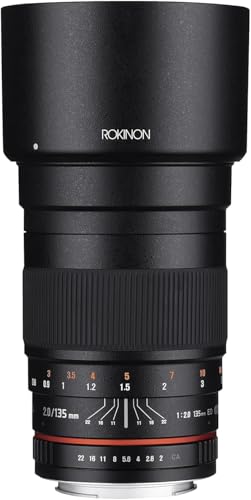
The Rokinon 135mm f/2.0 telephoto prime for Canon is a compelling choice for night-sky imaging thanks to its fast maximum aperture. The lens is fully compatible with full-frame cameras, offering an 18.8-degree angle of view, and it yields a 12.4-degree field on APS-C bodies. Its Ultra Multi-Coated (UMC) optics minimize flare and color bloom, preserving contrast in bright lunar scenes and star fields. With a minimum focusing distance of 2.6 feet, you can include foreground silhouettes in astro-landscapes for a more dynamic shot. The combination of bright glass and sharp performance makes this lens a popular pick for astrophotographers seeking a lighter, more portable option with strong performance in low light.
While not as long as 400–1000mm options, the 135mm focal length provides a practical balance between magnification and field of view for Milky Way images, bright star clusters, and night-sky portraits. Its relatively compact size helps with travel setups, and the fast f/2.0 aperture helps boost signal-to-noise for handheld or tripod-based exposures during night sessions.
Canon EF 100-400mm f/4.5-5.6L is USM Telephoto Zoom

Canon’s EF 100-400mm f/4.5-5.6L IS USM Telephoto Zoom is a versatile, high-quality option for Canon shooters exploring astrophotography. The lens covers a broad range from 100mm to 400mm, providing flexibility for wide Milky Way frames or tighter moon shots. The L-series design ensures sharpness and reduced aberrations across the frame, while image stabilization helps during handheld or low-light shooting, especially on a tripod with longer exposures. Coatings and advanced glass help minimize chromatic aberration and ghosting, preserving star points and night-sky detail across the focal span. It’s a solid all-around choice for those who want reliable performance without stepping up to the most expensive glass.
Canon EOS Rebel T7 Bundle With 500mm Preset Telephoto Lens

The Canon EOS Rebel T7 DSLR Bundle combines a 24.1 MP APS-C camera with a versatile 18-55mm kit zoom and a 500mm preset telephoto lens. This package provides a beginner-friendly entry into astrophotography, pairing a capable sensor with long-reach spectral capture. The 500mm lens adds substantial reach for lunar and star-field shots, enabling more dramatic compositions when paired with a sturdy tripod. The bundle often includes storage, editing software, and accessories, helping new photographers assemble a functional night-sky setup. The Canon EF/EF-S compatibility allows future upgrades with a broader lens collection, expanding possibilities as skills grow.
The Rebel T7 kit is best suited for photographers who want a guided start into astrophotography, emphasizing gradual lens upgrades and tripod-based long-exposure work. While not the most advanced option, this bundle provides a cost-effective path to begin capturing recognizable celestial scenes and learning the basics of exposure, focusing, and composition under dark skies.
Buying Guide
Choosing a telephoto lens for astrophotography depends on your target subjects, sky conditions, and camera system. Consider how focal length interacts with your planned shots, how much weight you’re willing to carry, and how you’ll manage focusing and exposure in low light. Below are key purchase considerations and practical comparisons among the five options above.
Focal Length And Field Of View
- Long focal lengths (500–1000mm) offer dramatic, close-up views of the Moon, planets, and distant star fields but require precise tracking and a solid tripod or mount.
- Moderate telephotos (400–800mm) balance reach with practicality for portable setups and still provide strong framing of bright targets.
- Mid-range primes (135mm) give wider fields than super-telephotos, which is useful for Milky Way portraits and astrophotography with foreground interest.
Aperture And Light Gathering
- Faster apertures (f/2.0–f/4) improve light collection and enable shorter exposures, beneficial for brighter nebulae and star clusters.
- F/8 to f/8.3–f/16 at longer focal lengths is common; plan for longer exposure times or higher ISO with careful noise management.
- When using very long focal lengths, licensing or tracking may be more impactful than absolute aperture in determining exposure quality.
Build Quality And Mount Compatibility
- All listed lenses with EF or EF-S compatibility are straightforward for Canon DSLR users; verify the exact mount on your body.
- All-metal bodies and multi-coated optics improve durability and reduce flare in night skies, especially near bright moons or city light pollution.
- Consider weather sealing and tripod compatibility for outdoor astronomy sessions that may span several hours.
Weight, Size, And Portability
- Telephoto lenses can add substantial weight; ensure your tripod or mount can handle the load to avoid shakes during long exposures.
- For travel and field sessions, balance between reach and portability matters; choose a lens that fits your typical observation sites and mobility needs.
Budget And Value
- Budget-friendly options with manual focus offer excellent practice for controlling focus and composition at prime targets.
- Premium glass with stabilization and fast autofocus expands capabilities but increases cost; select based on how often you shoot at night and the types of targets you prefer.
Practical Tips For Astrophotography With Telephoto Lenses
- Use a sturdy tripod, a remote shutter or intervalometer, and a low-vibration mount to minimize shake during multi-second exposures.
- Plan for weather, light pollution, and atmospheric conditions; a clear, dark sky improves star point fidelity, especially at longer focal lengths.
- Focusing is critical; use live view at 10x or higher magnification on bright targets like the Moon to achieve precise focus before stacking or long exposures.
- Stacking multiple shorter exposures can improve signal-to-noise for faint targets, and post-processing can reveal fainter nebulae and star fields.