Best Super 8 Transfer to Digital Solutions for Preserving Vintage Film
If you’re looking to preserve and view your old Super 8 and 8mm films in modern formats, these standalone digitizers do the work without a computer. They’re best for: casual viewers with 3″ to 9″ reels who want quick, on-device digitization; hobbyists who value built‑in screens for immediate playback; and families seeking simple, screen‑based transfer. Below are five top options that convert film frame by frame to 1080p MP4 files, with SD card saving and easy playback. A quick comparison table follows to help you decide at a glance.
| Product | Best For | Key Benefit |
|---|---|---|
| KODAK REELS 8mm & Super 8 | Best all‑in‑one handheld transfer | Large 5” onboard LCD with easy navigation |
| eyesen 8mm & Super 8 Film to Digital Converter (2.4″ Screen) | Best budget option | Simple stand-alone digitizer with included 32GB card |
| Magnasonic Super 8/8mm Film Scanner (FS81) | Best for built‑in display variety | 2.3” LCD and TV output for larger viewing |
| USHNIH 8mm & Super 8 Film to Digital Converter (2.4″ Screen) | Best for frame‑by‑frame control | Clear 1080p, 32GB card included |
| eyesen 8mm & Super 8 Reels to Digital MovieMaker Pro | Best for frame‑by‑frame editing on device | 2.4” LCD, strong frame‑by‑frame options |
KODAK REELS 8mm & Super 8 Films Digitizer Converter

Best for: viewers who want an all‑in‑one experience with a large onboard display. This model supports 3″, 5″, 7″, 8″, and 9″ reels and records to SD cards via a user‑friendly, frame‑by‑frame digitizing process. It uses an 8.08‑megapixel sensor and promises high‑definition 1080p MP4 output (no audio). The 5” touchscreen interface makes it easy to load film, adjust exposure, tint, and sharpness, and to navigate scanning options without external devices. A potential limitation is the absence of on‑device audio in the final video, so expect silent playback. Best for: families and hobbyists who want simple, hands‑on digitization with a big view screen.
8mm & Super 8 Film to Digital Converter (eyesen) 2.4″ Screen

Best for: budget-conscious buyers who want a straightforward, stand‑alone digitizer with a built‑in 2.4” screen and a 32GB SD card included. The device supports up to 9″ reels and records 1080P MP4 files frame‑by‑frame. It’s a solid pick for casual viewing and quick transfers. Caution: sound is not captured in recordings, and the device prioritizes video quality over advanced editing features.
Magnasonic Super 8/8mm Film Scanner (FS81)
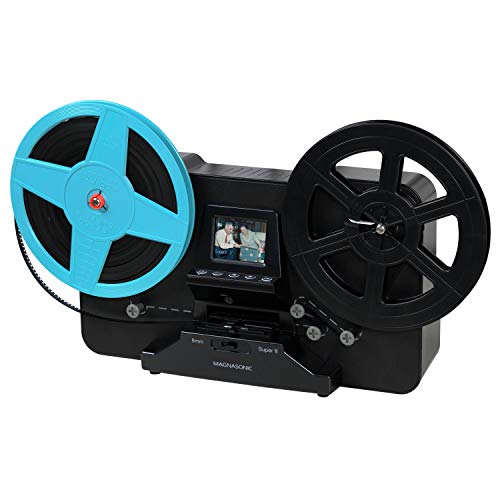
Best for: users who want multiple viewing options on a single device. The Magnasonic FS81 automatically digitizes 3″, 5″, and 7″ reels into digital MP4 files, with a built‑in 2.3” LCD screen for quick playback and an RCA TV output for larger viewing. It saves to an SD card (up to 32GB, not included). It does not explicitly state audio capture, so expect silent video. This makes it ideal for quick family viewing and archiving onto a local display.
USHNIH 8mm & Super 8 Film to Digital Converter (2.4″ Screen)

Best for: users who want a straightforward, frame‑by‑frame digitization experience on a compact device. It supports reels up to 9″ and records to a 32GB SD card (included). The 2.4” LCD provides on‑device control for exposure, brightness, and tint, with a simple transfer to SD. Limitation: frame‑by‑frame editing is limited to on‑device adjustments; complex edits require separate software or devices.
eyesen 8mm Reels to Digital MovieMaker Pro

Best for: users seeking a robust frame‑by‑frame digitizer with a built‑in screen and convenient SD card saving. The MovieMaker Pro supports 3″ to 9″ reels and outputs 1080P MP4 files. The device includes a 32GB card and emphasizes a stand‑alone workflow without a PC. Caution: like other standalone units, audio is not captured in the final video, so plan to add sound separately if needed.
Buying Guide
What to consider when selecting a Super 8 transfer device:
- Reel size compatibility: Ensure the device supports 3″, 5″, 7″, 8″, and 9″ reels if you have a mix of sizes.
- Stand‑alone operation: If you want no computer, verify that the unit saves directly to SD/SDHC cards and includes an internal display.
- Video resolution and format: Look for 1080p MP4 output for wide compatibility with modern TVs and devices; note whether audio is captured.
- Built‑in screen size: A larger screen eases framing and exposure adjustments during transfer.
- Storage: Check included card size and discuss whether you’ll need larger capacity for longer reels.
- Editing options: Some models offer basic frame‑by‑frame controls; others are more automated with fewer editing features.
- Ease of use: Flat‑out “plug and play” with simple prompts can reduce setup time for casual users.
Frequently Asked Questions
- Do these devices capture sound from film?
– Most standalone film digitizers record silent footage; if you need audio, you may need a separate source or later addition. - Can I transfer all reel sizes with a single device?
– Many models support 3″, 5″, 7″, and up to 9″ reels, but always confirm reel compatibility before purchase. - Is a computer required?
– Not for the listed standalone models; they save directly to SD cards and show playback on built‑in screens. - What formats are produced?
– The common output is MP4 (1080p) suitable for most devices and sharing platforms. - Do these devices preserve frame‑by‑frame quality?
– Several offer frame‑by‑frame scanning with adjustable exposure and color; results depend on sensor quality and film condition.