Best Slide Projector to Digital Scanners for Preserving Old Memories
Seeking an easy way to convert old slides and negatives into high-quality digital files? This guide compares top slide-to-digital scanners to help buyers choose the right option. The picks are best for different needs, including casual family history projects, archival digitization, and multi-format support. Each product section explains who it’s best for, plus practical trade-offs.
| Product | Best For | |
|---|---|---|
| KODAK Slide N SCAN | Casual collectors with 135/110/126 slides | Built-in 5” LCD for quick previews |
| Magnasonic All-in-One | Home archivists needing 24MP quality | HDMI output for big-screen viewing |
| DigitPro 22MP All-in-One | Budget-friendly multi-format scanning | Easy one-touch scanning |
| KODAK Slide N Scan Max | Fans of large view and gallery mode | Tiltable 7” LCD |
| HP Touch Screen Film & Slide Scanner | Interactive viewing with touch | 13MP sensor with 22MP interpolation |
KODAK Slide N SCAN Film & Slide Scanner Review

The KODAK Slide N SCAN is designed for users with 135, 110, and 126 film formats. It supports viewing and converting negatives and slides to digital JPEG files, saved to an SD card. The 5” LCD offers gallery-style previewing and a simple workflow that suits hobbyists who want a straightforward, all-in-one device. Choose this if you value a built-in display and easy loading trays for quick batch scanning.
Best for: casual memory keepers who want a single, self-contained scanner with quick previewing. Limitation: SD card storage is external (SD card not included), which may require an additional purchase to start scanning right away.
Magnasonic All-in-One 24MP Film Scanner

The Magnasonic scanner converts 35mm, 110, 126, and Super 8 film plus 135/126/110 slides into 24MP JPEGs. It includes a built-in 5″ LCD and supports HDMI output for viewing on a TV or monitor. This model is ideal for users who want high-resolution scans and the option to display outputs on a larger screen. It’s a solid pick for dedicated preservation projects in homes or small offices.
Best for: those prioritizing high-resolution outputs and a versatile viewing setup. Caution: HDMI output requires additional cables not included with the base package.
DigitPro All-in-One 22MP Film Scanner

The DigitPro scanner digitizes 35mm, 50mm slides, and other negatives with a 5” LCD display. It supports saving directly to built-in memory or an external SD card (up to 64GB) and emphasizes a simple, one-touch scanning workflow. This option fits buyers who want a compact, all-in-one device with a straightforward interface for large slide collections.
Best for: users seeking quick, uncomplicated digitization with a visible display. Caution: Built-in memory is modest, so larger libraries will rely on external storage.
KODAK Slide N Scan Max Digital Film Scanner

The Slide N Scan Max uses a 13MP sensor and a 7-inch tiltable LCD for easy previewing and editing. It supports a gallery mode to display memories like a digital photo frame, and its quick-feed tray speeds up scanning different slides and negatives. Best for: users who want a larger screen and flexible viewing angles. Caution: The tilting screen is a helpful feature, but may require adjustments for very small slides to avoid misalignment.
DigitPro 35mm Film & Slide Scanner With Feeder

The DigitPro 35mm scanner offers a fast slide feeder and supports 135 negatives and slides. It includes a 2.4” LCD for real-time preview and TV-out to view on a larger screen. The device is designed for users who need a compact, transportable option with a practical feeding mechanism. Best for: quick digitization of large 35mm slide collections. Caution: The 2.4” display is small for detailed editing on-device.
DIGITNOW! 135 Film Negative Scanner

The DIGITNOW model serves as a standalone, no-computer scanner for 35mm film and slides, offering a 1800DPI high-resolution output. It supports SD cards up to 32GB and includes a slide feeder for rapid batch processing. Best for: users who want a truly standalone device without computer software. Caution: Lower maximum card capacity may limit long projects without frequent card transfers.
HP Touch Screen Film & Slide Scanner
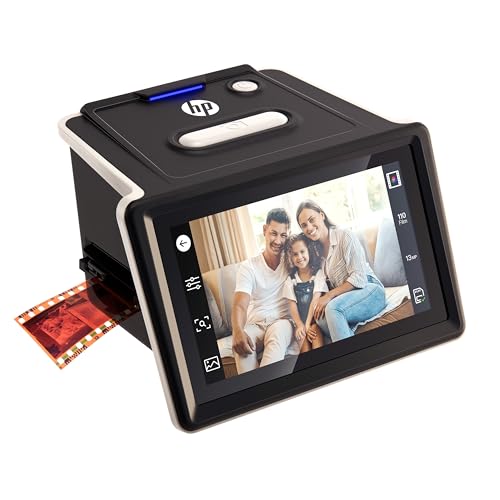
The HP scanner features a 5″ touchscreen, SD slot, USB-C, and a 13MP CMOS sensor with 22MP interpolation. It emphasizes interactive viewing and a gallery mode that doubles as a digital picture frame. Best for: buyers who want a user-friendly, touch-enabled experience with good upscaling. Caution: Interpolation can alter image originals; use when you need a larger display-ready version rather than strict archival fidelity.
DigitConvert 22MP Film & Slide Scanner

The DigitConvert scanner provides 22MP digital output for 135/110/126 negatives, 50mm slides, and Super 8 slides. It offers a built-in 128MB memory and supports SD cards up to 64GB. It features a 5” LCD with gallery mode for instant preview and playback. Best for: users who want versatile format support in a single device. Caution: Built-in memory is limited; plan for external storage for large libraries.
Buying Guide: How To Choose The Right Slide-To-Digital Device
- Format compatibility: Do you need to digitize 135, 110, 126, or Super 8 formats? Choose a model that supports your film types.
- Display and preview: A larger LCD or touch screen helps with framing and color adjustments before saving the file.
- Storage options: Consider internal memory versus SD/USB storage. External cards are essential for large collections.
- One-touch scanning vs. manual control: If you want speed, look for one-touch scanning; if you need precise color/brightness, seek devices with adjustable settings.
- Connectivity: HDMI output is useful for viewing on a TV, while USB-C or SD slots support quick transfer to a computer or cloud workflow.
- Ease of use: Standalone scanners require fewer software steps, while some models offer enhanced software for editing and resizing.
FAQ
- What is the practical difference between 22MP and 24MP scanners?
– Higher megapixel counts can capture more detail, useful for large prints, but the final quality also depends on sensor and lens quality. - Is an HDMI output necessary?
– Not strictly, but it helps when you want to view scans on a larger screen during editing or sharing. - Do I need a computer to use these devices?
– Many offer standalone scanning with internal memory or direct SD card saving; some require a computer for software editing. - Can I digitize Super 8 film with these scanners?
– Several models support Super 8, but verify format compatibility and any adapters needed before purchase. - What is gallery mode, and is it useful?
– Gallery mode displays scanned images like a digital photo frame, useful for quick sharing at home or in the office.