Best Slide and Print Scanners for Digitizing Old Photos and Negatives
Answering the need to turn old slides, negatives, and printed photos into accessible digital files, these slide and print scanners are designed for different kinds of users. This guide highlights five reliable options and explains who each is best for—whether you want a simple, standalone device for family memories or a feature-rich scanner for archiving large collections.
| Product | Brand | Best For |
|---|---|---|
| KODAK Slide N SCAN Film & Slide Scanner | KODAK | Casual users who want a 5” LCD for quick preview and easy SD storage |
| KODAK Slide N Scan Max Digital Film Scanner | KODAK | Users prioritizing a larger LCD and faster slide loading for ongoing archiving |
| Photo Scanner And Film Digitizer With 5” Screen | DigitPro | Families digitizing mixed media with no computer needed |
| ClearClick QuickConvert 2.0 | ClearClick | Portable, budget-friendly option needing minimal setup |
| HP Touch Screen Film & Slide Scanner | HP | Users wanting a 13 MP sensor and intuitive touchscreen workflow |
KODAK Slide N SCAN Film & Slide Scanner

The KODAK Slide N SCAN is a compact, standalone film scanner with a 5” LCD display. It supports 135, 126, and 110 film formats and 50mm slides, converting them to 22 MP JPEGs stored to an SD card (not included). This model is best for casual users who want immediate previews, simple editing, and a built-in gallery function for sharing memories. A potential limitation is the reliance on an SD card for file storage, which users must supply separately.
Best for: Light, on-the-go digitization of home slides and negatives without a computer. Why selected: It offers an all-in-one viewing, editing, and saving workflow with a user-friendly interface and direct HDMI/USB connectivity for easy display or transfer.
KODAK Slide N Scan Max Digital Film Scanner

The KODAK Slide N Scan Max offers a tiltable 7” LCD and a 13 MP sensor for high-quality previews and edits. Its quick-feed tray supports continuous scanning, which helps when digitizing larger slide collections. This choice suits users who want a larger, adjustable display and faster batch processing for archiving decades of film. Limitation: while it has a robust display, some users may still prefer a separate computer workflow for advanced edits.
Best for: Enthusiasts and small archive projects needing a bigger screen and smoother progress through long sessions. Why selected: It combines improved viewing with efficient loading, making it easier to manage sizable slide collections.
Photo Scanner And Film Digitizer With 5” Screen
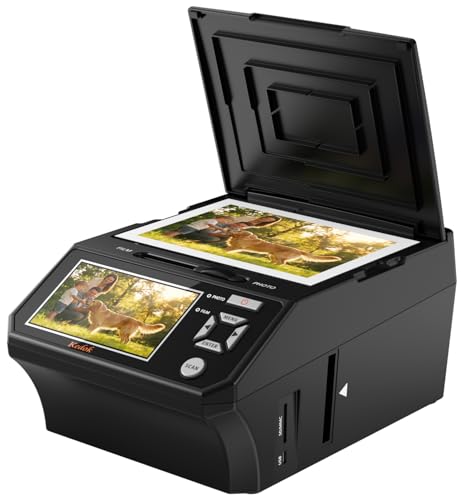
This DigitPro model is an all-in-one photo scanner designed for old pictures, including 35mm/135 and 110 negatives, slides, and prints. It’s a standalone device with a 5” LCD and a built-in memory option, making it ideal for households digitizing mixed media without a computer. Caution: Some users may prefer higher storage options for very large photo libraries since internal memory could be limited.
Best for: Families seeking a single, easy-to-use device to convert a range of old media. Why selected: It covers multiple formats (negatives, slides, prints) in one unit, simplifying the digitization workflow.
ClearClick QuickConvert 2.0 Photo, Slide, and Negative Scanner
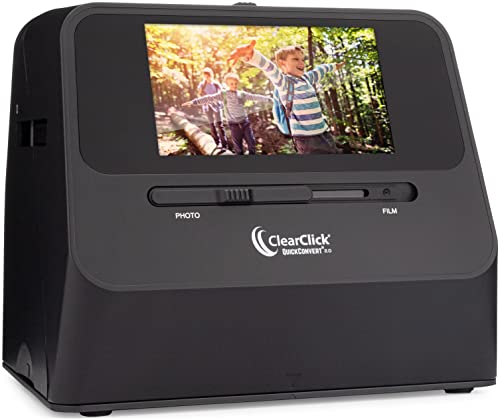
The ClearClick QuickConvert 2.0 emphasizes portability and quick scans. It scans one item at a time and stores JPEGs on an SD card, with a built-in rechargeable battery and a 5” LCD for instant previews. This option is best for on-the-go digitization or classrooms where a lightweight, no-computer approach is advantageous. Limitation: No auto-feeder means you must load items one by one, which slows large-scale projects.
Best for: Quick, single-item digitization away from a PC or power outlet. Why selected: It’s compact, easy to use, and requires minimal setup, making it ideal for spontaneous digitization sessions.
HP Touch Screen Film & Slide Scanner

The HP touchscreen scanner delivers a 13 MP sensor with a 7” or similar high-contrast display and convenient USB/HDMI connectivity. It emphasizes touch-based preview and editing, suitable for beginners and professionals who prefer a modern interface. Caution: As with many standalone scanners, larger archival projects may benefit from models with faster batch processing or larger storage options.
Best for: Users who want a modern, touchscreen workflow with clear previews. Why selected: It provides a clear, interactive interface for quick digitization and basic edits without a computer.
Buying Guide: Key Considerations For Slide And Print Scanners
- Media types supported: Confirm whether the model handles 35mm, 126, 110, and slides, as well as printed photos if you plan to digitize mixed media.
- Display size and quality: A larger LCD improves preview accuracy during scanning and editing; tiltable screens help with comfort and framing.
- Scan resolution and output: Look for devices offering 22 MP or higher JPEG outputs for sharp archival quality; check if interpolation is available for higher-than-native results.
- Standalone vs. computer-based: Standalone scanners work without a PC but may have limited editing; computer-connected models offer broader software options.
- Storage options: Are there built-in memories or SD card slots? Plan for sufficient storage or plan to transfer files regularly.
- Ease of use: One-touch scanning, feeder trays, and simple menus reduce learning time for casual users; more advanced users may want flexible color and exposure controls.
- Physical design and usability: Consider weight, tray design, and whether the device can handle bulk scanning without frequent jams or reloading.
Frequently Asked Questions
- What is the best scanner for 35mm slides?
– For balanced performance and a large display, models with 7” screens and quick-feed trays are strong choices, such as the Kodak Slide N Scan Max. - Do standalone scanners require a computer?
– No. Standalone models operate without a PC, saving scans directly to memory cards or internal storage. - Can I digitize printed photos with these scanners?
– Some models support prints (3R, 4R, 5R) in addition to slides and negatives; check the product features to confirm print support. - What file format is produced?
– JPEG is the common output; some devices offer simple editing and saving options directly on the device. - Are these scanners suitable for large archives?
– For very large collections, prioritize models with fast feeding, larger LCDs, and robust storage options to reduce manual handling time. - Is there a need to post-edit scanned images?
– Basic editing is available on many devices; advanced edits may require a computer and image software if you need precise color grading or restoration.