Best Security Cameras That Link to Your Phone for Easy Remote Viewing
Answering your search for cameras you can view on your phone, this guide highlights five reliable indoor and outdoor models. Each choice is explained for who it’s best for—whether you want pet monitoring, baby surveillance, or general home security. The following picks emphasize easy smartphone access, motion or sound alerts, and clear night vision. A quick summary table below helps compare key points at a glance.
| Product | Best For | Connectivity | Notes |
|---|---|---|---|
| TP-Link Tapo C100 | Families and pet households | 2.4 GHz Wi‑Fi | 2‑way audio, built‑in siren |
| blurams A31 2K | Rooms needing full coverage | Wi‑Fi 2.4/5 GHz, Alexa/Google | Auto tracking, AI detection |
| QUORVIXIA 4G LTE Solar | Remote locations with no Wi‑Fi | Cellular (SIM) | Solar powered, weatherproof |
| SEHMUA 4G LTE Solar | Off‑grid outdoor monitoring | Cellular (SIM) | Solar powered, 360° view |
| Techage 2K Indoor/Outdoor | Versatile, wired setups | 5G/2.4G Wi‑Fi | Color night vision option |
TP-Link Tapo 1080P Indoor Security Camera

The TP-Link Tapo C100 is a compact indoor camera designed for everyday home monitoring. It supports 2.4 GHz Wi‑Fi and sends instant push alerts when motion or sound is detected, useful for baby monitoring or pet surveillance without any monthly fee for basic usage. The device offers two‑way audio with a built‑in siren, making it suitable for calming a pet or signaling visitors remotely. Night vision reaches up to 30 feet for clear visibility in dark rooms. Best for: small apartment dwellers, parents wanting a simple baby monitor, and pet owners who want quick alerts. Limitation: no 5 GHz Wi‑Fi support, which can affect performance if your router operates on that band.
blurams 2K Indoor/Outdoor Camera (A31)

The blurams A31 2K camera delivers sharper indoor monitoring with full‑room coverage via 360° pan/tilt. It features AI detection that identifies motion, people, and sound without extra subscriptions, and it automatically tracks activity with short recording clips. This makes it well‑suited for families with multiple rooms or pet day‑to‑day monitoring. Best for: households needing comprehensive room coverage and AI-driven alerts. Better for: larger living areas and pet monitoring when you want quick automated tracking. Caution: as a 2K device, bandwidth use can be higher than 1080p models, depending on your network and storage plan.
QUORVIXIA No WiFi 4G LTE Solar Security Camera
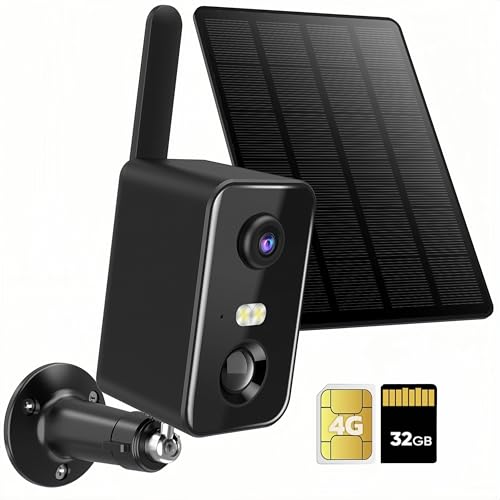
This model operates without WiFi or power outlets, using a built‑in SIM and a solar/battery setup. It’s designed for remote sites like farms, cabins, or driveways where traditional connectivity is unavailable. It includes a pre‑installed SIM with roaming across major networks and a 32GB storage card. Best for: off‑grid surveillance and locations with no electrical infrastructure. Choose this if you need continuous monitoring without network dependency. Limitation: requires cellular service and a data plan after any included trial, and solar performance depends on sunlight availability.
SEHMUA 4G LTE Solar Wireless Security Camera

The SEHMUA 4G LTE solar camera provides true wireless operation with a built‑in SIM and a solar panel for continuous use in outdoor spaces. It supports 360° live view and two‑way talk for real‑time interaction with visitors or family members. Best for: outdoor installations in locations with weak or no WiFi, like barns or remote properties. Choosing this device makes sense when you need a self‑contained security solution that isn’t tied to a power outlet. Limitation: requires 4G coverage and may incur data plans after a trial period.
Techage 2K Security Camera for Indoor/Outdoor

The Techage K07‑4P offers a 2K resolution with dual‑band WiFi (5G/2.4G) and indoor/outdoor versatility. It supports local recording and works with major smart home ecosystems like Alexa. It’s ideal for buyers who want higher resolution footage and flexible installation, whether indoors or outdoors. Best for: homes needing higher clarity than 1080p and a wired/dual‑band option to reduce network congestion. Caution: the camera requires continuous power for outdoor operation and network reliability is essential for 24/7 recording.
Buying Guide: Key Purchase Considerations
- Where will you place the camera? Indoor cameras are fine for living spaces and baby rooms, while outdoor models require weatherproof ratings and robust power options.
- How will you connect? Wi‑Fi cameras need a stable 2.4 GHz network; 5 GHz can offer faster performance but not all models support it. Cellular (4G/5G) options work where Wi‑Fi isn’t available.
- Storage and access. Decide between local storage (SD card) and cloud storage, and verify compatibility with your phone’s app and your preferred ecosystem (Alexa/Google Home).
- Video quality. Higher resolution (2K) gives clearer detail but consumes more bandwidth and storage. Consider your internet plan and drive space if using cloud storage.
- Power and maintenance. Battery or solar cameras offer true wireless operation but may require more frequent charging or solar exposure. Wired cameras provide constant power but need outlet access.
Frequently Asked Questions
- Can I view these cameras on my phone without a subscription?
Yes. Several models offer basic motion alerts and live viewing without paid plans, though advanced features may require cloud storage or AI services. - Is 2K or 1080p resolution better for home security?
2K provides more detail, which helps with identifying faces or license plates, but it uses more bandwidth and storage than 1080p. - Do these cameras work with both Alexa and Google Assistant?
Many listed models support both, enabling voice control and integration with smart home routines. - What’s the difference between indoor and outdoor cameras in terms of durability?
Outdoor cameras have weatherproof ratings and are designed to withstand rain, sun, and temperature changes; indoor cameras focus on compact placement and aesthetics. - Are cellular cameras truly wire-free?
Cellular cameras operate without WiFi or power cords, relying on SIM cards and batteries or solar panels, suitable for remote sites.