Best Professional Sports Photography Lenses for 2026
Choosing the right telephoto and zoom lenses is essential for capturing fast action, distant athletes, and dynamic sports moments. This guide highlights five prime options that suit professional workflows, from wildlife and outdoor action to stadium sports. Each lens offers strong image stabilization, fast focusing, and versatile focal ranges to help photographers stay on target during fast-paced events.
| Product | Focal Range | Mount | Key Benefit |
|---|---|---|---|
| Canon RF200-800mm F6.3-9 IS USM | 200–800mm | Canon RF | Extreme reach with lightweight handling |
| Canon RF70-200mm F2.8 L IS USM | 70–200mm | Canon RF | Bright, fast aperture for low light |
| Canon RF 75-300mm F4-5.6 | 75–300mm | Canon RF | Compact telephoto versatility |
| Canon RF70-200mm F4 L IS USM | 70–200mm | Canon RF | Lightweight L-series option with IS |
| Sigma 150-600mm f/5-6.3 Sports DG OS HSM | 150–600mm | Sony/Canon options | Ultra-tele reach with OS |
Canon RF200-800mm F6.3-9 IS USM: World-First Telephoto Zoom

The Canon RF200-800mm F6.3-9 IS USM combines a remarkable 200–800mm zoom range with in-lens image stabilization and fast autofocus, making it suitable for wildlife and extreme sports where distance and speed matter. Its lightweight design supports handheld shooting during long sessions, while compatibility with extenders RF1.4x and RF2x helps extend reach without swapping lenses.
Key features
- Telephoto zoom from 200mm to 800mm for flexible framing
- In-lens image stabilization to support handheld shooting
- Compatibility with RF extenders for extra reach
Canon RF70-200mm F2.8 L IS USM

This high-end telephoto zoom delivers exceptional image quality with a bright constant f/2.8 aperture, ideal for indoor arenas or fast-moving outdoor sports where light can vary. The RF70-200mm f/2.8 L IS USM is compact enough for on-the-field use, and its optical stabilization provides up to five stops of shake correction, helping maintain sharpness across challenging action sequences.
Key features
- Constant f/2.8 for low-light action
- Optical image stabilization up to ~5 stops
- Sharp Canon L-series optics with fast autofocus
Canon RF 75-300mm F4-5.6: Versatile Telephoto Zoom
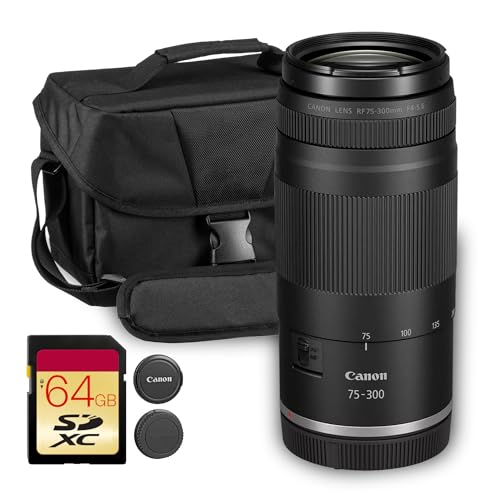
The RF 75-300mm f/4-5.6 offers a compact, affordable telephoto option for Canon RF-mount cameras. Its range is well-suited for outdoor practices, sideline coverage, and travel photography where size and weight matter. The design prioritizes portability while maintaining image quality across the zoom span, making it a practical choice for freelance shooters and teams on a budget.
Key features
- Versatile 75-300mm range for sports and wildlife
- Lightweight and travel-friendly
- Balanced performance with consistent rendering
Canon RF70-200mm F4 L IS USM

The RF 70-200mm f/4 L IS USM blends portability with professional-grade optics. Its fixed f/4 aperture maintains consistent exposure across the zoom range, while L-series construction and ASC coatings minimize flare and deliver high-contrast results in bright stadium lighting or backlit action. A reliable choice for photographers who need a lighter, travel-friendly telephoto on event days.
Key features
- Constant f/4 aperture across the range
- Lightweight L-series design with IS
- High-contrast rendering with reduced flare
Sigma 150-600mm f/5-6.3 Sports DG OS HSM (Canon)

The Sigma 150-600mm f/5-6.3 Sports DG OS HSM offers ultra-tele reach with Optical Stabilization (OS) for handheld shooting at long distances. It’s designed for sports, wildlife, and aviation photography, providing extended reach when you cannot get physically close to the action. The lens also employs Hyper Sonic Motor (HSM) for fast, quiet autofocus, helpful in capturing decisive moment shots during fast-paced events.
Key features
- Long reach for distant subjects
- OS stabilization for handheld shooting
- Quiet, fast AF with HSM
Sigma 150-600mm for Canon Included
Note: This listing showcases a high-zoom option for professional sports and wildlife shooters. It’s designed to complement Canon bodies with a robust optical system and proven stabilization to improve handheld performance in challenging lighting and action-packed scenes.
Buying Guide: Key Purchase Considerations
When selecting lenses for professional sports photography, several factors influence performance and value. The following perspectives help clarify how to choose among telephotos and super-telephotos:
- Reach vs. weight: Longer lenses reach distant action but add weight. Balance your carry-ons and on-field handling with stabilization systems to maintain sharpness.
- Aperture and light: Faster apertures (e.g., f/2.8 or f/4) improve subject isolation and shutter performance in indoor or overcast environments. Consider budget-friendly options like f/4 lenses for travel and versatility.
- Stabilization and IS: In-lens stabilization supports handheld shooting at long focal lengths. Evaluate the stability stops offered by each lens and how it helps with panning and tracking.
- Autofocus performance: Sports demand rapid, accurate AF. Lenses with advanced AF motors (USM, Nano USM, HSM) minimize focus hunting during fast actions.
- System compatibility: Ensure mount compatibility with your camera body. Some lenses are optimized for Canon RF systems, while others may offer adapters for different brands.
- Durability and weather sealing: Outdoor sports may expose gear to dust, moisture, and varying temperatures. L-series or pro-grade construction tends to be more durable for daily use.
- Budget and portfolio: A mix of mid-range and premium lenses can cover a wide range of sports scenarios—from indoor arenas to open fields—without overspending on gear that rarely gets used.
Professional shooters often value a combination of fast aperture, long reach, and reliable stabilization. For those who require extreme reach without sacrificing handheld usability, super-telephoto zooms like the 200–800mm options offer flexibility, while 70–200mm zooms provide fast performance in closer action and lower-light venues. Pairing these lenses with quality bodies, well-planned shooting strategies, and proper stabilization accessories will help photographers capture decisive moments across diverse sports environments.