Best Professional Camera Flash Units for Creators and Pros
In modern photography, a reliable flash unit is essential for shaping light, controlling shadows, and capturing sharp moments in challenging environments. The following professional camera flash units cover a range of capabilities from manual control to versatile wireless systems, ensuring you can light scenes precisely for portraits, events, or studio shoots. This guide highlights five top options, with practical insights into their features and how they fit different shooting styles.
| Product | Brand | Key Benefit |
|---|---|---|
| NEEWER TT560 Camera Flash | NEEWER | Budget-friendly manual power with flexible off-camera use |
| Canon Speedlite EL-10 | Canon | Portable, compatible with EOS R system and multi-unit control |
| PHOTOOLEX Camera Flash | PHOTOOLEX | Manual control with S1/S2 modes for off-camera lighting |
| Godox IT32 | GODOX | Universal system with X5 module for hotshoe and wireless triggering |
| Powerextra DF-400 | Powerextra | Multi-brand compatibility with PC port and manual modes |
NEEWER TT560 Speedlight
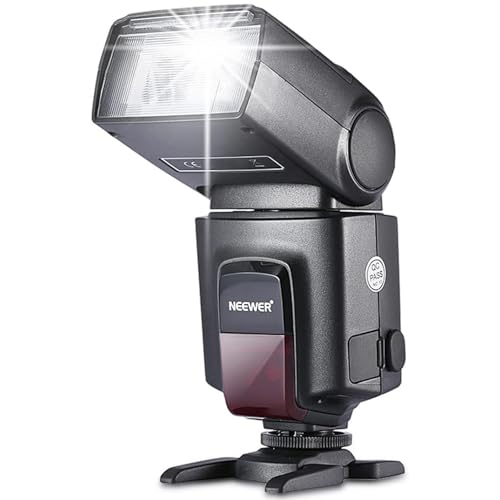
The NEEWER TT560 is a compact, manual-only speedlite designed for hands-on lighting control. It provides a GN38 guide number at ISO 100, with eight power levels from 1/128 to 1/1, delivering stable 5600K daylight color. It lacks TTL, high-speed sync (HSS), and built-in camera menu control, making it a straightforward option for studio setups or on-location shoots where consistent output is essential. Recycle times range from 0.1 to 5 seconds, and flash duration spans from 1/300 to 1/20000 seconds, enabling quick bursts for events or action. The TT560 includes S1/S2 optical modes for off-camera triggering and a PC sync port for wired control. Its head rotates 0–90 degrees vertically and 0–270 degrees horizontally, offering flexible lighting angles for portraits and product photography.
Canon Speedlite EL-10

The Canon Speedlite EL-10 is a mid-range portable flash designed to complement select EOS R-series mirrorless cameras. It serves photographers looking to expand creative lighting capabilities while maintaining a compact form. The EL-10 offers communication features to control up to 15 additional compatible Speedlites, enabling streamlined multi-light setups for portraits, events, and creative studio work. This model sits between entry-level and high-end offerings, making it suitable for photographers seeking reliable performance without the bulk of larger units.
PHOTOOLEX Camera Flash

The PHOTOOLEX flash emphasizes solidity and consistent color temperature at 5500K±200K. It offers manual mode, S1 and S2 light-induced modes for off-camera synchronization, and a Multi Flash mode to set output power and flash frequency. The device supports a range from 1/128 to 1/64 and beyond, giving photographers control for evenly lit portraits and product shots. Note that TTL and camera menu control are not supported, which suits creators who prefer predictable, repeatable lighting with a dedicated off-camera workflow.
Godox IT32 with X5 Trigger

The Godox IT32 TTL camera flash pairs with the X5 trigger for a versatile, cross-brand lighting system. The X5 module functions as both a hotshoe and a wireless transmitter, enabling seamless on-camera and off-camera operation. Its interchangeable magnetic X5 hotshoe allows quick brand-switching, while the built-in 2.4GHz system supports fast, reliable multi-light setups. This configuration is ideal for photographers who work across bodies and brands, requiring a scalable solution for studio and on-location shoots with consistent color and exposure control.
Powerextra DF-400 Speedlite

The Powerextra DF-400 offers broad compatibility with Canon, Nikon, Panasonic, Olympus, Pentax, Fuji, and Sony cameras with a Mi hot shoe. It features eight discrete power levels and a GN of 33 (ISO 100, 1 m), plus S1 and S2 wireless modes for off-camera triggering. A PC port provides wired synchronization, and vertical and horizontal rotation angles (0–90° and 0–270° respectively) support versatile lighting angles for portraits, product photography, and event coverage. Certain camera models are explicitly listed as not compatible, so verifying your camera’s hot shoe type is recommended before purchase.
Buying Guide: Key Considerations for Professional Flash Units
- Power and exposure control: For studio and event work, a flash unit with adjustable power (manual or TTL) and a clear guide number ensures consistent results across subjects and distances.
- Lighting modes: Manual, S1, and S2 modes offer flexibility for off-camera lighting. S1 follows the main flash, while S2 is synchronized with TTL, useful for multi-light setups and creative effects.
- Off-camera capability: A reliable optical slave or wireless triggering system reduces friction when building light setups with multiple units.
- Color temperature stability: A consistent 5500K daylight balance minimizes post-processing and ensures uniform color across lights.
- Rotation and positioning: A flexible head (vertical and horizontal rotation) enables precise angle adjustments for portraits, product photography, and dynamic scenes.
- Compatibility and ecosystem: Some brands offer universal hotshoe solutions or cross-brand compatibility via wireless triggers. Consider whether you want a single ecosystem or cross-brand flexibility.
- Durability and battery life: Recycle times, flash duration, and battery life influence throughput during shoots—especially in weddings or events.
- Portability vs. power: Lighter units are easier to move, but larger units deliver more powerful, consistent light—balance by use case.
- Future-proofing: Wireless X or multi-unit control capabilities can simplify expansion as your lighting needs grow.
How to Choose: Practical Scenarios
- Portrait sessions: Look for a unit with reliable manual power control, a rotatable head, and compatibility with off-camera triggers to shape light at different angles.
- Event and wedding photography: Multi-light compatibility and quick recycle times are crucial for capturing spontaneous moments and group shots.
- Small studios: Consider a system that supports on-camera and off-camera modes with easy integration into a broader lighting rig.
- Budget-conscious setups: Manual-only speedlites with solid build quality and predictable output can deliver professional results without high costs.