Best Film to Digital Scanners for Converting Negatives to Digital Photos
Answering the question “print negatives to digital” with clear options, this guide highlights five reliable film-to-digital scanners ideal for American buyers. These devices are best for different user types: casual hobbyists digitizing family archives, small-home archivists with large slide collections, and seniors or tech-averse users who want a simple stand-alone process. Below, compare each model’s strengths, what makes them stand out, and practical limits to consider before purchase.
| Product | Key Benefit | Best For | Limit |
|---|---|---|---|
| KODAK Slide N SCAN | 5” LCD, 22MP JPEG outputs, broad film compatibility | Families with mixed slide/negative collections | Requires SD card (not included) |
| DigitPro Photo Scanner (5” LCD, 22MP) | Standalone operation with one‑touch simplicity | Non-technical users digitizing old photos and slides | Internal storage small; external card recommended |
| DigitPro Film And Slide Scanner (5” LCD) | All-in-one for 35mm, 126, 110, and slides | Large vintage collections | Memory expansion needed for many scans |
| DigitConvert 22MP All-in-One | Versatile for 35mm, 135/4R prints, and slides | Multi-format archives and quick scans | Requires SD card or internal memory for storage |
| Portta Film Scanner with 5” LCD | 15–22MP options, HDMI output, no PC required | Home movie and archival projects with HDMI viewing | May require external storage for large libraries |
KODAK Slide N SCAN Film & Slide Scanner

The KODAK Slide N SCAN is a stand-alone film and slide digitizer that supports 135, 126, and 110 formats with a built-in 5” LCD for on-device viewing. It outputs 22MP JPEGs and saves to a memory card (SD card not included). This model is best for buyers who want a simple, all-in-one solution that preserves family memories without a computer. Its quick-load tray and included adapters for various film formats speed up processing. A limitation is the need to provide your own SD storage, which adds one more purchase if you do not already own cards.
Who this is best for: casual photographers and families with mixed film formats who want a straightforward, self-contained scanning workflow. It’s also suitable for users who value an immediate gallery-style preview on a large LCD before saving files.
DigitPro Photo Scanner With 5” Screen
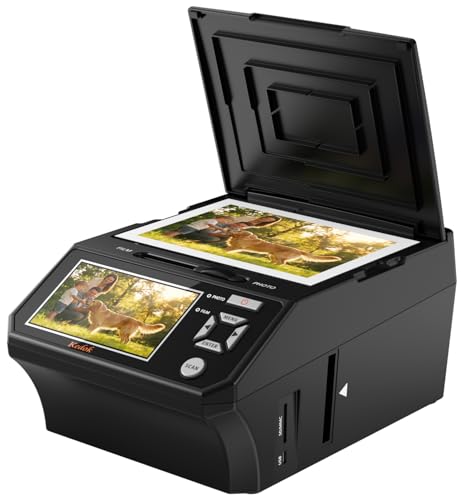
This all-in-one scanner digitizes 35mm slides, 135 and 110 negatives, and printed photos. It features a large 5” LCD for instant previews and simple “One-Touch” scanning, eliminating tricky software. The device stores images on its internal memory or accepts an SD card (8GB-64GB range as listed in features). It’s ideal for parents and grandparents who want a fast, understandable path from film to digital without a computer. A potential limitation is the reliance on built-in storage, which can fill up with large batches of scans.
Who this is best for: non-technical users who prefer a standalone unit and quick results for small-to-medium archives. Choose this if you want a no-fuss, all-in-one conversion workflow.
DigitPro Film And Slide Scanner 35mm, 126, 110

This DigitalPro model emphasizes versatility, supporting 35mm, 126, 110 negatives, and slides, with a 5” LCD for live preview. It features a fast loading slide feeder to speed up large digitization projects and outputs to a built-in memory card or external SD card (up to 64GB; format noted in features). It’s best for users who have a mixed-format archive and want a single device to handle multiple film types. A limitation is that expanding storage is often necessary for large collections.
Who this is best for: archivists digitizing diverse old slides and negatives; users who value speed and a dedicated stand-alone workflow, without a computer dependency.
35mm Film & Slide Scanner with 2.4″ LCD

This DigitPro model is a compact standalone scanner designed specifically for 35mm negatives and slides. It provides a 2.4” LCD for immediate viewing and a USB transfer option, making it simple to convert to JPEGs without a computer. It supports 135 negatives and slides and includes a quick slide feeder for faster batch processing. The smaller display reduces preview accuracy compared to larger 5” screens, which could affect precise color and framing decisions during scanning.
Who this is best for: users with compact storage needs or those who want a budget-friendly, portable 35mm-focused solution. Choose this if you primarily digitize a limited number of 35mm slides and want a smaller device.
22MP All-in-One Scanner With 2.4” LCD

This DigitConvert unit offers 22MP output for 35mm negatives and slides and also handles printed photos up to 5×7 inches and business cards. It operates standalone, saving scans to internal memory or an SD card (up to 4GB internal, 4GB SD card included in some listings). It’s a strong choice for multi-format archiving, especially if you want to digitize both film and print photos in one workflow. A limitation: the included memory may be modest for very large libraries; plan for external storage if needed.
Who this is best for: families with a mix of film and print photos who want a single device to digitize multiple media types efficiently.
PORTTA Film Scanner With 5″ LCD

The Portta model emphasizes flexibility with multiple formats (135, 126, 110, and Super 8 photo scans) and an optional HDMI output for viewing on a larger screen. It provides a choice between 16MP and 22MP outputs and supports SD storage. This makes it suitable for home archiving projects that require higher resolution scans and a direct connection to a TV or monitor. A limitation is the potential need for additional storage capacity for extensive archives, as HDMI viewing doesn’t increase storage on its own.
Who this is best for: users who want high-resolution scans with easy viewing on a bigger screen and a PC-free workflow, especially for larger slide collections.
Buying Guide
Key questions to guide your purchase:
- What formats will you digitize most often? If your archive mixes 35mm negatives, slides, and prints, a multi-format scanner like DigitConvert or Portta is advantageous.
- Do you prefer standalone operation or a computer-based workflow? Standalone units offer simplicity but may have limited storage; computers enable larger libraries but add software steps.
- How large is your library? Consider the number of photos and slides. Devices with expandable SD storage or larger internal memory are better for big archives.
- Is a built-in LCD display important? A larger screen (5”) aids preview accuracy and editing before saving, especially for color and exposure checks.
- How important is output resolution? For high-quality prints or archival quality, aim for 22MP outputs or higher when available.
FAQ
- Do these scanners require a computer to work? Most options shown are standalone, but some can transfer images to a computer via USB or HDMI when connected.
- Can I scan both slides and negatives with one device? Yes, several models support multiple formats including 35mm, 126, and 110 slides/negatives.
- What storage should I plan for large libraries? An SD card with ample capacity (64GB or more) or external hard drive backups help manage large archives.
- Is 22MP output enough for older slides? For most home archiving and prints up to large sizes, 22MP provides detailed images suitable for sharing and printing.
- Are there any compatibility concerns? Check whether your film type (color, B&W, slide thickness) is supported and whether adapters are included for your film formats.
- What maintenance is needed? Regular cleaning of glass, keeping trays dust-free, and updating any optional firmware when available can improve results.