Best Photo Storage Devices With Screen for Easy Family Sharing
Looking for a photo storage device with a screen to display memories beautifully at a glance? This guide highlights five top options that suit different needs—from large-frame displays for shared living rooms to compact, portable drives for on-the-go backups. The frames are best for households and seniors who want effortless viewing with family sharing via apps; the drives and sticks are better for those who prioritize large capacity, quick backups, and multi-platform compatibility. Below is a quick summary to compare at a glance.
| Product | Type | Best For | Key Benefit |
|---|---|---|---|
| 64GB 15.6″ Frameo Digital Picture Frame | Digital Frame | Families wanting remote photo sharing | Large IPS touchscreen, Frameo app connectivity |
| 32GB FRAMEO 10.1″ Smart WiFi Digital Photo Frame | Digital Frame | Compact living spaces | Built-in memory, easy sharing via Frameo |
| Digital Picture Frame, 10.1″ AiMOR / Linkdaze | Digital Frame | Budget-friendly living room display | IPS touchscreen, SD expansion, intuitive controls |
| NEWQ 2TB External Hard Drive for iPhone | External Storage | Large-capacity backups | One-click backup, USB-C & Lightning compatibility |
| ThePhotoStick Omni 128GB | Backup Drive / USB Thumb | Cross-device photo backup | Automatic backup across devices |
64GB 15.6″ Frameo Digital Picture Frame

Best for: Families and grandparents who want secure, private sharing of photos and videos from anywhere. The Frameo app enables invitations to relatives, enabling remote uploads up to 15 seconds per item. Its 15.6-inch IPS Full HD touch screen delivers vivid colors and broad viewing angles for group viewing. Memory is generous with 64GB onboard and expandable through SD cards or USB drives, although some users may need to format media to FAT32 for compatibility. This frame is recommended for users who prioritize private sharing and a large, interactive display in a common room.
Key features: 15.6″ IPS Full HD display, 178° viewing angle, touch screen, supports JPG/JPEG/BMP/PNG and MP4, built-in 64GB with expandability. Notes: Frameo works best on 2.4GHz Wi‑Fi; USB/SD expansion can require local media compatibility and formatting. Best for: households seeking a private family gallery with easy remote contributions.
Caution: The USB port supports USB flash drives only; it does not transfer photos from a computer directly. Use FAT32-formatted media for compatibility.
32GB FRAMEO 10.1 Inch Smart WiFi Digital Photo Frame
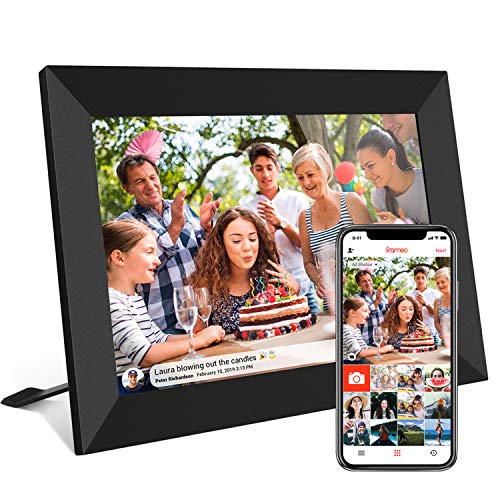
Best for: Small apartments or desks where a compact frame is preferred. This 10.1-inch frame offers built-in 32GB memory and Frameo app support to share moments privately from anywhere. It supports Mirco SD for extra capacity and imports/exports pictures or videos as needed. It’s a solid pick for single-occupancy spaces or as a gift for someone who wants quick setup and simple sharing.
Key features: 10.1″ IPS display, 1280×800 resolution, touch screen, 32GB internal memory, Frameo app; supports image formats JPG/JPEG/BMP/PNG and MP4. Best for: buyers who want a affordable, easy-to-use WiFi frame with expandable storage via Micro SD.
Caution: The frame relies on Frameo for sharing; offline media transfer may require initial setup and compatibility checks for SD expansion.
Digital Picture Frame, 10.1″ AiMOR / Linkdaze Frame

Best for: Viewers who want a shared gallery with easy AiMOR app integration and auto-rotation. This 10.1-inch frame includes a built-in 32GB memory and supports a Micro SD card for additional storage. It emphasizes portrait/landscape flexibility, weather, and clock displays. The frame is suited for family rooms and office spaces where quick sharing from multiple devices is valued.
Key features: 10.1″ IPS HD touch screen, 1280×800, supports JPG/JPEG/BMP/PNG and MP4, auto-rotate, 32GB memory, Micro SD compatibility. Best for: users who want a flexible, user-friendly frame with broad media support.
Caution: Photos or videos cannot play directly from SD cards; they must be imported into the frame’s storage first.
NEWQ 2TB External Hard Drive for iPhone

Best for: Users who need a high-capacity backup option for iPhone and other devices without relying on the cloud. It supports USB-C and Lightning, enabling straightforward backups with a simple app. This external drive is ideal for long-term photo storage and migration when devices change. It can also serve as a plug-and-play drive for Windows or Mac.
Key features: 2TB capacity, one-click backup, cross-device compatibility (USB-C, Lightning, Android, PC, Mac), offline transmission. Limitations: Backup efficiency depends on the companion app and device support; some older devices may require app updates.
ThePhotoStick Omni 128GB

Best for: People who want automatic backup across multiple devices and a single portable solution. The PhotoStick Omni automatically detects and saves photos and videos, facilitating organized backups without manual file handling. It’s compatible with most PCs, Macs, iPhones, iPads, and Android devices, making it a versatile cross-platform option.
Key features: 128GB capacity, automatic backup, multi-device compatibility. Caution: Automatic backup may duplicate files; users may need to organize duplicates afterward.
Buying Guide: How to Choose A Photo Storage Device With Screen
- Screen size and resolution: For living rooms or desks, larger frames (around 10–15.6 inches) provide a more immersive viewing experience. Look for IPS panels for wide viewing angles and accurate colors.
- Private sharing vs. cloud reliance: Frameo-based frames offer private, direct sharing without cloud exposure. If privacy is a concern, prefer frames with offline storage and local sharing options.
- Storage capacity and expandability: If you have thousands of photos, choose frames with large internal memory and SD/USB expansion. For backups, external drives with high capacity (2TB+) are preferable.
- Connectivity and ecosystem: Check Wi‑Fi compatibility (2.4GHz usually), app availability on iOS/Android, and whether the device supports cross-device sharing or needs a proprietary app.
- Media format support: Ensure the device handles common formats (JPG/JPEG, PNG, BMP, MP4). Note any restrictions on file types or durations for videos.
- Portability vs. permanence: Frames stay in one place for family viewing; USB drives and sticks are portable and useful for on-the-go backups or transfers.
- Ease of use: Look for touch controls, auto-rotate, weather/clock displays, and simple backup options. Consider whether you need auto-transfer from phones or only manual uploads.
Frequently Asked Questions
- What is the difference between a photo frame with a screen and a standard storage drive?
– A frame with a screen displays photos and videos directly on the device, often with built-in Wi‑Fi and an app for sharing. A standard storage drive stores files and requires a device to view the media. - Do Frameo frames require cloud accounts?
– Frameo frames typically use a private app-based sharing approach that does not force cloud storage, though internet access is needed for remote sharing. - Can I expand the memory of a digital photo frame?
– Many frames support SD cards or USB drives to expand storage, but compatibility (FAT32 format, drive type) varies by model. - Are external drives safe for photo backups?
– External drives provide physical backups and can be used offline, reducing dependence on cloud services. Regular backups and secure storage practices are recommended. - Which option is best for multi-device families?
– Frames with built-in Wi‑Fi and Frameo or AiMOR sharing apps work well for remote family contributions, while external drives are better for offline, cross-device archiving. - What should I consider when choosing between a large-frame display and a small-frame option?
– Consider viewing space, intended room use, and whether you want a shared display or a compact device for personal viewing and limited transfers.