Best Photo and Negative Scanners With Feeder for Easy Digitizing
Answers for buyers seeking a standalone photo and negative scanner with a feeder. These devices convert 35mm, 110, 126 negatives, slides, and printed photos into digital files, often without a computer. They’re ideal for preserving family memories and for hands-off scanning. The top picks below balance large built-in screens, fast one‑touch scanning, and convenient memory options. Each product is suited to different needs, from casual home use to relatives who want a simple, all-in-one solution.
Quick product overview for quick decisions:
- DigitPro Photo Scanner and Film Digitizer with 5” Screen — best for large-screen viewing and all-in-one scanning without a computer.
- Plustek Photo Scanner ePhoto Z300 — best for fast batch digitizing of standard photo sizes with good desk space efficiency.
- KODAK Slide N SCAN — best for easy viewing on a 5” LCD with gallery mode and convenient slide/dip loading.
- KODAK Slide N Scan Max — best for a larger display and quick-feed tray for frequent slide digitization.
- Epson FastFoto FF-680W — best for high-speed batch scanning of large photo collections.
DigitPro Photo Scanner And Film Digitizer With 5” Screen
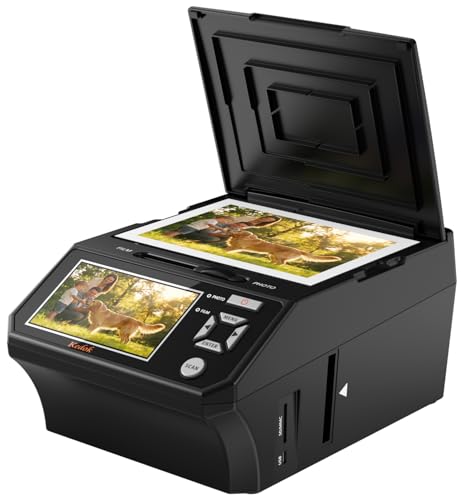
This all-in-one scanner handles 35mm slides, 135 & 110 negatives, and printed photos, plus business cards. The 5-inch LCD lets users preview results without a computer. Best for households that want a single device for various formats and easy, stand-alone operation. The built-in memory supports quick captures, and the absence of software requirements reduces setup friction.
Who this is best for: families digitizing mixed media and seniors who prefer a straightforward, screen-focused workflow. Limitation: may require larger storage or SD card for extensive collections.
Plustek Photo Scanner ePhoto Z300

Designed for speed, the ePhoto Z300 scans 4×6 photos in about 2 seconds and supports 3×5 to 8×10 sizes, plus document sizes. It’s a good choice for families with large photo archives who want fast batch digitization and simple, card-based storage. It’s more efficient than a flatbed for frequent photo scanning, and supports Mac and PC for flexible use.
Who this is best for: households with many 4×6 and standard photo prints that want quick conversion to digital files. Limitation: optical resolution up to 600 dpi, which may be lower than some higher-end flatbeds.
KODAK Slide N SCAN Film & Slide Scanner

This model emphasizes a 5” LCD with gallery mode for quick previews and sharing. It supports 135, 110, and 126 film formats, plus 50mm slides. Includes adapters and a slide holder, making it a solid all‑in‑one option for nostalgic slide collections. Best for those who want a visible, gallery-like preview before saving files.
Who this is best for: users who prioritize a large viewing area and straightforward loading. Limitation: not as fast as some high-volume feeders for extensive archives.
KODAK Slide N Scan Max Digital Film Scanner

The 7-inch tiltable LCD and quick-feed tray simplify the process of converting negatives and slides. It handles color and black & white 135, 110, and 126 formats, with a dedicated tray for rapid feeding. Gallery-style display helps with quick editing or sharing.
Who this is best for: users who digitize large slide collections and want a larger screen with efficient loading. Limitation: may be bulkier than other compact models.
Epson FastFoto FF-680W

High-speed personal photo scanner designed for large batches. It can scan thousands of photos at up to one per second at 300 dpi and batch-scan up to 36 photos at a time. It’s ideal for extensive photo archives and provides app-based sharing features for added context when preserving memories.
Who this is best for: households with long-term digitization goals and a need to process many photos quickly. Limitation: some users may prefer lower-cost options for smaller projects.
Buying Guide
What should you consider when choosing a photo and negative scanner with a feeder?
- Scan formats supported: Look for support for 35mm, 110, 126 film, slides, and printed photos to cover your collection.
- Screen size and preview: A larger LCD helps preview results before saving, reducing re-scans and edits.
- One-touch vs. manual controls: A single-button workflow speeds up digitization for casual users.
- Memory and storage: Check internal memory and SD card compatibility to store files locally.
- Connectivity: Standalone devices are convenient, but some models offer PC/Mac integration for flexibility.
- Speed and batch support: If you have many photos, prioritize models with fast per-photo scanning and batch loading.
- Quality vs. convenience: Higher resolution yields sharper images but may require more storage and time.
Practical considerations
- Size and footprint: Some scanners are compact; others include larger displays and trays. Choose based on workspace availability.
- Software requirements: Standalone models reduce setup headaches; software-enabled scanners may offer extra editing features.
- Future-proofing: An SD card with FAT32/EXFAT support extends compatibility for file transfers.
Comparison snapshot
| Model | Best For | Key Benefit | Limitation |
|---|---|---|---|
| DigitPro 5” Screen | All formats, no PC | Large LCD, versatile formats | May require SD upgrades for big libraries |
| Plustek ePhoto Z300 | Fast photo batches | 2s for 4×6, 600 dpi | Lower dpi than premium flatbeds |
| KODAK Slide N SCAN | Slides and negatives | 5” LCD, gallery mode | Moderate speed for large collections |
| KODAK Slide N Scan Max | Frequent slide digitizing | 7” tiltable LCD, quick-feeder | Bulkier footprint |
| Epson FastFoto FF-680W | Large archives | High-speed batch scanning | Higher price point |
FAQ
How does a feeder scanner differ from a flatbed scanner?
Feeder scanners streamline continuous input for photos, negatives, and slides, reducing manual handling and increasing speed for large archives compared with flatbeds that require individual placement for each item.
Can these scanners save directly to an SD card?
Many models offer direct save to built-in memory or an SD card. Verify card compatibility and maximum capacity before purchase to ensure enough space for your library.
Are standalone scanners easier for non-tech users?
Yes. Standalone scanners minimize software installation and driver issues, providing a simple “one‑touch” workflow suitable for non-technical users.
What resolution should I expect when digitizing slides?
Resolutions vary by model. Some offer up to 22MP JPEG outputs via internal processing, while others cap at 600 dpi. Higher resolutions capture more detail but require more storage.
Is a large LCD display necessary?
Not strictly, but a larger display helps preview quality and framing before saving, which is advantageous for preserving accuracy and reducing re-scans.
Are these scanners compatible with both Windows and macOS?
Many models support both platforms, but it’s best to check the product page for current compatibility notes and required software if you plan to transfer files to a computer later.
Buying guide takeaway: For mixed-media collections, consider a model with broad format support and a convenient, large display. If speed is your priority and you have thousands of photos, a high-capacity, fast feeder like the Epson FastFoto may be the best fit. For frequent slide digitizing with easy preview, look at the Kodak Slide N Scan Max or similar models.