Best Outdoor Home Surveillance System for 2026: Top 5 Picks for Reliable Outdoor Security
Answering the common buyer question: which outdoor home surveillance system delivers dependable 24/7 monitoring, simple setup, and cost efficiency? This guide highlights five standout options suited for different needs—solar-powered freedom, battery longevity, wired reliability, and color night vision. Ideal buyers include homeowners seeking wire-free installations, renters needing easy relocation, and those who prioritize local storage and privacy. Below, compare each product’s strengths, usage scenarios, and practical trade-offs to help you decide.
| Product | Best For | Storage Type | Power |
|---|---|---|---|
| ANSQUE Security Cameras Wireless Outdoor 4-Camera Kit | All-in-one 360° coverage with auto-tracking | Local storage (AES-128) | Solar powered |
| GMK Security Cameras Wireless Outdoor 4 Pack | High-detail color night vision | Cloud/SD storage ready | Battery powered |
| aosu Security Cameras Outdoor Wireless 4-Cam Kit | Cross-camera tracking with solar power | Local via aosuBase | Solar powered |
| Hiseeu 4K Security Cameras Wireless Outdoor Kit | Wide coverage with auto tracking | Local storage via NVR | Wireless with dual-band WiFi |
| Vivideye Security Cameras Wireless Outdoor 2-Cam Kit | 4MP color night vision with solar power | Local storage via Home Hub | Solar powered |
ANSQUE 360° PTZ Outdoor Kit With Local Storage

Best for: home users who want complete driveway-to-garden coverage with smart tracking. Why selected: this kit combines a 360° PTZ camera, auto-tracking, and built-in 32GB local storage for loop recording. With AES-128 encryption, it keeps footage private even if a camera is lost. The system supports cross-camera video linking for full-event review, which helps in quickly understanding multi-camera incidents.
Potential limitation: while solar powered, performance depends on sun exposure and battery management. Users in heavily shaded areas should consider a supplemental charging plan or a wired option.
GMK 4-Camera Wireless System With 2K Battery Power

Best for: property owners needing vivid color night vision and flexible mounting. Why selected: 2K live video with full-color night vision helps identify details in low light. Battery-powered operation supports quick installation in locations where wiring is impractical. It supports multiple triggers and mobile alerts for timely awareness.
Caution: operates over 2.4GHz WiFi only, which may be less stable in congested networks. Ensure robust home WiFi coverage for best performance.
Hiseeu 4Pcs 5MP Wired Security System + 10.1″ Display

Best for: users who want a wired, always-on setup with local recording. Why selected: a wired system with 5MP cameras, 10.1″ LCD monitor, and 1TB HDD provides continuous recording without subscription fees. Dual-band WiFi support helps in flexible indoor/outdoor placements.
Limitation: wired systems require physical cabling and may be less adaptable to rapid relocation; plan placement accordingly.
aosu Outdoor Wireless Kit With Solar Power
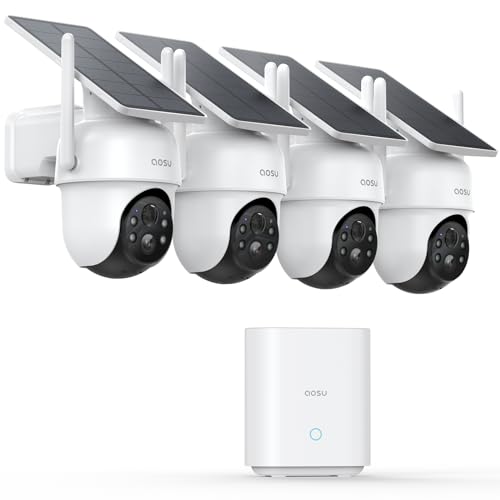
Best for: homeowners seeking a self-sustaining, wire-free option. Why selected: aosuBase storage with 32GB allows up to four months of loop recording. Cross-camera tracking and multi-area live viewing simplify monitoring a yard, driveway, and entry points from a single interface. The solar panel keeps the system running with minimal maintenance.
Limitation: ensure sufficient daily sunlight to maintain battery levels; consider location where sun exposure is reliable.
Vivideye 4MP Wireless Solar Outdoor Kit

Best for: solar-powered setups that require a balance of cost and capability. Why selected: 4MP color night vision, 128GB local storage, and a solar-powered design plus dual-band WiFi. The system’s local storage helps you avoid ongoing cloud fees, while Alexa compatibility supports hands-free viewing.
Limitation: as a 2-camera kit, it may not cover as wide an area as larger kits; evaluate coverage needs before buying.
Buying Guide: Key Considerations for Outdoor Surveillance Systems
- Power and installation: Choose solar-powered or battery-powered options for wire-free setup, or wired/NVR kits for constant, reliable operation where wiring is feasible.
- Storage and privacy: Local storage reduces ongoing costs and privacy concerns; AES-128 encryption and secure storage practices are advisable across any model.
- Video quality and night vision: Look for 2K or 4K for detailed footage; color night vision helps identify details, but require adequate lighting or smart infrared features.
- Field of view and PTZ: 360° PTZ cameras minimize blind spots; fixed cameras with wide-angle lenses can still offer strong coverage when positioned strategically.
- Motion detection and alerts: AI-based detection (humans, vehicles) reduces false alarms; configure motion zones to match property layout.
- Storage capacity: Higher capacity HDDs or larger local storage reduces overwriting and gaps in footage; plan for peak activity periods.
- App usability and integration: Ensure the companion app provides reliable remote viewing, alerts, and cross-camera event linking for a cohesive security narrative.
- Weather and durability: Look for IP ratings (e.g., IP65) and robust housings for exposure to rain, dust, and temperature swings.
Frequently Asked Questions
- What is the advantage of solar-powered cameras?
Answer: They offer wire-free installation and continuous operation with outdoor sunlight, reducing the need for electrical wiring. - Do I need a subscription for these systems?
Answer: Several models advertise no subscription fees and local storage, but some options offer optional cloud storage as an add-on. - Is color night vision worth it?
Answer: Color night vision provides more detail in low light, which can help identify objects, but depends on lighting and sensor quality. - Which setup is best for renters?
Answer: Wire-free solar or battery-powered kits are typically best for renters due to easier installation and relocation capability. - Can I mix cameras from different brands?
Answer: Compatibility varies by system; most kits perform best when all cameras are designed to work together. - What should I consider for data privacy?
Answer: Look for encryption, local storage options, and a trustworthy data-handling policy to minimize risks.