Best Night Vision Web Cameras for Clear Low-Light Viewing
Answer: For reliable night vision web cameras, these models provide automatic IR-cut switching, strong infrared illumination, and sharp 1080p or higher video. They’re best for security monitoring, home offices, and 3D printer setups in low light. The top picks below are suited to different buyers: compact, easy setup for beginners; wide-angle coverage for larger spaces; and higher-end options for precise night imaging.
| Product | Best For | Key Benefit |
|---|---|---|
| Arducam 1080P Day & Night Vision USB Camera (B0829HZ3Q7) | Home offices and small spaces | Automatic IR-Cut switching with 850 nm LEDs; Full HD 1080p |
| IFWATER 1080P USB Camera (B0GMGDRFC8) | Industrial monitoring and wide coverage needs | 170° wide FOV with 850 nm IR LEDs; up to 120fps in MJPEG |
| Arducam 1080P USB Camera (B0CZL1X463) | Compact, high-detail day/night capture | 1/2.7″ OV2710 sensor; 105° wide-angle lens; 6x 850 nm IR LEDs |
| Magnolia 1080P Day & Night Vision USB Camera (B0FDQBC2DW) | Wide-area monitoring | 166° fisheye field of view; 1080p at 30fps |
| Arducam 2MP Day & Night Vision USB Camera Module (B0G24BJ47Q) | DIY projects and compact security setups | STARVIS IMX462; up to 18 m night vision with 8 IR LEDs |
Arducam 1080P Day & Night Vision USB Camera (B0829HZ3Q7)

Best for: compact setups where a straightforward 1080p day/night image is sufficient. The camera uses a 1/2.7″ OV2710 sensor with a 1920×1080 max resolution and automatic IR-Cut switching. It relies on 850 nm IR LEDs to provide night visibility, making it suitable for desks, small rooms, or workstations with modest space.
Why selected: The combination of full HD imaging and automatic lighting adaptation helps maintain usable footage in mixed lighting. It’s a simple plug-and-play option for Windows, Linux, Android, and macOS. A potential limitation is the absence of ultra-wide angles, which may leave corners less covered in larger rooms.
Best for: buyers who want reliable day/night performance without extra configuration or specialized hardware. If you need very wide coverage, consider a model with a broader FOV.
IFWATER 1080P USB Camera with 170° Lens (B0GMGDRFC8)
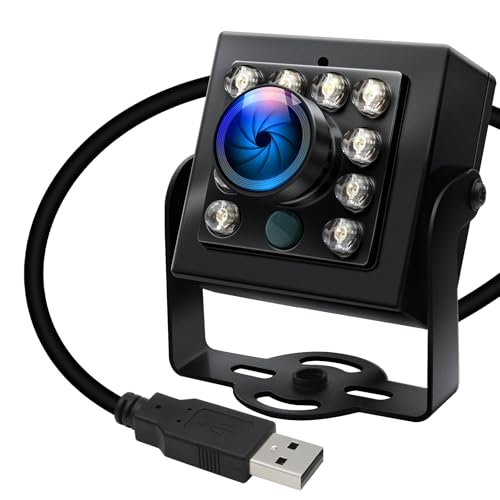
Best for: users needing broad room coverage and fast frame rates. This camera features up to 120fps at 640×480, which supports smooth monitoring and footage in fast-moving scenes, plus 170° wide-angle night vision with 850 nm IR LEDs.
Why selected: The wide horizontal FOV combined with automatic IR-CUT and 1080p resolution makes it well-suited for monitoring large spaces or projection areas. Caution: higher frame rates at lower resolutions may not translate to higher detail at 1080p in every scenario.
Best for: environments where wide coverage and smooth motion are more critical than ultra-high pixel density in every frame.
Arducam 1080P USB Camera, Day & Night Vision (B0CZL1X463)

Best for: users who want robust 1080p imaging with a wide field and night-vision clarity. The camera uses a 1/2.7” OV2710 sensor and 6x 850 nm IR LEDs for reliable night performance.
Why selected: The combination of a wide 105° lens and auto IR-cut switching yields sharp daytime details and clear night imagery. Limitation: the lens is fixed; for extremely tight spaces you may want a more compact or different FOV option.
Best for: standard desk-to-desk surveillance or small rooms where clear color-by-day and infrared night imaging are needed.
Magnolia 1080P Day & Night Vision USB Camera (B0FDQBC2DW)

Best for: monitoring large indoor spaces or work areas where a wide, immersive view helps reduce blind spots. It uses a 1/2.7” OV2710 sensor and a 166° wide fisheye lens with night vision.
Why selected: The 166° field of view can cover expansive rooms with fewer cameras. Caution: fisheye distortion can affect straight-line measurements or precise object placement in the image center.
Arducam 2MP Day & Night Vision USB Camera Module (B0G24BJ47Q)

Best for: DIY projects, compact security modules, and test setups where space is limited. It uses a STARVIS IMX462 sensor, 6x 940 nm IR LEDs, and automatic IR-Cut switching.
Why selected: This module provides strong low-light performance in a small form factor. Limitation: as a module, it may require additional hardware or integration work for full standalone use.
Buying Guide
- What to prioritize: If you need broad coverage, choose cameras with wide or fisheye lenses (e.g., Magnolia). For tighter spaces, a standard 105° or 90° lens (e.g., Arducam B0CZL1X463) may be preferable.
- Night vision range: Look for IR LEDs and wattage/LED count. More LEDs generally extend the effective night range but can increase power usage.
- Auto IR-Cut switching: Essential for true color in day and clean grayscale at night. Ensure the camera specifies automatic switching.
- Resolution and frame rate: 1080p at 30fps is common; higher frame rates (e.g., 60fps or 120fps) improve motion accuracy but may reduce detail at 1080p depending on encoding.
- Interface and compatibility: USB 2.0 cameras typically work across Windows, macOS, Linux, and some Android setups. Confirm driver availability if needed.
- Mounting and form factor: Compact modules suit DIY projects; larger cameras are easier to place for rooms or desks but require space.
- Power considerations: Some USB cameras are bus-powered; others may require additional power if using long USB cables or high LED counts.
FAQ
- What is “night vision” in these cameras?
Night vision uses infrared LEDs to illuminate a scene that is otherwise dark. The camera captures infrared reflections and may convert to grayscale images in low light.
- Do these cameras require drivers?
Most listed models are UVC-compatible and plug-and-play on major operating systems, but some modular cameras may need drivers or software for full feature access.
- Can I use these cameras for security monitoring?
Yes. Several models are designed for continuous or event-driven monitoring, with night vision to help identify objects in low light.
- What is field of view and why does it matter?
Field of view (FOV) determines how much of a scene is captured. Wider FOVs cover more area but can introduce distortion near the edges.
- Are higher frame rates better for security use?
Higher frame rates reduce motion blur in fast-moving scenes but may limit detail at the same resolution depending on bandwidth and processing.