Best Negative Scanner for 120 Film: Top 5 for 35mm & Medium Format
Preserving memories from 120 film and other formats has never been easier thanks to modern film scanners. This guide highlights five top options that deliver sharp digital equivalents, easy operations, and flexible storage. Whether you’re archiving old slides or digitizing negatives for sharing, these scanners offer a range of features to fit hobbyists and enthusiasts alike.
Summary table of chosen products:
| Product | Brand | Key Benefit | Storage | Resolution |
|---|---|---|---|---|
| Professional 22MP Film Scanner | Generic | High-resolution 22MP digitizing with internal memory | Internal + SD up to 32GB | 22 MP |
| JJC Mobile Film Scanner | JJC | Smartphone-based digitization with backlight and remote | Phone-based storage via App | High-res via phone camera |
| Kodak Slide N Scan Max | KODAK | 7” LCD for direct viewing and editing | SD Card (not included) | Up to 22MP when digitizing |
| KODAK Slide N SCAN | KODAK | 5” LCD with gallery mode and easy feeds | SD Card (not included) | Up to 22MP |
| KUSOLE 120 High Resolution Film Scanner | KUSOLE | High-res 22MP with multiple film adapters | SD up to large capacity (not included) | 22 MP |
Professional 22MP Film Scanner for 35mm & 120 Film
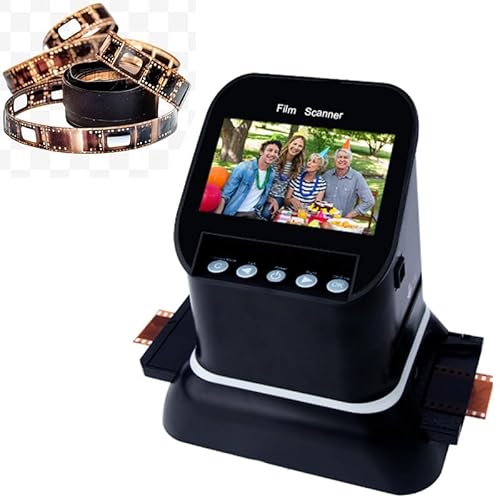
The Professional 22MP Film Scanner supports a broad range of formats, including 35mm and 120 film. It features 128MB built-in memory plus support for up to 32GB SD cards, enabling direct saving of scans to internal memory or an external card. Users can adjust brightness and color on the device, helping to optimize scans without needing a PC. The scanner promises JPEG outputs with up to 22 megapixels, making it suitable for preserving memories with crisp detail. For those digitizing a mix of film sizes, this model provides versatile scanning and quick conversion of negatives and slides.
JJC Mobile Film Scanner With LED Backlight

The JJC Mobile Film Scanner turns 35mm and 120 format film into digital images using a smartphone camera. It includes an LED backlight and a detachable wireless remote for capturing shots without touching the screen. A magnetic backlight panel attaches to the sliding rail, with adjustable brightness. The universal phone clamp fits most smartphones, and the holder can slide to achieve precise macro focus. While no software is bundled, users can leverage smartphone apps to edit and share scans quickly, making this a practical option for on-the-go digitization.
Kodak Slide N Scan Max Digital Film Slide Scanner

Kodak’s Slide N Scan Max provides a 7” LCD display for instant viewing and editing. It supports 135, 110, and 126 film formats and includes adapters for various sizes, a 50mm slide holder, cleaning brush, and USB-C connectivity. The built-in quick-feeding tray allows continuous loading, enabling faster processing of larger batches. The device saves to an SD card (not included) and offers straightforward gallery-style viewing, making it well-suited for home archives or small offices seeking an integrated scanning and viewing solution.
KODAK Slide N SCAN Film & Slide Scanner

This Kodak model shares a strong emphasis on simplicity, featuring a 5” LCD display with a gallery mode. It supports a wide range of formats, including 135, 110, and 126 negatives and 50mm slides, across multiple adapters. The Easy-Load feature accelerates scanning sessions, while USB and HDMI (cables included) offer flexible outputs for saving and viewing on larger screens. As with the Max variant, SD card storage is the primary method for saving results, making it a solid option for casual archivists and small-scale archives alike.
KUSOLE 120 High Resolution Film Scanner

The KUSOLE 120 High Resolution Film Scanner emphasizes 22MP scanning for 120, 135, 126, 127 formats, with adapters for loading speed and multiple film types. It supports saving to SD cards and internal storage where available, and includes the ability to preview and adjust images directly in the scanner. This model targets users who want a balance of quality and ease-of-use, with flexible output options for archiving or sharing memories from various film formats.
JJC Mobile Film Scanner Digitizer Set

This JJC set is designed for smartphone users who want to rephotograph 35mm or 120 films. It includes an 11-level backlight, a phone clip, and a magnetic film holder. The backlight magnetically attaches to the sliding rail and can be moved to align with different film holders. Compatible with most smartphones (width 2.2-3.5 inches), the kit emphasizes portability and ease of use for quick digitization and sharing through mobile devices.
WEIZIIA 120 High Resolution Film Scanner

The WEIZIIA 120 High Resolution Film Scanner supports 120 and other common formats with 22MP high-resolution output. It includes HDMI/USB outputs for flexible connectivity and offers editing and color adjustments directly within the device for streamlined workflows. This model targets users who want a robust, all-in-one scanning experience with compatible modern interfaces for easy integration into home or small studio setups.
Buying Guide
- Film format compatibility: Look for scanners that support 35mm, 120 (medium format), 110, and 126 when you have a mixed archive. A versatile model reduces the need for multiple devices.
- Resolution and output quality: A 22MP scan is a solid baseline for archival quality. Check whether the scanner outputs JPEGs directly or offers RAW/TIFF via PC connections for post-processing.
- Storage options: Internal memory is convenient, but SD cards are essential for long sessions. Consider devices with SD support up to 32GB or larger depending on your archive size.
- On-device editing and preview: Some models offer color and brightness adjustments, as well as a gallery/viewing mode. This reduces post-processing time and helps you decide which frames to keep.
- User experience and portability: Smartphone-based solutions are portable but rely on your phone’s camera quality. Standalone scanners are bulkier but generally easier to use for longer sessions.
- Lighting and color accuracy: Backlit panels with adjustable brightness help reveal details in dark negatives and reduce glare on slides. Look for magnetic backlights or adjustable rails for precise alignment.
- Connectivity: USB-C, HDMI, and SD card options enable flexible workflows. Decide whether you want direct SD saving or PC-based editing.
- Software and compatibility: If the device relies on a companion app, verify that it’s available for your device and supports the file formats you prefer. Some devices require third-party apps for full functionality.
- Price to value: Higher-end units provide better optics and more features, but entry-level models often cover essential needs for casual archiving. Match features with your usage and budget.
- Maintenance and accessories: Consider whether the package includes adapters for different film sizes, cleaning tools, and spare holders. A kit with multiple adapters saves future purchases.