Choosing a motorized camera rail system can dramatically improve motion control for video, time-lapse, and cinematic shots. This guide highlights five top options, ranging from compact 16-inch sliders to long 48-inch carbon-fiber rigs, each offering motorized movement, app or remote control, and versatile mounting. The selections balance stability, noise levels, portability, and payload compatibility to support DSLR, mirrorless, and cinema cameras. Read on for concise overviews of each model, followed by a buying guide to help you compare features and decide which rail best fits your production needs.
| Product | Brand | Length | Notable Feature |
|---|---|---|---|
| Zecti Camera Slider | Zecti | 16″ (40 cm) | Carbon fiber rails; portable; compatible with ball head |
| NEEWER ER1-80 | NEEWER | 31.5″ (80 cm) | App control; quiet motor; long battery option |
| IFOOTAGE Shark Nano II 660 | IFOOTAGE | 26″ (approx.) | 360° pan; dual-axis control; multi-gimbal compatibility |
| GVM 31″ Wireless Slider | GVM Great Video Maker | 31″ (80 cm) | Six shooting modes; multiple screw ports |
| GVM 48″ Motorized Slider | GVM Great Video Maker | 48″ (120 cm) | Long travel; adjustable torque and speed; auto loop |
Zecti 16-Inch Carbon Fiber Slider

The Zecti 16-inch slider offers a compact option for lightweight rigs. Its carbon fiber rails and four precision bearings deliver smooth, quiet movement ideal for entry-to-mid level photography and videography. Weighing about 600 g (21.16 oz), this unit is designed for easy portability, especially when traveling between locations. A scratch-resistant carrying bag is included, facilitating quick packing for backpack or luggage transport. Its slim profile helps with tight spaces while still providing dependable tracking and linear motion for tabletop or low-angle shots.
Compatibility covers Canon, Nikon, Sony, Panasonic, Samsung, and other DSLR or mirrorless systems, along with DV camcorders and smartphones (phone holder not included). The slider can connect to general-purpose photographic equipment, such as a ball head, enabling flexible framing and angle adjustments. Proper balance and setup can produce cinematic pans or gentle tracking moves without bulky gear. This makes it a practical first-step tool for shooters building a mobile micro-studio setup.
Designed for lightweight runs-and-gun work, the Zecti slider excels in mobile shoots, interviews, or product demonstrations where space is limited. Its carbon fiber construction helps dampen vibrations while maintaining rigidity, and the included bag ensures protection during transit. For creators seeking a compact, affordable entrance into motorized slides, this model delivers a reliable baseline of motion control without excessive weight.
NEEWER 31.5-Inch ER1-80 Slider

The ER1-80 from NEEWER measures 31.5 inches (80 cm) and supports up to 11 lb (5 kg) horizontally, with a maximum of 5.5 lb (2.5 kg) when tilted up 45 degrees. It uses a quiet stepper motor to deliver smooth, vibration-free movement suitable for professional video work. The system provides multiple control modes, including manual, video, and time-lapse presets, enabling precise motion planning across scenes or complex sequences.
Control is flexible: operate via the NEEWER app on your phone and, when available, a 2.4G RT-08 remote control (remote not included). You can set frames, video length, interval, and exposure settings from the app for consistent motion. Power is supplied by a 4400mAh NP-F750 battery, with the option to connect to a USB-C charger for extended shoots. The ER1-80’s carbon fiber build contributes to stability and low weight, making it suitable for on-location productions and run-and-gun shoots.
With its robust length and versatile control options, the ER1-80 is well-matched for mid-sized cameras, mirrorless kits, and compact cinema rigs. It provides dependable motion for dolly-style moves, time-lapse sequences, and tracking needs without requiring a full studio setup. The combination of portability, control flexibility, and solid payload makes this slider a practical choice in the mid-range category.
IFOOTAGE Shark Nano II 660 Slider

The Shark Nano II 660 from IFOOTAGE is a multi-axis motorized slider designed for advanced motion control. It unlocks 360° unlimited pan movement and dual-axis synchronized motion when paired with compatible gimbals via the Nano II-RS adapter, enabling seamless slider travel with pan rotation. The build uses aviation-grade aluminum and carbon fiber to minimize weight while maintaining rigidity, delivering near-zero jitter even under substantial loads. This setup supports cinematic slides that combine plane movement with panoramic or gimbal stabilization for fluid motion sequences.
Power delivery centers on USB-C PD 60W charging, allowing you to power the slider, attached DJI gimbal, and camera from a single source when compatible. This capability supports extended shoots and live streaming by reducing battery swaps. The Nano II 660 is especially suited for productions requiring complex, fluid multi-axis motion and compatibility with popular gimbal systems, while maintaining a compact form factor for on-location shoots.
As a high-end option, it emphasizes precision and stability. Users can achieve professional framing with tight attention to micro-mudule motion and buttery-smooth transitions, making it appropriate for corporate videos, commercials, and cinematic projects that demand sophisticated camera choreography with a streamlined control workflow.
GVM 31-Inch Wireless Carbon Fiber Slider

The GVM 31-inch wireless carbon fiber slider provides a versatile platform for professional video and photography. It supports multiple shooting modes, including manual, constant-speed video, and time-lapse, enabling precise control over motion. The carbon fiber construction offers stiffness and lightness, helping to keep weight manageable while reducing vibration. The unit includes a robust slew of mounting options with multiple 1/4″ and 3/8″ screw ports on both sides and in the middle, allowing use with tripods, slider rigs, or ball heads for vertical, horizontal, or angled shots.
Users can route shots across tracks with smooth, controlled motion and SOC-friendly power management. The inclusion of six shutter release cables and an extension cable further enhances compatibility with a variety of cameras and accessories, supporting synchronized captures and complex sequences. This model is well suited for interviews, product videos, and creative storytelling where reliable motion and flexible mounting matter most.
GVM 48-Inch Motorized Slider
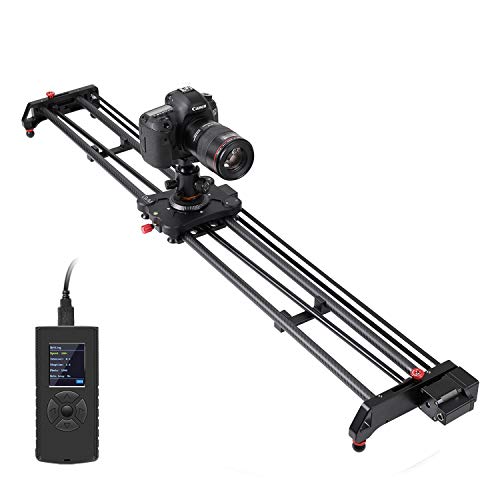
The 48-inch GVM motorized slider delivers extended travel for dramatic, long tracking shots. Constructed from carbon fiber with a stable carriage, it provides reliable performance for a range of camera systems. The unit supports setting start and end points, adjustable motor torque, various slip speeds from 1% to 100%, and adjustable slip intervals and stop times, enabling precise motion planning for time-lapse and video sequences. It also supports auto loop shooting to create continuous motion for dynamic scenes.
Tracking capabilities complement the long reach: you can configure the red knobs to achieve upper-left and lower-right tracking motion, with 120-degree panoramic options. The design includes multiple 1/4″ and 3/8″ screw ports on both sides and the center, enhancing compatibility with tripods and support rigs. With a combination of carbon fiber construction and a flexible control suite, this slider is ideal for longer dialogue scenes, interviews, and cinematic tracking shots.
Buying Guide
When choosing a motorized camera rail, consider how each model fits your workflow and production demands. Key factors include track length, payload capacity, control method, power options, material, and mounting flexibility. A longer track enables expansive parallax and dramatic moves, but adds weight and setup time. If you frequently shoot on location, portability and quick setup may trump the need for maximum length. For studio work, a higher payload tolerance and richer control features can justify a larger, more expensive system.
Key Purchase Considerations
- Track length and travel: Decide if 16″ to 26″ fits your typical lens and camera combination, or if you need 31″ to 48″ for longer tracking shots.
- Payload capacity: Match the slider’s maximum load to your camera body, lens, and accessories to avoid overloading the track.
- Power and runtime: Check whether the model uses NP-F style batteries, USB-C power, or external adapters, and estimate how long it can operate between charges.
- Control method: Apps provide on-the-fly adjustments, while remote controls offer tactile control on set. Consider hybrid setups for flexibility.
- Motion modes: Look for time-lapse, video, and tracking capabilities. Pan or panoramic options add creative flexibility for multi-axis rigs.
- Material and build: Carbon fiber rails offer higher stiffness-to-weight ratios; aluminum can be lighter and less expensive but may flex under load.
- Mounting versatility: Ensure the rail provides ample 1/4″ and 3/8″ holes for tripods, ball heads, and other accessories.
- Noise and vibration: A quiet motor helps keep audio clean during shoots; consider sliders designed for near-silent operation.
- Warranty and support: Longer warranties and readily available replacement parts can be decisive for frequent production work.
Product Comparison Snapshot
| Product | Length | Control | Power | |
|---|---|---|---|---|
| Zecti 16″ Slider | 16″ / 40 cm | Manual with optional ball head | Battery-free (manual operation) | Portable and affordable entry point |
| NEEWER ER1-80 | 31.5″ / 80 cm | App + Remote (RT-08, not included) | 4400mAh NP-F750 or USB-C | Balanced capability for mid-size cameras |
| IFOOTAGE Shark Nano II 660 | 26″ | High-end app/adapter control | USB-C PD 60W | Multi-axis, cinema-grade motion |
| GVM 31″ Wireless Carbon Slider | 31″ | App/remote compatible | External power options (varies by model) | Six shooting modes with flexible mounting |
| GVM 48″ Motorized Slider | 48″ | Motorized control with manual override | Standard power options (model dependent) | Long travel with detailed motion controls |
These factors help align the choice with your typical shooting scenarios. If you regularly carry gear for on-location shoots, prioritize portability and a compact travel-friendly model like the 16″ or 31″ options. For studio setups or filmmaking, prioritize longer travel, multiple shoot modes, and robust mounting options. Always verify compatibility with your camera system, lenses, and any gimbals you plan to use. By focusing on your most common frames, you can select a rail that delivers consistent, repeatable motion without sacrificing efficiency.