Best Popular Camera Lenses for Smartphones and DSLRs in 2026
Answering the question “which camera lens should I buy?” this guide highlights five widely used lens options across smartphones and cameras. Each pick fits a distinct need—macro detail, telephoto reach, wide-angle context, or classic portrait capabilities—helping buyers match their shooting style. The top picks are well-suited for hobbyists, content creators, travelers, and budding professionals seeking better image versatility without heavy gear.
| Product | Type | Best For | Why It Stands Out |
|---|---|---|---|
| Xenvo Pro Lens Kit | Smartphone Lens Kit | Everyday photography and macro detail | Broad compatibility, macro and wide-angle options, LED light for low light |
| MIAO LAB 28X Telephoto | Smartphone Telephoto | Distant subjects, candid wildlife | High magnification with good color reproduction |
| KINGMAS 3-in-1 Fisheye/Macro/Wide | Clip-on Lens Kit | Creative wide, macro, and fisheye shots | All three lenses in one, durable build |
| KEYWING 3-in-1 Lens Kit | Clip-on Lens Kit | Casual social photos with wide and macro | Affordable, easy to use, versatile set |
| Canon EF 50mm f/1.8 STM | DSLR Prime Lens | Portraits, low light | Classic prime with clean background blur |
Xenvo Pro Lens Kit for Smartphones

The Xenvo Pro Lens Kit combines a 0.45x wide-angle lens with a 15x macro lens, plus a compact LED light and clip system. Best for smartphone owners who want enhanced wide shots and close-up details in one portable package. The kit is built with aircraft-grade aluminum and coated glass to reduce ghosting and lens flare. This option is ideal for hobbyists and social-media creators who need quick, versatile enhancements on the go.
Best for: casual photographers and content creators who want a single kit that covers wide views and macro detail. Why chosen: broad compatibility, built-in lighting for low-light scenes, and durable construction. Caution: macro performance requires close proximity to the subject; lighting may drain the LED battery with extended use.
MIAO LAB 28X HD Telephoto Lens

The MIAO LAB 28x telephoto lens is designed to overcome smartphone distance limits, delivering crisp close-ups of distant subjects with high resolution and true color. It features a robust light path design for a wider view and is suitable for long-distance captures, wildlife, or sports events. It can also double as a monocular for simple observation tasks.
Best for: users needing substantial reach from a phone camera. Why chosen: strong magnification with stable results and good color fidelity. Caution: telephoto performance depends on steady hands or stabilization; prime distance is essential for sharp images.
KINGMAS 3-in-1 Universal Lens Kit

The KINGMAS kit offers a combined fisheye, macro, and wide-angle lens with an attached macro option. It is built from top-grade aluminum for durability and provides a large hemispherical image with the fisheye lens, and strong macro capabilities. The wide lens is meant to be used alongside the macro for best results.
Best for: creators who want three creative perspectives in one kit. Why chosen: integrated design and durable construction. Caution: macro and wide lenses are sold as a combination; the wide angle should be paired with the macro lens for optimal results.
KEYWING 3-in-1 Phone Lens Kit
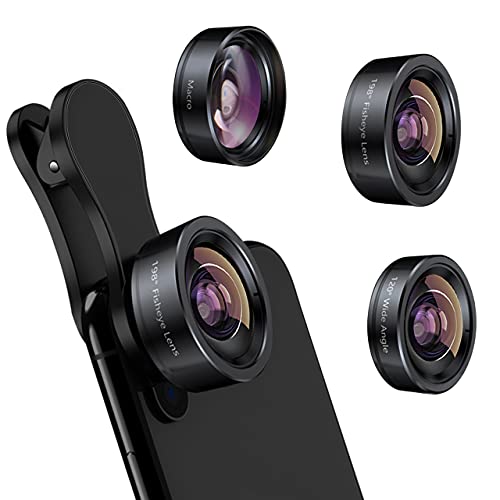
The KEYWING bundle includes a 198° fisheye, a 120° wide-angle, and a 20x macro lens. This kit emphasizes easy clip-on use and durable aluminum housing. The macro lens has a close focusing distance that supports detailed close-ups, and the clip is designed to minimize phone surface scratches.
Best for: social-media shooters who want bold creative effects and quick swaps. Why chosen: broad variety in a single clip-on package and easy setup. Caution: some users report the need to remove a phone case for stable clipping on certain models.
Canon EF 50mm f/1.8 STM

The Canon EF 50mm f/1.8 STM is a classic DSLR prime lens with a bright f/1.8 aperture, making it well-suited for portraits and low-light shooting. It offers a 40º horizontal, 27º vertical, and 46º diagonal field of view with a close focus distance of about 0.35 meters. This lens is a simple, affordable way to achieve sharp images with natural background blur on Canon bodies.
Best for: DSLR shooters seeking a fast, affordable prime for everyday portraiture. Why chosen: strong image quality at a modest price with reliable autofocus behavior. Caution: compatibility is limited to Canon EOS bodies; not a universal option for mirrorless systems without adapters.
Buying Guide
What should I consider when choosing a lens kit?
- Device compatibility: Smartphone clip-on lenses require compatible phone lenses and may not fit every model perfectly. DSLRs require the right mount and filter size.
- Intended use: For macro detail and close-ups, prioritize macro capabilities and working distance. For landscapes or architectural photography, prioritize wide-angle reach.
- Image quality vs. convenience: Clip-on kits offer versatility and portability but may introduce vignetting or color shifts. Prime lenses provide superior image quality but are more expensive and require a dedicated camera body.
- Durability and build: Aluminum housings are generally sturdier and long-lasting. Consider lenses with anti-reflective coatings to minimize ghosting and flare.
- Lighting considerations: kits with LED lights help in low-light macro or vignette-prone scenes but may drain batteries; consider extra power options if you shoot away from outlets.
Practical comparisons
- Best overall versatility: Xenvo Pro Lens Kit for smartphones—wide, macro, and lighting in one portable package.
- Best for long-distance mobile shots: MIAO LAB 28x Telephoto Lens.
- Best three-lens coverage in one kit: KINGMAS 3-in-1 Universal Lens Kit.
- Best budget all-rounder for quick social shots: KEYWING 3-in-1 Lens Kit.
- Best DSLR portrait option: Canon EF 50mm f/1.8 STM for sharp subject separation.
Frequently asked questions
- Can clip-on smartphone lenses replace a dedicated camera? They offer convenience and creative options but may not match the image quality of a dedicated camera in low-light or high-detail scenarios.
- Do macro lenses work on all smartphones? Most clip-on macros do, but alignment and distance to subject can affect sharpness; some models require precise positioning.
- Is a wider lens always better? A wider field of view helps landscape and group shots, but distortion near the edges can occur; many kits include distortion correction in post.
- Are telephoto lenses worth it for phones? Yes for distant subjects, but expect a narrow depth of field and potential stabilization needs for sharp images.
- Should I buy a DSLR lens kit or a smartphone clip-on kit first? If you shoot primarily with a phone, clip-ons are convenient. If you own a DSLR, a fast prime like the 50mm f/1.8 can provide a strong baseline upgrade.
- What about durability and care? Keep lenses clean, use the included cleaning cloth, and store in the supplied case to prevent scratches and dust intrusion.