Best Monopod Ball Head and Tilt Head Options for Photographers
Looking for a reliable monopod head that handles varying angles with ease? This guide compares popular monopod tilt and ball head options to help you pick the right model for your setup. Best for travelers who need compact versatility, professional shooters seeking precise panorama control, and hobbyists wanting quick adjustments will find clear, practical picks here. The top five products below cover a range of mounting styles, load capacities, and mounting systems, with notes on who benefits most from each design.
| Product | Best For | Key Benefit |
|---|---|---|
| Manfrotto 234RC Monopod Tilt Head | Budget-conscious shooters needing quick tilt control | Simple tilt head for monopods with quick release |
| SmallRig Mini Ball Head (BUT2665) | 360° panorama lovers and compact rigs | Precise 360° panning with multiple tilt ranges |
| Andoer M-12 Monopod Tilt Head | Monopod users needing ±90° tilt | Panoramic tilt with quick release plate |
| NEEWER Basic Mini Ball Head (GM01) | Budget rigs for compact gear and phones | Economical 360° swivel and 90° tilt |
| ULANZI H28 Panoramic Head | Multi-attachment setups and action cameras | Sturdy dual hot shoe and universal 1/4″ screw |
Manfrotto 234RC Monopod Tilt Head

The Manfrotto 234RC Tilt Head is designed for monopods with straightforward tilt control. It provides a simple interface suitable for users who want reliable vertical and horizontal orientation without extra complexity. Best for enthusiasts who value quick tilt adjustments in everyday shooting scenarios.
Best for: Photographers needing quick tilt adjustments on a monopod without added features. Why selected: It emphasizes ease of use and compatibility with standard threads.
Caution: Limited advanced pan control may be less suitable for precise panoramic work compared to higher-end ball heads.
SmallRig Mini Ball Head (BUT2665)
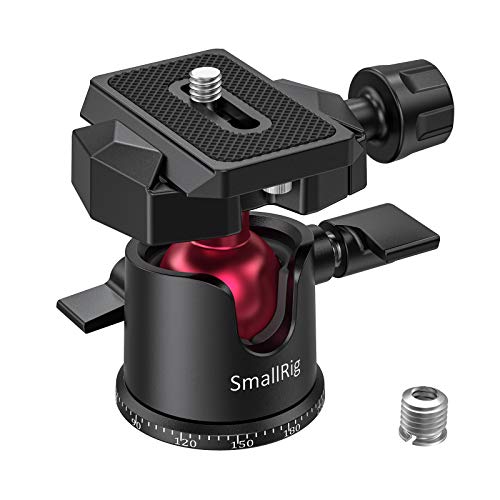
This SmallRig mini ball head provides 360° panoramic rotation and multiple tilt angles, with universal 1/4″ and 3/8″ thread options. It’s a compact option that fits DSLRs, camcorders, and monopods, making it versatile for travel and on-the-go shoots.
Best for: Creators who want versatile angle control in a compact form. Why selected: Precise panning and multi-angle tilts make it ideal for landscape and event work.
Caution: The maximum load capacity is moderate; heavier cameras may require a sturdier head.
Andoer M-12 Monopod Tilt Head

The Andoer M-12 Tilt Head for monopods supports ±90° tilt and offers a quick-release plate with a 1/4″ screw. Its 38mm bottom diameter and 3/8″ thread provide flexible mounting options for lighter setups, making it suitable for travel and wildlife observation roles.
Best for: Users who need high-angle tilt on a monopod with easy quick release. Why selected: Straightforward tilt range paired with a reliable quick-release interface.
Caution: Might be less robust for heavier telephoto lenses or demanding studio work.
NEEWER Basic Mini Ball Head (GM01)

The NEEWER Basic Mini Ball Head provides a 360° swivel and 90° tilt with a simple 1/4″ mounting screw. This economical option targets compact cameras, action cameras, and small rigs, including phone accessories and LED lights, for simple, everyday use.
Best for: Budget setups needing reliable basic movement. Why selected: Economical, uncomplicated design ideal for lightweight gear and entry-level configurations.
Caution: Limited load capacity means it’s not suitable for larger mirrorless or DSLR lenses.
ULANZI H28 Panoramic Head

The ULANZI H28 offers a panoramic-capable head with a dual hot shoe mount and a universal 1/4″ screw. It’s built for action cameras, smartphones, and compact setups that require flexible mounting options and quick accessory attachment for light video work.
Best for: Content creators needing quick access to lights or mics while shooting with compact cameras or phones. Why selected: Dual hot shoe and universal screw provide extended accessory versatility.
Caution: Not designed for heavy camera rigs; avoid with larger DSLRs or telephoto lenses.
Buying Guide
What to consider when choosing a monopod head or tilt head:
- Load capacity: Match the head’s capacity to your camera and lens weight to avoid droop or instability.
- Motion range: Tilt and pan angles determine how you frame portraits, landscapes, and overhead shots. A 360° pan head supports seamless panoramic images.
- Mount compatibility: Check screw size (1/4″ is standard) and bottom threads (3/8″ is common for larger stands) to ensure compatibility with your equipment.
- Size and weight: For travel, choose compact, lightweight options without sacrificing stability.
- Quick-release system: A reliable quick-release plate speeds setup and changes between rigs.
- Accessory options: Some heads include dual hot shoes or built-in scales, which can streamline lighting and monitor setups.
Frequently Asked Questions
- What is a monopod tilt head best used for?
It provides straightforward tilt control on monopods, ideal for quick portrait framing and angle adjustments in constrained spaces. - When should I choose a ball head over a tilt head?
Ball heads offer flexible multi-direction control and smooth pan/tilt in one joint, suitable for dynamic compositions and compact travel rigs. - Is 360° panning important for landscapes?
Yes, 360° panning helps with precise panoramic stitching and expansive landscape scenes. - Can I mount action cameras on these heads?
Some models, like the ULANZI H28 and SMALLRIG options, support compact devices and accessories via standard screws, but verify weight limits first. - Do I need a heavy-duty head for telephoto lenses?
Yes. For long lenses, choose a head with higher load capacity and solid locking to prevent drift. - What is the advantage of a quick-release plate?
It speeds attachment and removal, enabling rapid transitions between setups and tripods or monopods.