Best Mini Fiber Optic Camera for Quick Inspections
Answering the common buyer question: which compact fiber optic camera delivers reliable visuals in tight spaces and across various tasks? This guide highlights five top options, each suited for different use cases—from automotive checks to home maintenance and medical-grade portable inspection. The best picks emphasize maneuverability, image clarity, and ease of use. Read on to see who each product is best for, plus practical buying considerations.
| Product | Best For | Why It Stands Out |
|---|---|---|
| Teslong Two-Way Articulating Borescope | Automotive and mechanical inspections | Two-way articulation, 5 ft semi-rigid cable, 4.5″ IPS LCD, no app required. |
| USB C Endoscope Camera | Smartphone users and quick diagnostics | Plug-and-play USB-C design, wide device compatibility, high-LED brightness. |
| NIDAGE Two-Way Articulating Endoscope | Tight spaces and detailed engine work | 210° two-way articulation, 4.3″ IPS screen, bright adjustable LEDs. |
| Vanxse CCTV Mini Pinhole Camera | Indoor/outdoor hidden surveillance and general purpose | 1/3″ 1000TVL, 3.6 mm lens, night vision with IR LEDs. |
| OdontoMed2011 LED Pocket Otoscope | Medical-friendly dental/ear/nose checks or home use | Fiber optic mini otoscope with a handcrafted touch in tooling. |
Teslong Two-Way Articulating Borescope

The Teslong borescope uses a flexible two-way articulating probe, enabling precise navigation through confined spaces. This is ideal for automotive maintenance and household inspections where cables must bend around corners. The 4.5-inch IPS LCD screen presents crisp visuals, and there is no app to manage, simplifying setup and reducing compatibility concerns. A 5-foot semi-rigid gooseneck balances flexibility with stability, so you can guide the camera with confidence without losing the view. Best for professionals who need dependable, stand-alone inspection visuals in tight areas; better for those who prefer a dedicated display over smartphone connectivity. A potential limitation is the screen size for very small details or high-magnification tasks, where a larger or higher-resolution display could help.
USB C Endoscope Camera With Light

This USB-C endoscope is designed for quick plug-and-play use with devices that support USB-C. It emphasizes broad compatibility with iPhone and Android devices, and requires no WiFi or complex setup. The built-in 8 LED lights provide solid illumination, and a white balance adjuster helps optimize images in variable environments. This option is best for smartphone-centric users who want rapid diagnostics and easy sharing of captured footage. Choose this if you need simple, mobile-friendly inspections; avoid if your device lacks USB-C support or you need a dedicated external display for those hard-to-see details.
NIDAGE Two-Way Articulating Endoscope
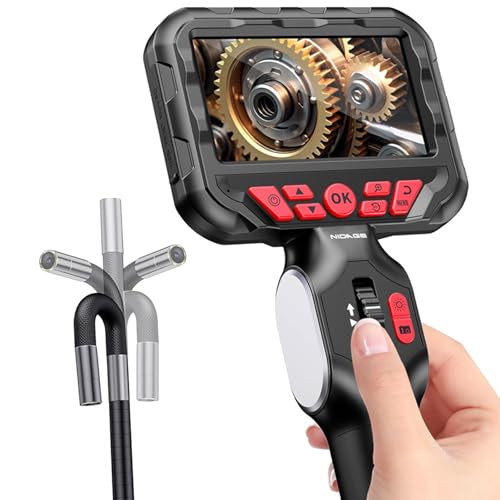
The NIDAGE endoscope combines a 210° two-way articulation with a 4.3-inch IPS screen for crisp visuals. Its 6.2 mm tiny endoscope camera with 6 LED lights ensures brightness in tight spaces and dim environments. It is well-suited for automotive work, electrical checks, and mechanical inspection where precise angles improve visibility. Best for users who need all-around viewing flexibility and a stand-alone display; better for those who value a compact, articulating camera with reliable lighting. A possible limitation is the cable length at 5.2 feet, which may feel short for very large engines or distant access points.
Vanxse CCTV Mini Pinhole Camera

This compact pinhole camera delivers 1/3” CCD at 1000 TVL with a 3.6 mm lens, designed for hidden surveillance in discreet installations. Its low power consumption and easy operation make it suitable for both indoor and outdoor monitoring tasks. The camera captures color by day and switches to grayscale in low light. Best for covert or space-constrained monitoring where a small form factor is required; better for static placements rather than dynamic close-up inspections, given the pinhole design. A caution: pinhole cameras can have limited field-of-view and may require careful placement for optimal coverage.
OdontoMed2011 LED Pocket Otoscope

The OdontoMed2011 LED Pocket Otoscope is a fiber optic mini otoscope set designed for portable medical inspections. It emphasizes a handmade craftsmanship touch for quality and reliability. This option is best for medical-oriented tasks, such as basic ear or dental checks at home, where a compact, fiber-optic light source is advantageous. Choose this if you require a lightweight, pocket-friendly tool for personal health checks; avoid if you need heavy-duty industrial inspection features or the broader field of view offered by larger borescopes.
Buying Guide
What should you consider when choosing a mini fiber optic camera?
- Probe flexibility and length — For tight spaces, a bendable or articulating probe helps access awkward areas; consider length based on typical inspection depth.
- Display options — Stand-alone screens are easy to use and don’t rely on a phone; smartphones offer portability but may introduce connectivity issues.
- Lighting and image quality — LED brightness and camera resolution impact visibility in dark or reflective environments; look for adjustable lighting where possible.
- Compatibility — If using with mobile devices, confirm platform support (iOS/Android) and connection type (USB-C, HDMI, etc.).
- Durability and handling — Semi-rigid cables balance flexibility with stability; consider build quality for frequent use in automotive or industrial settings.
- Intended use scope — Mechanical inspections, electrical checks, or medical-adjacent tasks require different compliance and ergonomics; align product choice with primary tasks.
FAQ
- What is a mini fiber optic camera best used for?
It is ideal for inspecting tight spaces like engine bays, plumbing, HVAC ducts, or medical-adjacent checks where lighting and flexible visualization are essential. - Do these devices require an app?
Some models operate as standalone units with built-in displays, while others connect to phones or tablets via USB-C or wireless methods. - Is a brighter LED always better?
Brighter LEDs improve visibility in dark areas, but excessive brightness can wash out details or reflect off shiny surfaces; look for adjustable lighting. - Should I pick an articulating probe?
If you need to view around corners or behind components, an articulating probe provides better angle control and coverage. - What maintenance is needed?
Keep cameras clean, protect from water exposure beyond rated IP levels, and store with minimal bending stress on the cable to extend life. - Can these replace professional inspection tools?
They are intended for convenient, quick checks and routine maintenance. For legal or critical diagnostics, consult a professional toolset or service.