Best Oil Immersion Microscope Oils and Maintenance Kits
Choosing the right immersion oil is essential for achieving crisp, high-contrast images when using oil immersion lenses. This guide spotlights five top immersion oils and maintenance kits available on Amazon, selected for American classrooms, labs, and microscopy enthusiasts. Each option emphasizes a consistent refractive index, clean application, and storage practices to minimize air bubbles and cross-contamination. The following product summaries, a quick comparison table, and a practical buying guide will help you select oils and maintenance tools that fit your microscope, objectives, and imaging goals.
| Product | Brand | Volume / Type | Refractive Index | Notes |
|---|---|---|---|---|
| AmScope Immersion Oil, 1/4 Oz | AmScope | 1/4 Oz (7 ml), Type A | ND 1.515 | Universal use; high clarity for routine imaging |
| AmScope Maintenance Kit With Immersion Oil | AmScope | 1/4 Oz Type A oil + 1/4 Oz Type B | ND ~1.515 (A), ~1.515 (B) | Includes wipers and lens cleaner |
| Immersion Oil, 3/4 Oz | Generic | 3/4 Oz (25 ml), Type A | ND ~1.510 | Large volume; universal compatibility |
| Immersion Oil Type A, 1/2 Oz Amber | Rs’ Science | 1/2 Oz (15 ml), Type A | ND 1.515 | Amber bottle with dropper for controlled application |
| Cargille Immersion Oil, 1/4 Oz | Cargille | 1/4 Oz (7 ml), Type B | ND 1.515 | Reliable Type B option for longer imaging sessions |
AmScope Immersion Oil, 1/4 Oz

This immersion oil is designed for all microscopes using Type A oil and comes in a 1/4 ounce (7 ml) quantity. The refractive index is ND=1.515, which closely matches glass to minimize refraction and glare at high magnifications. The oil’s viscosity is formulated to reduce air bubbles that can disrupt image clarity when working with high NA objectives. Its consistency supports smooth light transmission between the slide, cover slip, and objective lens, enabling sharper details in cellular structures and fine specimens.
Intended for routine imaging, this oil is compatible with a wide range of microscope brands. Store it in a clean, sealed container away from heat and light to preserve viscosity and prevent oxidation. Apply only a tiny drop to avoid excess residue, and wipe away any surplus after imaging. This product is a practical choice for classrooms, clinics, and hobbyists who value reliable, repeatable results without complex preparation.
AmScope Maintenance Kit With Immersion Oil

This kit provides a complete workflow for microscope upkeep, featuring immersion oil in 1/4 Oz Type A oil for high-image fidelity and an additional 1/4 Oz Type B oil for extended use. The package also includes professional-grade wipers and an optical lens cleaner, helping prevent lens scratches and keep optical surfaces free of dust and oils between sessions. The Type A oil offers ultra-low viscosity, reducing bubble formation, while Type B oil offers a steadier performance for longer imaging experiments.
Designed for professionals and serious students, this maintenance kit emphasizes practical cleaning and oil management. The included wipers are soft, anti-static, and lint-free to protect delicate optics, and the lens cleaner helps remove smudges that can compromise resolution. Proper storage in a cool, dark place and careful application techniques are recommended to maximize oil life and minimize contamination. This kit supports consistent imaging workflows in busy labs and classrooms.
Immersion Oil, 3/4 Oz, Type A

This oil comes in a larger 3/4-ounce (25 ml) bottle and is universal for most microscopes with Type A immersion oil. The refractive index is close to glass, with a practical ND of about 1.510, which provides reliable light transmission at moderate to high magnifications. The generous volume reduces the frequency of replacement during long staining workflows or extended observations, making it suitable for labs, classrooms, and fieldwork where consistent imaging is essential.
With easy handling and a straightforward application profile, this oil is designed for broad compatibility. It’s important to maintain a clean applicator and avoid cross-contamination with different oil types. Store away from heat sources and sunlight to preserve viscosity over time. While not a premium amber-bottle option, the ample volume offers value for frequent users who need dependable performance without frequent restocking.
Immersion Oil Type A, 1/2 Oz Amber
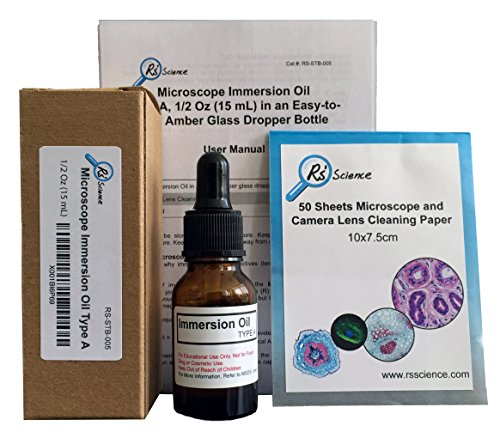
This offering provides Type A immersion oil in a 1/2 ounce amber glass bottle with a glass dropper for precise application. The refractive index ND=1.515 supports high-quality imaging across common objectives, and the amber bottle helps protect the oil from light-induced viscosity changes. The included dropper simplifies small-volume dispensing, reducing waste and keeping the oil clean during repeated use. It suits a range of microscopes and is especially helpful for educators and researchers who perform frequent, careful oil applications.
Designed for user-friendly handling, this product emphasizes accessible storage and careful application. Keep the bottle capped when not in use and avoid exposing the oil to heat or direct sunlight. Pairing this oil with appropriate cleaning practices and wipe-down routines minimizes residue and maintains optical performance across sessions. It represents a practical balance of convenience, quality, and control for everyday microscopy tasks.
Cargille Immersion Oil, 1/4 Oz

Cargille’s immersion oil comes in a 1/4-ounce (7 ml) bottle and is identified as Type B, with a refractive index ND of approximately 1.515. Type B oils are often chosen for longer imaging sessions or when a slightly higher viscosity is beneficial for maintaining a stable oil path during high-magnification observations. This option offers reliable performance across a wide range of microscope models and objectives, making it a solid choice for labs that routinely use immersion oil for detail-rich specimen analysis.
As with any immersion oil, proper handling is important. Use only a clean dropper or applicator to avoid introducing contaminants. Store in a cool, dark place to preserve viscosity and prevent oxidation. When combined with appropriate lens-cleaning practices and anti-static wipers, this oil helps maintain image clarity and reduces the need for frequent oil changes during extended observations.
Buying Guide
Oil Type And Viscosity
Immersion oils are typically categorized by viscosity and a standard refractive index around 1.515. Type A (low viscosity) oils are favored for high-NA objectives and quick imaging sessions because they reduce air bubbles and glare in the light path. Type B (medium viscosity) oils offer greater staying power during longer sessions and can provide steadier optical performance when imaging complex or densely stained specimens. When choosing, consider whether you need rapid, bubble-free imaging (Type A) or longer, steadier exposure (Type B) for detailed analysis.
Refractive Index And Optical Match
The refractive index (ND) of immersion oil should closely match glass to minimize light refraction. Most common Type A and Type B oils target around ND 1.515. Small variations can affect sharpness, especially at higher magnifications. For high-NA objectives, an oil with ND near 1.515 helps preserve resolution and contrast. If your microscope uses specialized objectives, verify compatibility with the included ND specification to maintain optimal imaging results.
Packaging, Storage, And Contamination Prevention
Amber glass bottles offer light protection and can extend oil stability, while dropper bottles enable precise application and reduce waste. Always reseal containers after use and store oils in a cool, dark place away from heat sources. Avoid cross-contamination by using clean tools for each oil type, especially if you alternate between Type A and Type B oils. Wipers, lens cleaners, and lint-free cloths are essential accessories in any kit to maintain lens integrity and prevent residue buildup that can degrade image quality over time.
Maintenance Kits Versus Pure Oils
Maintenance kits combine immersion oil with cleaning supplies, wipers, and lens cleaners, offering a complete workflow for optics care. Pure immersion oils focus on the fluid used in the light path and may come in larger or more varied volumes. If your daily routine includes frequent imaging and lens cleaning, a maintenance kit can streamline workflows and reduce the risk of cross-contamination. For occasional use, individual bottles of Type A oil may be more economical and simpler to manage.
Compatibility And Application Best Practices
Most immersion oils labeled Type A are broadly compatible with standard microscopes and objectives. When applying, use only a tiny drop to avoid excess residue; wipe away any surplus after imaging. Always ensure the objective lens is clean before applying oil, and avoid letting oil contact non-immersion lenses or mechanical parts. If you switch between oils, clean the optical surfaces thoroughly to prevent composition changes that could affect imaging. Following these practices helps maintain consistent results across sessions and minimizes the risk of lens damage.
Practical Considerations And Use Cases
For routine classroom imaging or quick specimen checks, Type A oils in small bottles are typically sufficient and cost-effective. For longer experiments, high-magnification work, or professional lab workflows, oils with longer stability or a maintenance kit may provide better reliability and ease of use. Consider how often you image, the types of specimens, and your microscope’s objective NA when selecting between oil volumes, viscosity, and whether to incorporate accompanying cleaning tools into your routine. The right combination supports consistent, high-quality microscopy results.