Best Micro Four Thirds Wide-Angle Zoom Lenses for Your Mirrorless Camera
The best Micro Four Thirds wide-angle zoom lenses deliver sharp landscapes, architecture, and travel photography with compact, portable designs. This guide highlights five solid options, explaining who each is best for and why. Use this to quickly compare focal ranges, portability, and performance for Micro Four Thirds systems from OM SYSTEM and Panasonic. The table below summarizes the chosen lenses and their ideal use cases.
| Product | Focal Range | Best For | Why Pick |
|---|---|---|---|
| OM SYSTEM M.Zuiko Digital ED 9-18mm F4.0-5.6 II | 18-36mm equivalent | Travelers, landscapes, architecture | Ultra-wide, compact, affordable |
| OM SYSTEM M.Zuiko Digital ED 8-25mm F4.0 PRO | 16-50mm equivalent | Professional landscapes, urban photography | Pro-grade optics, weather-sealed |
| Panasonic Lumix G Vario 12-32mm F3.5-5.6 | 24-64mm equivalent | Everyday carry, starter kit | Very compact, versatile range |
| Panasonic Lumix G Vario 14-140mm F3.5-5.6 II | 28-280mm equivalent | Travel, all-in-one zooms | Broad range, stabilized |
| OM SYSTEM M.Zuiko Digital ED 14-42mm F3.5-5.6 EZ | 28-84mm equivalent | Casual daily photography, lightweight setup | Electric zoom, extremely compact |
OM SYSTEM M.Zuiko Digital ED 9-18mm F4.0-5.6 II Wide-Angle Zoom
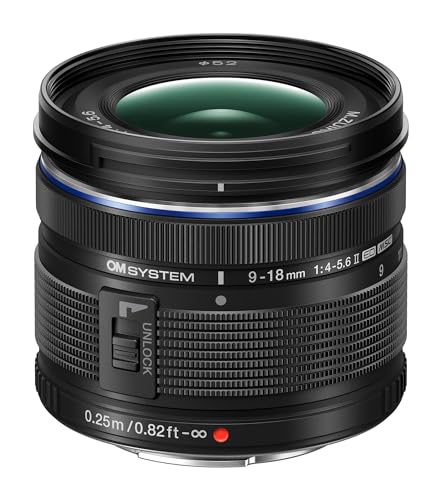
The OM System 9-18mm F4.0-5.6 II is designed for Micro Four Thirds cameras, offering an ultra-wide 18-36mm equivalent range. It uses multiple elements to reduce spherical aberrations and distortion, with a focus on portability. Best for travelers and photographers who want broad composition without bulk.
- Best for: Landscapes, cityscapes, travel photography
- Why selected: Ultra-wide perspective in a compact package
- Caution: Wider end can show slight distortion at extreme edges
OM SYSTEM M.Zuiko Digital ED 8-25mm F4.0 PRO

The 8-25mm F4.0 PRO provides a robust, weather-sealed design with a versatile 16-50mm equivalent focal range. It targets serious enthusiasts and professionals who need reliable sharpness, contrast, and texture in varied light. This lens is best for landscapes and architecture where weather resistance matters.
- Best for: Landscape and architectural photography
- Why selected: Pro-grade optics and sealing for challenging environments
- Caution: Higher price relative to entry-level options
Panasonic Lumix G Vario 12-32mm F3.5-5.6 ASPH

The 12-32mm is a compact, everyday zoom that covers an adaptable 24-64mm equivalent range. It’s designed for travel and casual use, with a lightweight build and useful focal lengths for street and everyday photography.
- Better for: Minimal carry, general purpose shooting
- Why selected: Very small footprint with practical zoom range
- Caution: Slightly slower at the far end in dim light
Panasonic Lumix G Vario 14-140mm F3.5-5.6 II

This versatile all-in-one zoom spans a wide to telephoto range, making it ideal for travel and situations where lens changes are inconvenient. The mounted stabilization helps reduce blur in low-light or handheld shooting scenarios.
- Best for: Travel, all-in-one lens for varied scenes
- Why selected: Broad focal range in a single lightweight body
- Caution: Slightly bulky compared to single focal-length options
OM SYSTEM M.Zuiko Digital ED 14-42mm F3.5-5.6 EZ

The 14-42mm EZ is one of the most compact wide-angle zooms. It uses an electric zoom for smooth control, making it a strong pick for casual shooters and travelers who want effortless, lightweight operation.
- Best for: Casual daily photography, travel light
- Why selected: Ultra-compact with convenient electric zoom
- Caution: Not the best choice for ultra-wide architectural precision
Buying Guide: Key Considerations for Micro Four Thirds Wide-Angle Zooms
Purpose and style guide selection. For landscapes and travel, prioritize ultra-wide or wide zooms with compact form factors. For architecture, look for low distortion and sharp corners. For video, consider silent focusing and stabilization features.
What focal range do I need?
18-36mm equivalents are excellent for broad scenes. 16-50mm equivalents add versatility for urban photography. Ultra-wide options like 18-36mm excel in immersive landscapes, while mid-zooms such as 24-70mm equivalents support everyday shooting.
How important is weight and weather sealing?
Travel and outdoor photographers benefit from light, weather-sealed lenses. PRO-grade optics in weather sealed designs deliver durability in rain or dust.
Is stabilization important for a wide-angle lens?
Stabilization helps in low light and when handholding at longer focal lengths. Some lenses integrate in-body stabilization synergy for smoother footage and steadier stills.
What about optical quality and distortion?
Look for multi-element designs with aspherical and low-dispersion elements. These reduce distortion and chromatic aberration for sharper, truer color rendering across the frame.
Budget and availability concerns
Entry-level options provide good value, while PRO or premium models offer advanced optics and sealing. Consider your typical shooting environments and whether you prioritize portability over ultimate image quality.
Compatibility and future-proofing
All listed lenses target Micro Four Thirds bodies. Ensure compatibility with your camera’s wind and AF systems, especially for video work where autofocus performance matters.
Quick comparison recap
- Best for ultra-wide landscapes: OM SYSTEM 9-18mm F4.0-5.6 II
- Best for rugged, pro-grade builds: OM SYSTEM 8-25mm F4.0 PRO
- Best all-around travel kit: Panasonic 12-32mm
- Best all-in-one travel option: Panasonic 14-140mm II
- Best ultra-compact daily lens: OM SYSTEM 14-42mm EZ
Frequently Asked Questions
- What is the advantage of Micro Four Thirds wide-angle zooms? They offer broad perspective in a compact system, ideal for travel, landscapes, and architecture.
- Which lens is best for architectural photography? The OM SYSTEM 8-25mm F4.0 PRO provides sharpness and reduced distortion in wide scenes.
- Are there lightweight options for everyday carry? Yes, the 12-32mm and 14-42mm EZ are among the lightest options in their class.
- Is image stabilization necessary in wide-angle zooms? It helps in low light and when shooting handheld, especially at longer focal lengths.
- What should I consider before buying? Focal range, build quality, weather sealing, stabilization, and weight relative to travel plans.
- Do these lenses work with all Micro Four Thirds bodies? They are designed for Micro Four Thirds cameras and should be compatible across major brands in the system.