Best Micro Four Thirds Prime Lenses for Everyday Photography
The Micro Four Thirds system is prized for compact, lightweight lenses that deliver excellent image quality and versatile focal ranges. This guide highlights five top prime lenses that suit a range of shooting styles—from low-light portraits to wide perspectives—while keeping size and weight in check. Each entry includes key features to help you compare options at a glance.
| Chosen Product | Key Benefit |
|---|---|
| Meike 35mm F1.4 Large Aperture Manual Focus Prime | Bright fixed focal length for sharp portraits and low-light work |
| Panasonic LUMIX G VARIO 45-150mm F4.0-5.6 | Versatile zoom for distant subjects with steady stabilization |
| Sigma 16mm f/1.4 DC DN Contemporary | Ultra-wide fast prime for landscapes and low-light scenes |
| OM SYSTEM Olympus M.Zuiko Digital 45mm F1.8 | Compact portrait prime with beautiful bokeh |
| Olympus M.Zuiko Digital 25mm f/1.8 | Bright standard prime with natural field of view |
Note: Each product section provides a brief overview based on listed features to help you compare performance, size, and intended use.
Meike 35mm F1.4 Large Aperture Prime
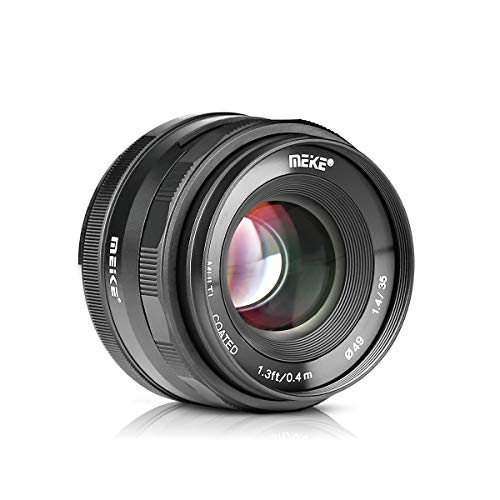
Meike’s 35mm F1.4 is a fixed focal length prime designed for Micro Four Thirds cameras. It features a wide maximum aperture of f/1.4, enabling smooth bokeh and better performance in low light. The lens is listed as compatible with Olympus and Panasonic mirrorless bodies in the MFT ecosystem, including various OM-D and E-P series models. The combination of 5 groups and 8 elements helps produce a compact, sharp lens with reliable performance for portraits and everyday shooting. The lens is manual focus, requiring camera body settings to enable non-electronic focusing in certain bodies.
Panasonic LUMIX G VARIO 45-150mm F4.0-5.6 ASPH

This zoom lens covers a versatile telephoto range on Micro Four Thirds bodies. It employs multiple coated elements to reduce ghosting and flare, delivering clearer images across its focal span. The inner focus system provides smooth, near-silent operation for both photos and video, while Panasonic Mega O.I.S. helps stabilize shots in low light or at longer focal lengths. A compact design makes it a practical option for travel or documentary work where space matters.
Sigma 16mm f/1.4 DC DN Contemporary

The Sigma 16mm f/1.4 DC DN Contemporary is a fast wide-angle prime optimized for Micro Four Thirds. With 16 elements in 13 groups, this lens minimizes aberrations while delivering sharp resolution from wide open to stopped down. The 24mm equivalent focal length is ideal for landscapes, environmental portraits, and street photography. Its large f/1.4 aperture furnishes strong subject separation and shallow depth of field when desired, enhancing low-light performance and creative control.
OM SYSTEM Olympus M.Zuiko Digital 45mm F1.8

This compact portrait prime offers a fast f/1.8 aperture, delivering bright performance in low light and satisfying subject isolation through shallow depth of field. The 45mm focal length on Micro Four Thirds yields a flattering perspective for head-and-shoulders portraits, street photography, and candid shots. The lens is praised for its compact size, light weight, and attractive bokeh in a serviceable, everyday carry form factor.
Olympus M.Zuiko Digital 25mm f/1.8

The 25mm f/1.8 is a bright standard prime offering a natural field of view equivalent to 50mm on full-frame. With a 0.24 m macro-like focus range and seven-blade diaphragm, this lens is well-suited for everyday street and documentary photography. Its compact build and fast aperture contribute to versatile shooting in varied lighting, enabling pleasing background blur without sacrificing image sharpness.
Buying Guide: Key Purchase Considerations
- Focal Length and Field of View: Choose a focal length that matches your typical subjects. Wider primes (like 16mm) suit landscapes and interiors, while standard (25mm, 35mm) and short-tele primes (45mm) excel in portraits.
- Aperture and Low-Light Performance: Faster apertures (f/1.4–f/1.8) deliver better low-light performance and shallower depth of field, but may come with trade-offs in size and cost. Consider how often you shoot in dim light or seek background separation.
- Autofocus vs. Manual: Some lenses are designed for manual focus (e.g., Meike 35mm f/1.4), while others offer fast, near-silent autofocus for video and action. Your shooting style will determine the best pick.
- Size, Weight, and Portability: Compact lenses are ideal for travel and street photography, whereas heavier, larger primes may offer exceptional sharpness and build quality, but add bulk.
- Image Stabilization: Lenses with built-in stabilization help reduce camera shake, especially at longer focal lengths or slower shutter speeds. Pair with a body that also benefits from stabilization when available.
- Compatibility and Mounting: Ensure the lens is designed for Micro Four Thirds and compatible with your camera model (Olympus, Panasonic, or OM System bodies). Manual vs. electronic coupling may affect autofocus and EXIF data transfer.
- Use Case Scenarios: Consider your typical shoots—portraits, landscapes, street, or video—and choose a focal length and aperture that align with those scenarios.
In summary, the five lenses featured here provide a range of options across price, aperture, and focal length within the Micro Four Thirds ecosystem. When comparing, consider the balance between speed, size, and autofocus behavior to meet your specific photographic needs.