Best Micro Four Thirds Lens Adapters for Auto Focus and Compatibility
Finding the right lens adapter can unlock the full potential of Micro Four Thirds cameras, letting you use legacy lenses with modern bodies while preserving autofocus and other functions. This guide highlights five top adapters that support 4/3 and Micro Four Thirds systems, focusing on automatic focus, build quality, and reliable performance for common camera models.
| Product | Brand | Key Benefit |
|---|---|---|
| Hersmay Electronic Lens Auto Focus Adapter | Hersmay | Electronic AF for 4/3 lenses on MFT bodies |
| K&F Concept M42 to Micro Four Thirds Adapter | K&F CONCEPT | Manual focus, brass/aluminum build, no electrical contacts |
| Fotodiox Lens Adapter for MFT on Sony E | Fotodiox | Manual or quick setup for MFT on Sony E, durable aluminum |
| Fotasy Minolta MD to M43 Adapter | Fotasy | MD to Micro Four Thirds with infinity focus |
| EBYPHAN EF-M1 Auto-Focus Metal Adapter | EBYPHAN | AF support for Canon EF lenses on MFT bodies |
Hersmay Electronic Lens Auto Focus Adapter

This electronic lens adapter is designed to fit existing Four Thirds lenses on Olympus Pen and Panasonic Lumix Micro Four Thirds cameras. With electronic pins, it enables auto focusing and supports infinite focus. Built with bronze bayonet mounts and a plastic body for balance and durability. It is compatible with original MMF-1 mounts, enabling smooth integration into a growing MFT system.
K&F Concept M42 to Micro Four Thirds Adapter

The K&F Concept adapter allows M42 screw-mount lenses to fit Olympus/Panasonic Micro Four Thirds bodies. It provides a precise, durable brass and aluminum construction with no electrical contacts, so exposure and focus must be manual. This adapter emphasizes a tight field of view and reliable manual operation for legacy glass on modern bodies.
Fotodiox Lens Adapter for MFT on Sony E

Fotodiox offers a universal solution for mounting manual focus MFT lenses on Sony E-mount cameras. Constructed from anodized aluminum for durability, this adapter provides a quick, cost-effective way to adapt lenses and explore a broader range of focal lengths on a Sony platform with Micro Four Thirds optics.
Fotasy Minolta MD to M43 Adapter

The Fotasy Minolta MD to MFT adapter enables MD Rokkor lenses to attach to Micro Four Thirds cameras, including many Olympus and Panasonic bodies. It guarantees infinity focus with a copper lens mount for durability, providing a robust option for MD glass users looking to step into modern mirrorless bodies.
EBYPHAN EF-M1 Auto-Focus Metal Adapter
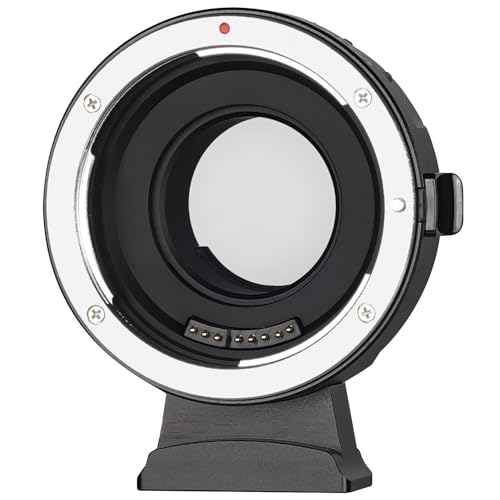
This metal EF-M1 AF adapter is designed to connect Canon EF lenses to Micro Four Thirds cameras. It supports a wide range of MFT bodies, including BMPCC and Olympus/Olympus-compatible models. The adapter provides quick AF, aperture control, and exposure parameter adjustments directly from the camera for efficient use with older Canon glass on MFT bodies.
Buying Guide: Key Considerations For Micro Four Thirds Lens Adapters
- Autofocus vs. manual focus: Some adapters enable electronic AF with particular lens brands, while others are strictly manual. Assess whether AF is essential for your shooting style and budget.
- Electrical contacts and signal integrity: Adapters with robust contact pins and signal transmission improve reliability. Look for gold-plated or well-machined contact interfaces for better durability.
- Build materials: Brass, aluminum, and bronze mounts provide durability and stability. Avoid plastic-only designs if you plan to use heavy or older lenses.
- Infinity focus and optical alignment: Ensure the adapter supports infinity focus and precise alignment to avoid vignetting or misfocus, especially with vintage glass.
- compatibility with camera models: Check compatibility lists to confirm support for your specific camera body (e.g., Olympus, Panasonic, BMPCC). Some adapters are optimized for select models.
- Manual control vs. auto control: Some adapters require you to manually set aperture and exposure, while others integrate with the camera to provide exposure control and AF. Decide based on your workflow.
- Lens compatibility range: If you plan to use a variety of lenses, consider an adapter with universal fit and good mechanical tolerance across different diameters and bayonet styles.
- Size, weight, and handling: Heavier metal adapters can affect balance on compact bodies. Verify grip and mounting stability for handheld shooting.
- Autofocus performance: For AF-enabled adapters, factor in potential lag or focus hunting with certain lens types. Manufacturer notes can help gauge performance expectations.
- Cost vs. value: While high-end adapters offer features like AF, they may not be necessary for every user. Weigh price against required functionality and lens compatibility.