Best Micro 4/3 Fisheye Lenses for Pan/Ol Micro 4/3 Cameras and More
The micro four thirds system supports a range of ultra-wide and fisheye lenses that unlock creative perspectives for landscapes, architecture, starscapes, and immersive panoramas. This guide highlights five notable fisheye options with manual focus and distinct optical traits, helping you compare field of view, size, and build quality across popular brands.
Summary of chosen products
| Product | Brand | FOV (approx) | Aperture | Notes |
|---|---|---|---|---|
| Brightin Star 7.5mm F2.8 III | Brightin Star | 190° | f/2.8 | Ultra-wide, starburst potential |
| 7Artisans 4mm F2.8 | 7Artisans | 225° | f/2.8 | Compact, travel-friendly |
| OM SYSTEM Olympus M.Zuiko 9mm F8.0 BCL | OM SYSTEM | 180° | f/8 | Body cap style, lightweight |
| Brightin Star 10mm F5.6 Fisheye | Brightin Star | 173° | f/5.6 | Wide architectural/landscape option |
| AstrHori 10mm F8 II | AstrHori | 180° | f/8 | High-contrast, compact |
Brightin Star 7.5mm F2.8 III Wide Angle Fisheye Lens

The Brightin Star 7.5mm F2.8 III is a compact fisheye designed for Micro Four Thirds cameras. With a 190° field of view, it captures expansive scenic views, starry skies, and architectural exteriors in dramatic, curved perspective. The bright f/2.8 aperture helps collect light in dimmer conditions, supporting night photography and astrophotography workflows. Its optical design emphasizes aberration control to preserve edge-to-edge sharpness while delivering the characteristic circular warp that defines the fisheye look. A 10-needle star light capability is highlighted by a five-element aperture arrangement, enabling dazzling highlights in bright scenes.
Key considerations:
- Ultra-wide 190° FOV creates dramatic distortion; best for creative shots rather than tight compositions.
- Fast aperture (f/2.8) improves performance in lower light and allows selective focus with pronounced depth.
- Manual focus demands careful practice for precise framing, especially in astro or indoor scenes.
7Artisans 4mm F2.8 Fisheye Ultra Wide Angle

The 7Artisans 4mm F2.8 fisheye is tailored for Micro Four Thirds bodies with a remarkably wide 225° field of view. This lens emphasizes a compact, travel-ready form factor (around 201 g) and a short overall length, which makes it easy to carry for street photography, landscapes, or immersive panoramas. The lens uses a wide aperture range of f/2.8 to f/16, supporting creative exposure control and reducing internal reflections to maintain clarity. The design includes multiple elements and coatings to reduce flare and color fringing, preserving contrast across the frame.
Key considerations:
- Large, nearly hemispheric field of view; ideal for sky domes and immersive scenes.
- Manual focus can be a constraint in rapidly changing environments; plan focusing distance in advance.
- Lightweight and compact—great for hiking or travel kits with limited space.
OM SYSTEM Olympus M.Zuiko 9mm F8.0 Fisheye

The M.Zuiko 9mm F8.0 fisheye offers a discreet, body-cap style option for Micro Four Thirds users seeking a compact fisheye with consistent performance. Its 180° field of view makes it well suited to architectural photography, tight interior spaces, and creative indoor shoots where distortion adds interest without requiring bulky glass. The manual focus lever allows for precise focus control, while the minimalist build keeps weight to a minimum. This lens is often favored by users who want a simple, ready-to-shoot fisheye option that minimizes extraneous gear.
Key considerations:
- Body-cap form factor keeps it unobtrusive and portable.
- Manual focus is straightforward but requires careful sighting for sharpness across the frame.
- Fixed aperture at f/8 is a trade-off between light transmission and depth of field; best for brighter scenes or stopped-down landscapes.
Brightin Star 10mm F5.6 Fisheye

The Brightin Star 10mm F5.6 fisheye presents another Ultra-Wide option with a 173° field of view designed for Olympus and Panasonic MFT compatible bodies. The lens emphasizes a compact, lightweight profile (about 0.22 lb) along with a short thickness, making it a practical travel companion. The lens design supports hyperfocal concepts to simplify shooting when distance-to-subject varies, enabling quick capture of expansive scenes without constant focusing adjustments. It is well-suited for cityscapes, large interiors, and wide landscapes where space looks expansive.
Key considerations:
- Hyperfocal-friendly design supports quick, hands-off shooting in various scenes.
- F5.6 aperture balances depth of field and light gathering in brighter settings.
- 173° field of view is substantial but not as extreme as some 190° options, offering a balance of distortion and practicality.
Meike 6.5mm F2.0 Fisheye
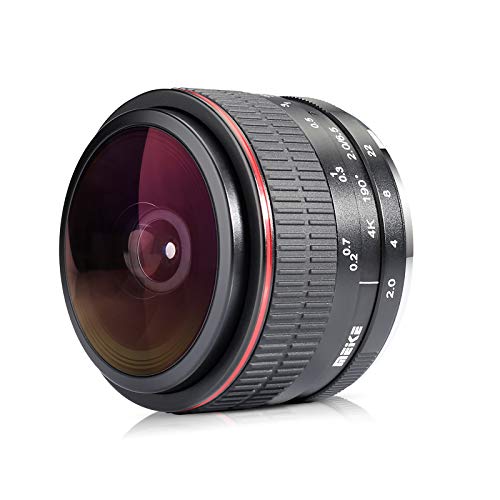
The Meike 6.5mm F2.0 is a compact fisheye option compatible with Micro Four Thirds cameras. It extends wide through a 180° field of view and provides a practical minimum focusing distance for close-up scenes. The lens is designed to minimize glare and ghosting with multi-layer coatings, contributing to better contrast in bright, reflective environments. The broader lens family suggests a balance of performance and value for photographers who want an economical fisheye with good optical fundamentals.
Key considerations:
- Short minimum focusing distance supports creative close-up shots in enclosed spaces.
- F2.0 aperture aids low-light performance while keeping a compact footprint.
- Coatings help reduce flare, though extreme backlighting still benefits from careful exposure management.
Buying Guide: Key Considerations For Micro 4/3 Fisheye Lenses
Choosing a fisheye lens for Micro Four Thirds involves evaluating field of view, image quality, and practicality for your shooting style. Here are factors to consider across brands and models:
- Field of view and distortion: 180° to 225° options deliver the strongest curvature effects, suitable for immersive panoramas and abstract landscapes. 173° to 190° options strike a balance between extreme distortion and usefulness in architectural shoots.
- Aperture and light gathering: Faster apertures like f/2.8 enable more creative night or astrophotography work, while f/8 or f/5.6 offer consistent depth of field for daytime scenes. Consider whether you need low-light capability or if you’ll shoot mostly in daylight.
- Build and weight: Body-cap style or ultra-compact designs improve portability, especially for travel. Heavier pro-level fisheyes may offer more robust construction but increase bulk.
- Manual focus and usability: Fisheyes often rely on manual focus to control edge sharpness. Look for smooth focus rings and precise distance scales if available. Some lenses include focusing aids or “Release w/o Lens” compatibility for certain bodies.
- Compatibility: Confirm Micro Four Thirds mount compatibility with your camera body, and ensure the lens’s minimum focusing distance aligns with your subject distance needs (landscapes, interiors, or macro-adjacent shots).
- Coatings and flare control: Wide-angle optics can suffer from internal reflections in bright conditions. Lenses with multi-coatings and proper edge-to-edge performance will minimize ghosting and maintain contrast across the image.
- Portability vs. versatility: If you travel often, prioritize compact designs with reasonable FOV. If you shoot interiors or architecture frequently, consider a wider FOV paired with practical focusing distances.
In practice, photographers may select a primary ultra-wide fisheye for dramatic landscapes or star fields, and a secondary 180° or near 173° option for street or architecture where a more natural distortion is desirable. Manual focus lenses benefit from deliberate composition and pre-planning, especially in astrophotography or panorama work.