Best Macro Lens Extension Tubes for Sharp Close-Ups and Flexible Focusing
Macro lens extension tubes enhance close-up photography by increasing the distance between your lens and the sensor, letting you focus closer and achieve higher magnification. This guide highlights five leading options across different mounts and ecosystems, so hobbyists and professionals alike can expand macro capabilities without buying new lenses. Below you’ll find short overviews, key features, and buying insights to compare performance across brands and mounts.
Summary of Selected Products
- Meike MK-S-AF3A AF Auto Focus Macro Extension Tube Adapter Ring (10mm+16mm) for Sony E-mount
- Fotodiox Macro Extension Tube Set for Canon EF/EF-S
- JJC E Mount Auto Focus Macro Extension Tube Set for Sony ZV-E10 and Alpha Series
- JJC RF Mount Auto Focus Macro Extension Tube Set for Canon RF Mount
- DG-C Auto-Focusing Macro Lens Extension Tube for Canon EF/EF-S (Viltrox)
Meike AF Macro Extension Tube Set (Sony E-mount)

Meike’s AF macro extension tubes are designed for Sony NEX, E-mount, and FE-mount cameras, spanning APS-C and full-frame bodies. The kit includes 10mm and 16mm tubes that can be used individually or combined for greater magnification. Autofocus support helps preserve quick setup, while manual exposure adjustments can directly influence exposure by selecting shutter speed in manual mode. This set is compatible with a broad range of Sony camera bodies, making it a versatile entry point for macro experimentation on Sony systems.
Key features include autofocus compatibility, compatibility with multiple Sony formats, and the option to stack tubes for flexible magnification. The robust build and ease of use make it a practical first step into macro with existing lenses. Photographers can pair these tubes with standard primes or macro-capable lenses to maximize close-up opportunities without purchasing dedicated macro glass.
Fotodiox Macro Extension Tube Set (Canon EF/EF-S)

The Fotodiox set is built to preserve optical quality while expanding macro capabilities on Canon EF and EF-S lenses. Known for all-metal construction, these extension tubes keep rigidity and durability at the forefront, ensuring consistent performance under varied shooting conditions. The kit’s versatility stems from multiple tube combinations, enabling different macro effects without changing lenses. It’s well-suited for Canon shooters looking to extend macro reach with a straightforward, robust accessory.
Performance notes emphasize that optical quality remains largely intact, with the tubes acting as pass-through spacers that do not introduce glass. The all-metal design provides reliable spacing and alignment, making it a stable platform for close-up work. For users who want to explore extreme macro without investing in new lenses, this option covers a broad range of Canon bodies and lens types.
JJC E Mount Auto Focus Macro Extension Tube Set (Sony)

Designed for Sony ZV-E10, A6000-series, and other E-mount bodies, this JJC set uses aluminum for the camera-mount portion and brass for the lens-mount portion, with an ABS plastic tube. This combination aims to balance weight, strength, and cost. It shortens the minimum focusing distance and effectively converts many lenses into macro lenses, enabling full autofocus and auto exposure compatibility. For Sony shooters who want a quick, affordable macro path without sacrificing autofocus, this kit offers a compelling solution.
With the ability to shorten focus distance and enable macro work across a wide range of lenses, the JJC E-mount set can help photographers maintain speed and accuracy when framing tiny subjects. The system is particularly attractive for travelers and street shooters who occasionally need macro capability without a dedicated macro lens.
JJC RF Mount Auto Focus Macro Tube Set (Canon RF)

This JJC RF system targets Canon RF mirrorless cameras and compatible RF mount lenses. The kit employs aluminum for the camera mount, brass for the lens side, and ABS plastic for the tubes, delivering a sturdy, affordable macro extension option. It shortens the working distance to enable close-ups and supports autofocus and auto exposure, helping users preserve ease of use while achieving macro magnification with existing RF lenses.
Canon RF users can leverage these tubes to maximize macro capabilities on bodies like the R-series and R5/R6 ecosystem. The design’s emphasis on compatibility and quick setup makes it a practical choice for photographers who want straightforward macro extension within the Canon RF system.
D&F AF Auto Focus Macro Tube Set (Canon EF/EF-S)
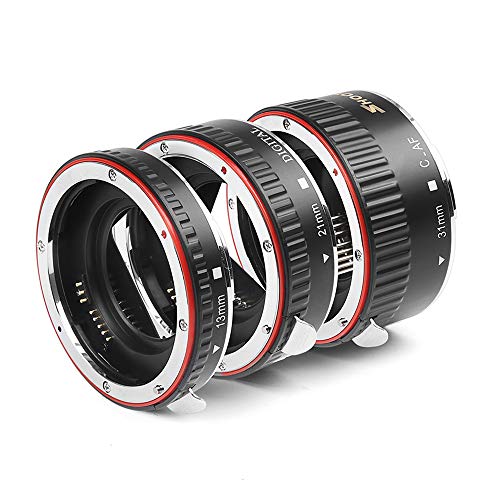
The D&F macro tube set is designed for Canon EF and EF-S lenses and is compatible with a broad range of Canon bodies, including EOS-series DSLR cameras. The kit includes 13mm, 21mm, and 31mm tubes, offering flexible stacking for various magnifications. It moves the lens closer to the sensor, enabling tighter macro shots while preserving autofocus and automatic exposure where supported. This option is particularly appealing to Canon shooters seeking an affordable, multi-tube solution for macro work across multiple camera generations.
Users should consider tube combinations to achieve the desired magnification and depth of field. The versatility of multiple tube lengths makes it possible to tailor the setup for flowers, small subjects, or product photography, without switching lenses or compromising convenience.
Buying Guide: Macro Extension Tubes
Key purchase considerations help determine the best macro extension tubes for a given system and shooting style. The following perspectives cover essential factors and practical tips to compare options:
- Mount compatibility: Confirm the tube set matches your camera body and lens mount (Sony E, Canon EF/EF-S, Canon RF, Nikon F, etc.).
- Autofocus and exposure: Some tubes preserve autofocus and auto exposure, while others require manual settings. If you rely on fast focusing, prioritize autofocus-enabled options.
- Tube configuration and magnification: Check included tube lengths and whether they can be combined. Stacking options expand magnification ranges (e.g., 10mm, 16mm, 10+16mm).
- Build quality: Look for materials like aluminum, brass, and durable plastics. All-metal builds tend to be more rigid and durable.
- Optical integrity: Extension tubes are typically glassless spacers; ensure the design minimizes play, misalignment, or looseness that could affect image sharpness.
- Weight and balance: Heavier tubes can affect camera handling, especially on smaller bodies. Consider how the setup impacts grip and fatigue during shoots.
- Budget and value: Compare price versus the features offered, including compatibility with multiple lenses and camera platforms.
When choosing, consider your primary camera system, the lenses you own, and the subjects you shoot most often. For dynamic macro work—like flowers or insects—autofocus-enabled tubes can speed up workflows. For studio product photography, stacking versatility and build quality may take precedence. If you frequently switch between systems or lenses, a model with broad compatibility and a solid construction offers the best long-term value.
In practice, starting with a two-tube kit (10mm and 16mm) provides a solid baseline for full control over magnification. Adding additional tubes or combining sets can unlock higher magnification while still maintaining autofocus where supported. Always test with your preferred lens to confirm focusing behavior and exposure control before committing to long shoots.