Best Lux Meter to Measure LED Lighting for Every Need
Answering the right question helps you pick the best lux meter for LED work. This guide targets buyers seeking accurate light measurements for plants, photography, offices, and studios. Each top pick is best for a specific use case—plant growth, indoor photography, or general lighting audits. The following table highlights key options and who they’re ideal for, so you can compare at a glance.
| Product | Best For | Key Range | Notes |
|---|---|---|---|
| URCERI Light Meter | General purpose and plant setups | 0–200,000 Lux | Ambient temperature readout; compact LCD |
| Dr.meter LX1330B | Indoor/outdoor lighting and plant care | 0–200,000 Lux | FC/Lux toggle; fast readings |
| BTMETER BT-881D | Wide-range audits and high dynamic scenes | 0.01–400,000 Lux | High accuracy; broad range |
| Triplett LT80 | Multi-source lighting environments | 0–400,000 Lux | Min/Max/Avg; broad source support |
| TOPTES TS-710 | Grow rooms and photo/video lighting setups | 0.1–200,000 Lux | 180° rotating sensor; backlit display |
URCERI Light Meter Digital Illuminance Meter
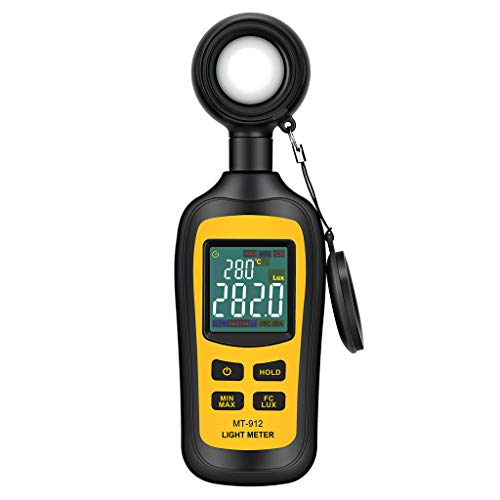
The URCERI lux meter measures luminance from 0 to 200,000 Lux and reports ambient temperature. It features a four-digit color LCD, MIN/Max readings, data hold, auto power off, and a low battery indicator. Best for general spot checks in homes, studios, and plant environments where quick, reliable readings are needed. Choose this if you want a compact, all-in-one device with temperature data and simple operation.
Best for: hobbyists, DIY gardeners, and small studios needing quick lux measurements with basic data retention.
Limitation: Data display updates may be slower on very low-light scenes; high precision is within ±3% for lower ranges but can vary in extreme conditions.
Dr.meter LX1330B Digital Illuminance Meter

The Dr.meter LX1330B is a high-precision illuminance meter with a fast response. It supports FC/LUX units and offers peak data recording, ideal for measuring brief high-intensity sources like flashes or laser beams. Best for horticulture where precise light timing matters or for photography planning where fast top-end readings are useful.
Best for: plant growers and photographers needing rapid, unit-flexible measurements and peak value recording.
Limitation: May not have as long a battery life as some low-energy models; conversions between FC and LUX require user attention to ensure consistency across projects.
BTMETER BT-881D Digital Illuminance Light Meter
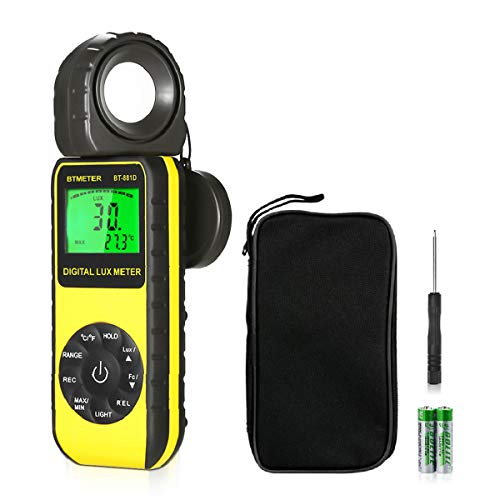
The BT-881D features a broad range from 0.01 to 400,000 Lux (0.01–40,000 FC) with high accuracy and a fast 0.4-second response. The wide range makes it suitable for audits in both indoor and outdoor settings, including horticulture and facility lighting evaluations. Best for users who need a wide measurement span and quick readings.
Best for: electricians, facility managers, and gardeners who require a broad dynamic range in a single device.
Limitation: Some users may prefer more compact form factors for field use; the sensor rotation is useful but can add bulk in tight spaces.
Triplett LT80 LED Illuminance Meter

The Triplett LT80 measures light intensity from white LED sources up to 40,000 FC (400,000 Lux) and supports other sources like fluorescent and high-intensity lamps. It provides Min/Max/Avg readings for a full performance profile. Best for environments with mixed light sources where a single tool must capture multiple data points over time.
Best for: mixed-light environments, photography studios, and classrooms needing a reliable multi-source reading with historical statistics.
Limitation: The sensor is tailored toward common light sources; extreme spectral conditions may require cross-checking with another meter for absolute spectral accuracy.
TOPTES TS-710 Light Meter

The TopTes TS-710 offers a 180° rotating sensor and 0.1 to 200,000 Lux range with a backlit 2.25″ LCD. It provides 0.5-second sampling and supports Lux/FC units. This makes it particularly well-suited for plant growth setups and photo/video lighting planning where angle flexibility and readability are critical. Best for growers and content creators who need flexible, angle-adjustable measurements.
Best for: grow rooms, film/photography lighting, and vehicle lighting checks where reading angles matter.
Limitation: Some users may require a higher upper Lux limit for intense industrial lighting setups; confirm your environment’s maximum before relying on the upper end.
Buying Guide
What should you consider when choosing a lux meter for LED lighting?
- Measurement range: Pick a meter that covers your typical LED environment, from subtle ambient lighting to bright grow lights (around 0.1–400,000 Lux is common).
- Accuracy: Look for devices with ±3–5% accuracy; lower percentages matter more in horticulture and photography.
- Display and usability: A backlit LCD and large digits improve readability in low-light setups. Data hold and MAX/MIN features save useful readings.
- Unit flexibility: The ability to switch between Lux and FC helps when working across different regions or standards.
- Sensor orientation: Rotating sensors or flexible probes allow measurements from awkward angles and tight spaces.
- Portability and battery life: For field work, choose compact devices with long battery life and auto power-off features to conserve energy.
How to interpret readings for LED-focused tasks?
- Gardening and plant growth: Target specific lux ranges for different growth stages; use a meter with stable long-term readings and quick response.
- Photography and video: Aim for consistent, uniform lighting; prefer meters with fast sampling and a clear backlit display for on-set use.
- Office and retail lighting audits: Look for accuracy across a wide range and a clear MIN/MAX history to identify lighting issues.
Which features are most valuable for LED users?
- Wide dynamic range (0.01–400,000 Lux or more)
- Fast sampling (0.4–0.5 seconds)
- Rotating sensors for flexible angles
- Unit conversion between Lux and FC
- Data hold, MAX/MIN/AVG statistics
FAQ
- What does Lux measure?
Lux measures illuminance, or the amount of light hitting a surface, not the light source’s brightness alone. - Do I need a lux meter for LED grow lights?
Yes. LED grow lights require accurate light levels to optimize plant photosynthesis and growth stages. - Is FC the same as Lux?
FC and Lux are units of illuminance; 1 FC equals 10.764 Lux. Some meters switch between them. - What is a good range for photography lighting?
For general photography, aim for a stable, uniform range within your scene’s target, typically tens of thousands of Lux depending on the subject. - Should I buy a rotating sensor meter?
Rotating sensors offer flexibility for multi-angle measurements, useful in rooms, grow tents, and set designs. - How important is data logging?
Data logging helps compare lighting over time and across different spots, especially in larger spaces or seasonal studies.