Best Long Distance Camera Lens Options for Sharp Distant Shots
Answer: For capturing distant subjects with clarity, these long-distance camera lenses are designed to maximize reach, sharpness, and control. They’re ideal for wildlife, sports, and astronomy enthusiasts who want closer-in detail without moving closer. The top picks below cover classic telephotos, specialty manual focus options, and a modern super-tele with image stabilization considerations. Each product section notes who benefits most, along with practical limitations to consider.
| Product | Best For | Key Benefit |
|---|---|---|
| High-Power 420-1600mm Telephoto (Big Mike’s) | Serious wildlife and sports shooters | Hybrid reach with 2x converter for up to 1600mm |
| Canon EF 75-300mm III | Budget-friendly beginners and casual shooters | Smooth zoom with lightweight design |
| High-Power 500mm/1000mm f/8 Telephoto (Big Mike’s) | Wildlife and nature observers | Excellent image clarity with 2x converter |
| EF/EF-S 420-800mm F8.3 (Lightdow) | Manual-focus enthusiasts and learners | Fully manual control with long focal range |
| JINTU 420-800mm f/8.3 (Two options) | Travel-friendly telephoto for Canon DSLRs | Metal build, good reach, broad camera compatibility |
| Canon RF100-400mm F5.6-8 IS USM | Canon mirrorless users seeking compact telephoto | Stabilized, versatile for EOS R series |
High-Power 420-1600mm Telephoto Zoom Lens For Canon

Best For: Wildlife and sports photographers who need extreme reach with flexible framing. This lens spans 420mm to 1600mm with a built-in 2X teleconverter for maximum magnification. It’s compatible with a broad range of Canon cameras, including EOS 5D and high-end Rebel and SL series. The main advantage is the extended reach for distant subjects, allowing framing options that would otherwise require a larger tripod setup or closer proximity.
Caution: The lens is fully manual in operation; expect a steeper learning curve for focusing and exposure control. Its weight and handling may require sturdy support for handheld use over long sessions.
Canon EF 75-300mm III Telephoto Zoom

Best For: Beginner and hobby photographers looking for an affordable long lens to explore telephoto photography. The 75-300mm range provides practical reach for travel, birding, and sports. It features a smoother zoom mechanism and a compact profile compared with larger telephotos, making it a good entry point into longer focal lengths.
Limitation: Aperture varies from f/4 to f/5.6, which can limit performance in lower light and may require higher ISO settings or slower shutter speeds in dusk conditions.
High-Power 500mm/1000mm f/8 Telephoto (Big Mike’s)

Best For: Wildlife and distant landscape shooters who want reliable, sharp results at extreme focal lengths. The 500mm base with a 2X teleconverter yields 1000mm, with high-index, low-dispersion glass for improved clarity and contrast. It’s a solid choice when you need more reach without stepping up to larger professional lenses.
Limitation: As with many fast-reaching telephotos at longer focal lengths, camera shake can be pronounced without stabilization or a tripod. Manual focus may be needed at higher magnifications, depending on the subject and lighting.
EF/EF-S 420-800mm F8.3 Manual Focus (Lightdow)

Best For: Photographers who want true manual control and a long reach at a relatively affordable price. The fully manual design encourages deliberate focus and exposure decisions, making it ideal for learners and enthusiasts who want to experiment with long focal lengths without electronic focus aids.
Limitation: The lens is fully manual with no electronic contacts; you must switch the camera to manual mode and manage exposure and focus without the aid of autofocus.
JINTU 420-800mm Manual Telephoto With T-Mount
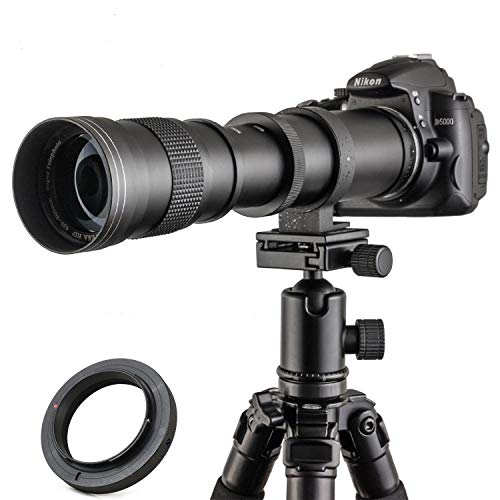
Best For: Canon DSLR users who value a compact, metal-bodied telephoto with broad compatibility and solid build quality. The lens offers a practical zoom range for wildlife and sports, with lightweight construction suitable for travel and fieldwork.
Limitation: It is manual focus, which may slow shooting in fast-moving scenes or dim lighting. Ensure you’re comfortable with manual MF adjustments for precise framing at long distances.
JINTU 420-800mm EF/EF-S Mount + T2 Adapter

Best For: Canon EOS Rebel and mid-range DSLR users who want a versatile prime/zoom telephoto option with broad camera compatibility. The included T2 adapter enhances compatibility with multiple Canon bodies and provides extended usage across generations.
Limitation: The lens is designed for manual operation; autofocus is not available, and users must pre-plan settings for each shot, particularly in wildlife or sports contexts.
Canon RF100-400mm F5.6-8 IS USM

Best For: Canon mirrorless users seeking a compact, versatile telephoto with image stabilization. The RF 100-400mm covers typical wildlife and travel scenarios with modern stabilization and a lightweight design suited for handheld shooting or light tripods.
Limitation: The variable aperture can be slower in low light; pairing with a high ISO or wider aperture at the short end is sometimes necessary to maintain shutter speeds in action shots.
Buying Guide
What should I consider when choosing a long distance lens?
- Camera system compatibility: Ensure the lens matches your camera mount (Canon EF/EF-S versus RF for mirrorless).
- Reach and intent: Decide whether you need 400–800mm for birds, 1000–1600mm for distant wildlife, or a moderate range for sports.
- Autofocus vs. manual focus: Autofocus helps in fast action; manual focus provides precise control in challenging lighting or when using adapters.
- Weight and handling: Longer lenses can be heavy; consider monopods, tripods, or lens collars for stability.
- Image stabilization: Lenses with IS/VR help in handheld use; check compatibility with your camera body’s stabilization features.
- Budget vs. quality: Entry-level telephotos offer value, while premium options deliver sharper images and better contrast at distance.
How to use telephoto lenses effectively?
- Stabilize: Use a sturdy stance, supported elbows, and a tripod or monopod for extreme focal lengths.
- Exposure controls: Longer focal lengths require faster shutter speeds to avoid motion blur; adjust ISO as needed.
- Focus strategy: For moving subjects, pre-focus on a spot where action is likely to occur, and use burst shooting to capture decisive moments.
Maintenance and care tips
- Keep lens elements clean and free of dust to preserve image clarity at long distances.
- Store in a padded bag or case with a lens hood to protect against incidental impacts.
- Avoid abrupt temperature changes which can affect lens coatings and precision mechanisms.
FAQ
- What is the difference between EF and RF telephotos? EF/EF-S lenses fit Canon DSLRs, while RF lenses are for Canon’s mirrorless system; adapters may be needed for some bodies.
- Do telephoto lenses require macro-style focusing? No; telephotos are for distance. Close-up work uses macro lenses or extension tubes.
- Is manual focus viable for wildlife photography? Yes, with time to acquire precise focus and often in stable lighting, manual focus can yield satisfying results.
- Can I use these lenses without a tripod? Some lighter telephotos can be handheld, but long focal lengths benefit from stabilization or support to reduce shake.
- Do telephoto lenses improve image quality at distance? They can, by reducing perspective distortion and improving subject isolation, given proper technique and lighting.
- Which lens offers the best value? Value depends on your camera system and intended subjects; the Lightdow and JINTU options provide broad compatibility at accessible prices for learning and amateur photography.