Best Light Meters for Photography
Find the right light meter for precise exposure control in both ambient and flash photography. This guide targets photographers seeking reliable, field-ready meters across budgets and needs. The top picks cover pocket-sized meters, touchscreen devices, and advanced multi-function units for film, video, and studio work. Each entry notes who it’s best for, why it’s a fit, and a practical caveat. Use the quick buyer’s table below to compare at a glance.
| Product | Best For | Key Benefit |
|---|---|---|
| Sekonic L-308X-U Flashmate | Still photography and flash users | Accurate ambient and flash readings, compact |
| Sekonic LiteMaster Pro L-478D-U | Professional studios and motion work | Touchscreen, multiple modes, cine frame control |
| Sekonic L-858D-U Speedmaster | Advanced exposure with HSS and flash timing | Flash duration analysis, radio triggering option |
| UNI-T UT383 | Budget-conscious photographers | Lux/FC readings, compact with backlit display |
| Mcbazel Digital Light Meter | LED/plant photography and dynamic lighting | 8x/s sampling, LED-specific correction |
The following sections highlight five highly relevant models. Each entry includes a brief why-this-mits, who it’s best for, and a practical note to consider before purchasing.
Sekonic L-308X-U Flashmate Light Meter

The L-308X-U excels for still photographers and hobbyists who need reliable ambient and flash readings. It supports photo mode with both ambient and flash functions, includes a range suitable for ISO 100, and offers a compact, pocket-sized design for field use. Best for photographers who want straightforward exposure data without extensive setup.
Why selected: It delivers precise readings down to a tenth of a stop in both ambient and flash modes, making it a dependable all-around meter for photographers who frequently mix ambient with strobe. The compact form supports on-location shoots and quick adjustments.
Caution: In extremely low light or when using unusual flash configurations, verify the setting modes to avoid misreadings. Its full-feature set is solid for standard setups, but may lack some high-end cine controls found in professional models.
Sekonic LiteMaster Pro L-478D-U
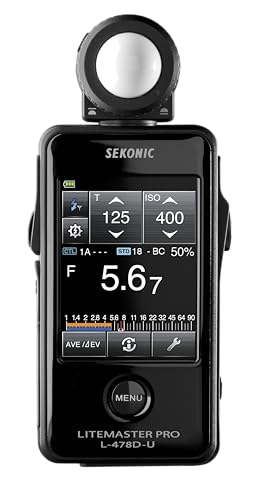
The LiteMaster Pro is geared toward professional studios and motion workflows. It features a touchscreen interface, incident and reflected metering, cine frame rate and shutter angle controls, and a dedicated flash analysis capability. Best for advanced users who need precise balance between flash and ambient light across video and still frames.
Why selected: Its touchscreen navigation streamlines exposure adjustments in fast-paced environments, and the added cine features support consistent lighting for film and video production. It provides a cohesive workflow that integrates both photo and cinema requirements.
Caution: The feature set is comprehensive, but beginners may find the touchscreen and cine controls overwhelming. Plan time to learn the interface for optimal results.
LightMate AirPro Light Meter

The LightMate AirPro targets photographers who value a wide metering angle and independent dials. It offers a 35-degree metering angle, multiple shooting modes, and independent ISO, aperture, and shutter speed controls with half-stop resolution. Best for enthusiasts who want tactile control and precise exposure tuning for stills and cinematic lighting in one device.
Why selected: It provides granular control with tactile feedback and strong support for various shooting modes, making it a versatile choice for those who prefer manual adjustments and a traditional look-and-feel. Its wide-angle metering helps in scenes where lighting across a frame varies.
Caution: The device’s wind-down complexity may introduce a learning curve for new users. Ensure you understand the M, A, S, and EV modes before critical shoots.
UNI-T UT383 Light Meter

The UT383 provides a compact, budget-friendly option for film and photography. It measures light intensity in Lux and FC, with a large LCD and backlight. It’s suitable for basic exposure planning and quick readings in field work. Best for students, hobbyists, or as a secondary meter in a kit.
Why selected: Its dual-unit display (Lux/FC) and straightforward operation make it an approachable choice for entry-level photographers and plant/LED testing scenarios where basic luminosity data is sufficient.
Caution: It offers fewer advanced features than pro-grade meters, so rely on it for basic readings rather than complex lighting setups or precise flash analysis.
Mcbazel Digital Light Meter
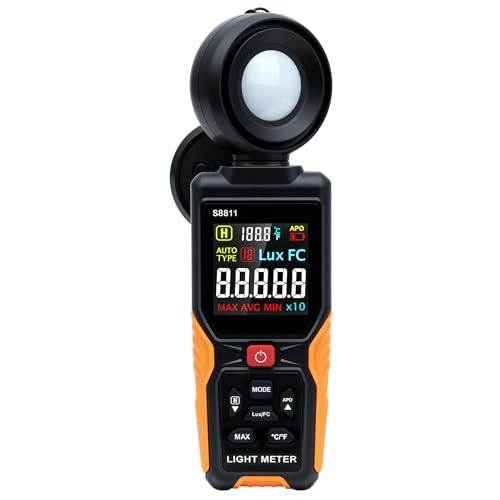
The Mcbazel meter emphasizes fast sampling and LED-specific calibration. It features an 8x/s sampling rate for real-time data, with light-source correction coefficients to adjust for LEDs and other sources. Best for photographers working with dynamic lighting, LED-heavy environments, or plant photography where rapid changes matter.
Why selected: Real-time responsiveness helps track flicker and shifting exposure quickly, while LED-specific calibration improves accuracy in modern lighting. Its rotatable sensor and color display support readability in tight spaces.
Caution: While fast, it may rely on specific calibration steps for LED types; verify light source alignment when precision matters in critical shoots.
Buying Guide: Key Purchase Considerations
- Exposure needs: Do you require incident and reflected readings, or primarily ambient with flash analysis? Choose a model that matches your typical setup.
- Display and interface: Do you prefer a touchscreen, physical dials, or a simple LCD? Consider learning curve relative to your workflow.
- Light source compatibility: Are you working with LEDs, studio strobes, or cine lighting? Look for presets or correction coefficients for common sources.
- Portability vs. feature depth: Pocket meters suit fieldwork; multi-feature meters fit studios and video work. Balance size with required controls.
- Workflow integration: If you use cine or video, ensure the meter offers frame-rate, shutter angle, and HSS analysis when needed.
- Battery life and reliability: For on-location shoots, battery life and auto-sleep features help avoid interruptions.
Frequently Asked Questions
- What is the difference between incident and reflected light metering?
– Incident meters measure light falling on a subject, while reflected meters measure light reflected off the subject. Both help determine exposure, but incident readings are independent of subject color, whereas reflected readings depend on the scene’s reflectivity. - When should I use a flash meter vs. ambient light meter?
– Use a flash meter to quantify strobe output and flash-to-ambient balance, especially in studio or outdoor flash setups. Ambient meters are ideal for natural light conditions or when flash is not used. - Do I need a cine/Video-ready light meter?
– If you shoot video or cinema, meters with frame rate, shutter angle, and flash analysis help maintain consistent exposure across motion shoots. - Is a high-end meter worth it for hobbyists?
– For frequent on-location shoots or complex lighting, a more capable meter can save time and improve results, but entry-level meters remain adequate for basic photography. - Can meters read LED lighting accurately?
– Many meters include LED-specific correction or coefficients. If you work largely with LEDs, choose a model that explicitly supports LED correction. - How important is a wide metering angle?
– A wide angle helps in scenes with uneven lighting or when you cannot place the meter close to the subject. It reduces measurement bias from shadows or bright spots.