Photographers rely on light meters to lock in accurate exposures, whether shooting with ambient light, strobes, or both. The following selection highlights five dependable models that deliver consistent readings, intuitive controls, and versatility across stills, video, and studio setups. Each option offers a balance of precision, ease of use, and durability for American photographers seeking reliable metering in diverse shooting environments.
| Product | Type | Key Benefit | Best For |
|---|---|---|---|
| Sekonic L-308X-U Flashmate | Ambient & Flash | Extremely precise to 0.1 stop, full ambient and flash range | Stills with both flash and ambient control |
| Sekonic LiteMaster Pro L-478D-U | Ambient & Flash | Simultaneous ambient and flash readings; comprehensive display | Studio setups with flash-heavy lighting |
| UNI-T UT383 | Lux/FC Meter | High-visibility display; wide measurement range | Compact, portable light assessment |
| TopTes TS-710 | Lux/FC Meter | 180° rotating sensor and backlit display | Plant growth, photography, and general illumination tasks |
| Dr.meter LX1330B | Lux/FC Meter | Fast readings with easy FC/LUX toggle | Indoor/outdoor photography and plant lighting |
Note: The featured products cover a range of budgets and use cases—from compact pocket meters suitable for field work to advanced models ideal for studio environments. All items are compatible with standard ISO settings and common exposure workflows, making them suitable for both beginners and seasoned photographers alike.
Sekonic L-308X-U Flashmate Light Meter

The Sekonic L-308X-U Flashmate offers precise ambient and flash measurements with a tenth-of-a-stop accuracy in full-stop mode. Its ambient EV range at ISO 100 spans from 0 to 19.9, while the flash range covers f/1.0 to f/90.9, with a shutter-speed span of 60 seconds to 1/8000th of a second (and 1 sec to 1/500th for flash). This makes it ideal for still photography that requires reliable exposure values for both ambient light and strobe-driven scenes. In Photo Mode, photographers can view ambient and flash functions across a full range, including both corded and cordless flash measurement. The compact design plus clear, familiar Sekonic controls helps streamline on-location shoots and studio work alike.
Light Meter Digital Illuminance Meter By URCERI
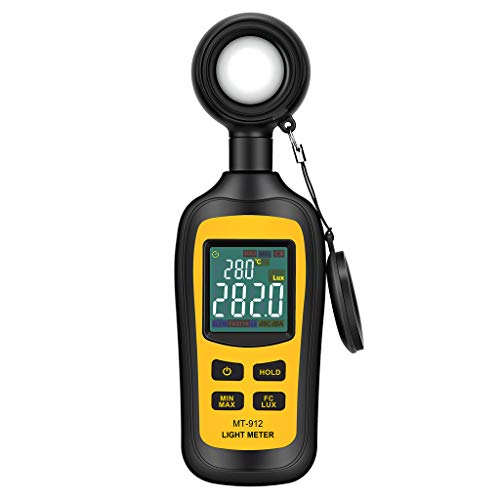
The URCERI Lux Meter measures luminosity from 0 to 200,000 Lux and reports ambient temperature, delivering high-accuracy readings within specified tolerances (±3% rdg and ±8 digits up to 10,000 Lux; ±4% rdg and ±10 digits beyond that). Its four-digit color LCD screen provides easy readability, with MIN/Max readings, data hold, auto power-off, and a low battery indicator. This handheld device suits photographers who need quick, reliable light measurements outdoors or in variable environments, and it accommodates both ambient and color LCD visibility for fast decision-making on exposure and lighting setups.
Sekonic LiteMaster Pro L-478D-U Light Meter

The LiteMaster Pro L-478D-U is designed for photographers who frequently balance ambient and flash exposure. It measures ambient and flash simultaneously and automatically indicates the percentage of flash in the total exposure. The meter’s large color LCD presents ambient, flash, cine, and other data clearly, helping photographers quickly interpret exposure values. Its two motion-capture modes adapt to various camera systems, including HD SLRs and Cine frame rates, enabling precise shutter and frame-rate matching. This makes it a solid choice for studio shooters and filmmakers who require fast, reliable metering with flexible display options.
UNI-T UT383 Light Meter Lux Meter

The UNI-T UT383 measures light intensity from 0 to 199,900 Lux (0 to 18,500 FC) with a compact form factor. It features high accuracy and a large, backlit LCD screen for easy reading in dim environments. With MAX/MIN readings, data hold, auto power-off, and an auto-shutdown for power saving, the UT383 is a reliable pocket option for field photographers and videographers who need quick checks of scene illumination, whether outdoors or in controlled indoor settings. The included auto-backlit display and straightforward controls minimize setup time on location.
TopTes TS-710 Light Meter

The TopTes TS-710 provides a 180° rotating sensor with a backlit 2.25″ LCD, measuring in lux and foot-candles from 0.1 to 200,000 Lux (and 0.1 to 20,000 FC). Its precision is rated at 3% rdg + 5 digits, and it supports a wide array of applications—from plant lighting to photography and general illumination assessments. The rotating sensor enables measurements from multiple angles, making it practical for work in studios or locations with awkward lighting angles. The TS-710’s broad range and visibility help photographers and other professionals ensure appropriate light levels for their projects.
Dr.meter LX1330B Digital Illuminance Light Meter

The Dr.meter LX1330B offers a fast, two-per-second measurement rate with an easy FC/LUX toggle. It’s a practical choice for photographers needing rapid readings in variable light conditions and for plant lighting setups. The unit is designed for indoor and outdoor use, helping users quickly determine whether lighting meets exposure goals or plant growth requirements. Its straightforward operation and widely understood units make it a versatile tool for quick field checks and studio calibrations alike.
Buying Guide
- Measurement range and accuracy: Look for meters with a wide Lux/FC range and tight accuracy (often ±3% to ±4% rdg). Ambition for at least 0.1 EV precision for still photography.
- Ambient vs. flash capability: If you shoot with strobes, ensure the meter can read ambient and flash readings simultaneously or quickly switch between modes.
- Sensor orientation: A rotating sensor (180°) offers flexible placements for inconsistent lighting and awkward angles, which is valuable in studios and on-location shoots.
- Display readability: Backlit LCDs and clear typography help in low-light conditions. Font size and contrast matter when working in dim environments.
- Units and calibration: Most meters switch between Lux and FC; confirm the unit you prefer and assess whether calibration is required or recommended for your workflow.
- Portability and ergonomics: Compact meters are ideal for field work, while larger meters with more features suit studio environments. Consider battery life and power options as well.
- Data features: MIN/MAX, data hold, peak readings, and memory functions can improve efficiency, especially during rapid lighting changes.
- Camera compatibility: Some meters offer modes tailored to cine or HD DSLR shutter speeds and frame rates, which can simplify exposure management in video shoots.
- Durability and warranty: For frequent field use, durability and a solid warranty can influence long-term cost of ownership.
- Price-to-feature balance: Higher-cost models provide sophisticated controls and faster responses, but a robust mid-range meter can satisfy most photography needs effectively.