A laser line generator lens set helps turn simple laser modules into precise alignment tools for woodworking, fabricating, and calibration tasks. Green wavelengths are especially visible in bright environments, making these units suitable for workshops, studios, and hobbyist setups. This guide highlights five compatible laser line modules and lenses, focusing on adjustability, mounting options, and power requirements to help you select the right kit without overpaying or mismatching components.
| Product | Brand | Key Feature | Wavelength | Power/Notes |
|---|---|---|---|---|
| 532nm Focusable Green Projector Line Module | Laserlands | Focusable, adjustable line width, includes adapter and magnetic base | 532 nm | Output <5 mW (Class IIIr); 12V |
| GM532-30 Green Line Module (2 Pack) | Qianfabeam | DIY green laser line modules; two-pack for parallel builds | 532 nm | Requires external power; preheat in cold temps may be needed |
| 520nm Green Line Module 16mm | Laserlands | Focusable, adjustable line width; 16 mm diameter | 520 nm | 5V DC (adapter recommended) |
| 5pcs Laser Line Module Lens Set | Lilly Electronics | Five interchangeable plastic lenses for beam spread control | Not specified | 8 mm diameter; 2 mm thick |
| Green Crosshair Module VLM-520-29 | Quarton | Crosshair line generator; economical Class I | 520 nm | 7–10 V DC; <0.39 mW; >60° angle; 40 cm line at 40 cm |
532nm Green Projector Line Module
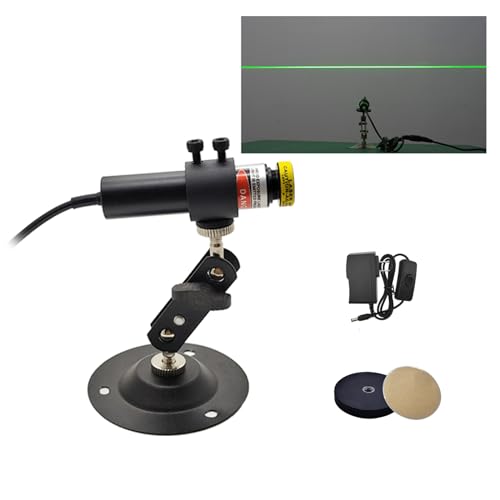
The 532 nm green line module from Laserlands is designed as a focusable projector-style line generator with adjustable line width. It outputs under 5 mW, class IIIr, providing a bright, visible line suitable for woodworking alignment, stage props, and display work. The package includes a 12 V adapter, mounting hardware, and a magnetic base for convenient placement, making it a ready-to-install option for fixed or portable setups. Its 18 mm footprint supports compact integration into tools and fixtures.
In operation, the focusable optics let users tailor the line width for long-throw or close-range tasks. The magnetic base and included mounting hardware simplify attachment to jigs and benches. For safety, always follow laser safety guidelines and ensure proper eye protection when working with higher-brightness green lasers in bright environments.
GM532-30 Green Line Module (2 Pack)

Qianfabeam’s GM532-30 provides a two-pack of 532 nm green diode line laser modules designed for DIY line-generator projects. The set is aimed at makers and hobbyists who want to experiment with multiple lines or build parallel testing rigs. The modules are designed for DIY assembly rather than a complete, standalone system, and brightness is noted to be higher than some 520 nm alternatives. Cold-weather performance may require a 2–10 second preheat when temperatures dip below 15°C.
Because these modules are typically bare diode components, users must provide an external power source and housing. They’re ideal for those who want modular flexibility, custom mounting options, and the ability to compare different optics or beam shapes without purchasing full assemblies each time.
520nm Green Line Module 16mm

This 520 nm green line module offers adjustable line width for alignment tasks at different working distances. The unit operates from a 5V DC supply, with a recommended 5V 1A adapter to ensure stable performance. The compact 16 mm diameter form factor allows integration into mini jig systems, fabric alignment rigs, or portable measurement fixtures. It is suitable for hobbyists and professionals who need a bright green reference line with simple external power requirements.
The product emphasizes versatility and reliable performance in a compact package. For best results, pair with a stable 5V supply and mount using a compatible base or magnetic attachment to ensure repeatable, clean lines across setups and rework cycles.
Five Lens Set for Laser Line Modules

This set contains five interchangeable plastic lenses with beam spreads of 35°, 45°, 60°, 90°, and 120°. Each lens is 8 mm in diameter and 2 mm thick, making them compatible with common 8 mm laser line modules. These lenses enable quick customization of line width to suit different distances and applications, from close-up alignment to long-range referencing. The plastic construction keeps the kit lightweight and easy to handle for rapid prototyping and testing.
Lens interchangeability is especially useful for calibrating instruments or fixtures where line width must be tuned without swapping entire modules. Users should ensure their existing laser modules have the corresponding lens interface diameter to avoid incompatibilities and achieve optimal optical performance.
Green Crosshair Module VLM-520-29

The VLM-520-29 from Quarton is a green crosshair laser module designed for economical cross-line generation. It operates as a Class I device with a wavelength of 520 nm and a low power output (<0.39 mW). The unit provides an emitting angle greater than 60°, producing a practical crosshair line width of about 40 cm at a 40 cm distance. Size is compact (D9 x 26 mm) and it is designed for consumer-grade alignment tasks while meeting safety standards. It runs on 7–10 VDC, and the module is intended to be wired into the user’s own power supply and mounting fixture.
As a crosshair generator, this module excels for layout checks, calibration setups, and alignment tasks where a stable reference crosshair is more helpful than a single line. It requires proper mounting and a suitable power source, and it should be integrated with care to maintain alignment accuracy and safe operation in mixed lighting environments.
Buying Guide
Key considerations when selecting a laser line generator lens system include wavelength color, safety classification, line width control, mounting and housing options, and power requirements. For visibility in bright environments, green wavelengths (around 520–532 nm) are typically preferred. Review the Class rating to balance visibility with eye safety. If a device is Class I, it is generally eye-safe under normal use, whereas Class IIIr units require more protective measures and safe operation practices.
The ability to adjust line width quickly can be essential for different tasks. Some modules offer focusable optics and true line-width adjustment, while others rely on interchangeable lenses to alter beam spread. Consider whether you need a single-line module for straightforward alignment or a multi-pack capable of testing several line configurations at once. Lens sets provide flexibility but may require compatible interfaces to install properly.
Power supply and mounting options play a significant role in installation. Units with 12 V adapters and built-in magnetic bases are convenient for quick placement on metal fixtures. Others require external power supplies and housings, which adds to assembly time but enables custom enclosures. If you plan to use these devices in variable temperatures, check operating temperature ranges and preheat recommendations to maintain beam stability and response times.
Usage scenarios vary from woodworking and metalworking jigs to stage effects and calibration rigs. When selecting, compare wavelength, line width range, required voltage, and mounting compatibility. If you need both a green line and a crosshair, choosing modules designed for cross-line generation can simplify your setup while offering predictable line behavior across distances.