Best IR LED for CCTV Camera Options for Night Vision and Security
Answering the question “which IR LED is best for CCTV cameras?” this guide highlights top IR LED illuminators commonly used with security cameras. It helps buyers choose by beam range, angle, durability, and compatibility. It’s ideal for property owners, installers, and small-business security setups seeking clearer night footage. The table below previews five solid options with practical use cases.
| Product | Brand | Best For |
|---|---|---|
| 850nm 48pcs LED IR Illuminator Infrared Night Vision Light Lamp for CCTV Camera IR Illuminators | GODIYMODULES | Moderate-range night illumination for standard CCTV shells |
| JC Infrared Illuminator 4 Led High Power LED IR Array Illuminator | JCHENG SECURITY | Wide-angle coverage for larger camera views |
| Tendelux 120ft IR Illuminator | 90° Infrared Light | Tendelux | Outdoor security with longer reach and weatherproofing |
| DMetric IR Illuminator, AC 110V – 220V 850nm | DMetric | Long-range, automatic night activation in varied environments |
| NVRTTRR IR Illuminator, 6 LED Lights, 12V | NVRTTRR | Durable, compact option for simple installations |
Introduction continues below. The sections that follow match each product to practical buyer needs, with clarity on who should choose each option and why. A brief Buying Guide and FAQ are included at the end to support informed decisions.
GODIYMODULES 850nm IR Illuminator

Best for: Basic CCTV setups needing extra infrared light with a compact footprint. This board-style illuminator uses 850nm LEDs to extend night vision for cameras with a 50mm shell diameter. It’s suitable for entry-level installations in homes or small offices.
Why selected: It provides a straightforward IR boost without complex mounting, and its 850nm spectrum is widely supported by many security cameras.
Caution: The unit’s 48 LEDs are fixed; check your camera’s distance requirement to avoid under-illumination in larger areas.
JC Infrared Illuminator 4 Led High Power Array

Best for: Cameras needing a wider angular spread to avoid hotspots. The built-in 4 high-power IR LEDs deliver a 65-foot range, making it suitable for medium-sized outdoor spaces.
Why selected: The wide-angle design helps evenly light scenes, reducing shadows that complicate facial or license-plate recognition at night.
Caution: The stated distance is approximate and depends on camera sensitivity and environmental lighting conditions.
Klgeivb IR Illuminator 850nm Bulb

Best for: Users with existing 850nm-compatible cameras seeking a simple bulb-style addition. This 15W, 180° wide-angle IR bulb works well where a broad, even glow is preferred.
Why selected: The milky diffuser helps minimize hot spots, supporting more uniform coverage across large areas.
Caution: It emits a faint red glow even when off in some 850nm setups; for 100% invisible light, consider 940nm options and verify camera IR sensitivity.
Tendelux 120ft IR Illuminator
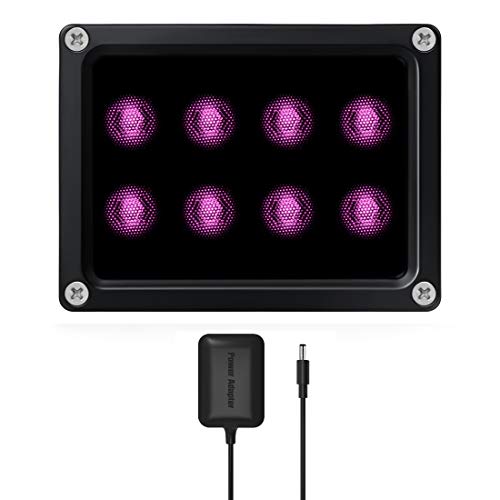
Best for: Outdoor CCTV setups requiring longer night-range and durable weather protection. With 8x1W LEDs and an IP66 rating, it suits exterior walls, driveways, and yards.
Why selected: The 90° flood spread and anti-UV IR filter help deliver even lighting while minimizing foreground overexposure and hot spots.
Limiter: In bright environments or small rooms, the long-range beam may be excessive, causing glare or unnecessary power usage.
Acxico 48 IR LEDs 940nm Option

Best for: Cameras requiring consistent, uniform night vision with a broad infrared footprint. The 48 IR LEDs provide broad emission with a stable driving circuit.
Why selected: Designed for compatibility with many CCTV cameras, offering wide voltage design and stable operation to reduce flicker in low-light scenes.
Caution: While 940nm is near-invisible to the naked eye, some cameras may still perceive a slight glow under certain settings; confirm IR sensitivity before purchase.
NVRTTRR IR Illuminator 6 LED Night Light

Best for: Compact, weather-resistant installations where a simple, reliable night-light solution is needed. The 6-lamp design provides solid performance for smaller outdoor setups.
Why selected: Durable metal shell and rainproof features support outdoor use, with automatic night operation for convenience.
Caution: The 12V system requires appropriate power supply compatibility; verify voltage requirements with your camera setup.
Buying Guide: Key Considerations For IR LED Illuminators
- Range vs. Beam Angle: Consider if you need long-range illumination (tens of feet) or wide-angle coverage to reduce hotspots. Higher wattage tends to increase reach but may require camera compatibility checks.
- Wavelength: Most cameras respond to 850nm or 940nm. 850nm is visible as a faint red glow when active; 940nm is typically invisible but not all cameras can detect it equally, so confirm camera sensitivity.
- Power and Voltage: Verify the illuminator’s supply requirements (AC vs. DC, 12V vs. 24V) and ensure your installation avoids voltage drops that can reduce performance.
- Weatherproofing: For outdoor use, look for IP ratings (IP65, IP66) and solid housings to withstand rain and dust.
- Diffusion and Hotspots: Diffusers help create uniform illumination. Avoid products with sharp hotspots that obscure details at the edges of frames.
- Mounting and Compatibility: Check diameter, mounting brackets, and compatibility with camera lenses (e.g., 2.8–4 mm or fixed shells). Some units are designed for specific camera shells or enclosures.
- Automatic On/Off: CDS or light-sensor-enabled models provide day/night switching, reducing unnecessary illumination during daylight.
Frequently Asked Questions
- What wavelength should I choose for CCTV night vision?
– 850nm is the most common and widely supported; 940nm is nearly invisible but may vary in camera sensitivity. Pick based on whether you prefer invisibility or broader camera compatibility. - How do I know if an IR illuminator will fit my camera?
– Check the camera’s lens size, mounting options, and recommended IR range. Look for a unit that matches your enclosure diameter and mounting bracket needs. - Is weatherproofing important for outdoor use?
– Yes. Choose at least IP65 or IP66-rated housings to protect against rain, dust, and temperature changes. - Can an IR illuminator be used with indoor cameras?
– Yes, but ensure the coverage area and power supply align with indoor space constraints to avoid glare or over-illumination. - Should I prefer more LEDs or longer range?
– It depends on the area to be lit. More LEDs can offer broader or more uniform coverage, while longer-range units work best for distant targets. - Is automatic night switching necessary?
– It’s convenient and energy-efficient, especially in environments with variable lighting, but not essential if you manually manage illumination.