Best Inspection Cameras and Video Borescopes for Tight Spaces and Dark Environments
Answering buyers’ needs for reliable, easy-to-use inspection tools, these best-in-class borescopes and inspection cameras help you peek into engines, pipes, walls, and more. They’re ideal for pros in automotive, plumbing, HVAC, and DIY alike. The top five options below balance articulation, image quality, and durability to fit different inspection jobs and budgets.
Summary of selected products
| Product | Best For | Key Benefit |
|---|---|---|
| Teslong Two-Way Articulating Borescope | Automotive and home inspections | Two-way articulation and a bright 4.5″ IPS screen |
| DEPSTECH Dual-Lens Endoscope | Versatile plumbing and automotive work | Dual lenses with split-screen and long cable |
| MugEasy Endoscope With Light | Wet environments and pipe inspections | IP67 waterproof with 16.6ft semi-rigid cable |
| Teslong Endoscope With Light | Tight spaces and professional-grade work | 180° rotating display and 16.5ft semi-rigid cable |
| Ditomil Endoscope With Phone Connectivity | Mobile monitoring and field use | 1920P image quality with phone integration |
Teslong Two-Way Articulating Borescope With Light

This borescope prioritizes maneuverability and clarity for tight spaces. The two-way articulation allows precise navigation around corners, making it better for automotive inspections and mechanicals where access is limited. The 4.5-inch IPS LCD provides high-resolution visuals in various lighting conditions, and the semi-rigid 5ft cable balances flexibility with control. Best for technicians who need quick, accurate detail in confined areas; avoid if you require extremely long reach without repositioning.
DEPSTECH Dual-Lens Endoscope Camera
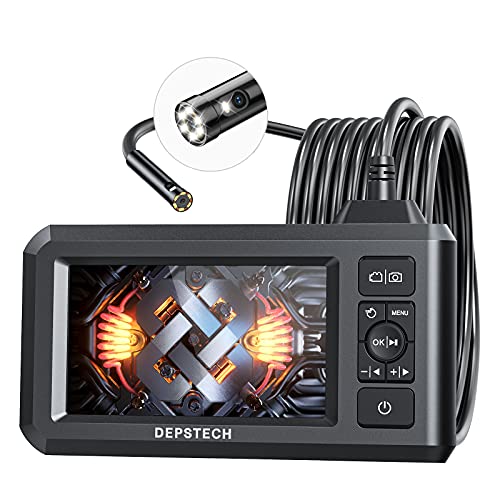
The DEPSTECH DS300 uses dual lenses and a split-screen view to show front and side perspectives simultaneously. This is especially useful for plumbing or HVAC inspections where obstacles block direct access. The 4.3″ IPS screen with a wide field of view (about 170°) helps reduce misreads in cluttered spaces. A 2nd CMOS chip and a long 16.5ft snake cable improve image responsiveness and reach. Choose this if you need versatile angle options; it may be less ideal if you require single-view simplicity in very small spaces.
MugEasy Endoscope Camera With Light

This model emphasizes a bright, reliable display and robust waterproofing. The 4.3″ IPS screen delivers a wide viewing angle, and 8 LED lights adapt to dark inspection sites. IP67 waterproofing makes it suitable for wet environments like sewers and drainage lines. The 16.6ft semi-rigid cable helps reach challenging routes, though note that pictures or video storage is not supported as part of its feature set. Best for users who prioritize a strong screen and camera light in damp spaces; may not suit users who need built-in photo/video capture.
Teslong Endoscope With Light

The Teslong model emphasizes durability and a broad inspection capability with 16.5ft semi-rigid cabling and 8 LEDs. The 78° viewing angle and 180° rotating display enhance situational awareness in complex spaces, from wall cavities to engine bays. The ability to capture photos and videos adds documentation value, although data transfer depends on the included accessories. Best for contractors who need a comprehensive, long-reach tool; consider a model with built-in memory if photo storage is a priority.
Acoath Two-Way Articulating Borescope

Acoath blends two-way articulation with a dual-lens system, enabling quick switching between front and side views. The 4.3″ IPS display and eight LEDs provide reliable visibility in darker spaces, with up to 1080p image clarity. The 5ft semi-rigid cable is compact for tight inspections and IP67 waterproofing supports use in wet environments. Best for users who need flexible angle control in confined areas; longer reach would improve utility for very large pipes or engines.
Buying Guide: Key Purchase Considerations
- Articulation and reach: If you frequently inspect tight corners, prioritize models with two-way or 210–220° articulation and longer semi-rigid cables (around 16–16.5ft). This improves access without excessive repositioning.
- Screen and visualization: A bright, high-contrast display (IPS or equivalent) helps in bright shop lights or sunlit areas. Aim for screens around 4.3–5 inches with sufficient resolution for clear detail.
- Lighting and optics: Adjustable LED counts (6–8) and a narrow lens provide better visibility in dark, dusty, or wet spaces. IP67 waterproofing adds resilience in wet environments.
- Dual lenses vs single lens: Dual-lens devices offer wider context and easier switching for complex scenes. Choose this if you need multiple angles without relocating the probe.
- Data capture: If keeping records matters, look for borescopes that store photos/videos or enable easy transfer to devices. Some models support SD cards or direct USB/phone connections.
- Cable flexibility: Semi-rigid cables balance maneuverability and staying power. Longer lengths help span larger areas but may require more careful handling.
- Compatibility and use-case: For automotive, plumbing, HVAC, or wall inspections, match the tool’s form factor and articulation range to the typical job. IP ratings and corrosion resistance matter in contaminated environments.
FAQ
- What is the advantage of a two-way articulating borescope?
Two-way articulation allows the probe to bend in multiple directions, enabling inspection around corners and behind obstacles without moving the entire device.
- Do these cameras require an app to view footage?
Most of the models listed operate with built-in screens or do not require apps; a few offer phone connectivity for viewing, but several do not rely on smartphones for operation.
- Is IP67 waterproofing important for inspection cameras?
Yes. IP67 rating protects against immersion in water and dust, which is valuable for sewer, drain, or wet environment inspections.
- What cable length is best for automotive work?
Typically 5–16.5 feet, depending on access. Longer cables reach deeper areas but can be harder to maneuver in tight spaces.
- Should I prioritize dual lenses or a single broad-angle lens?
Dual lenses provide more perspectives and flexibility for complex inspections; if you mainly need a straightforward view, a single wide-angle lens is simpler to use.
- Can I store images and videos from these borescopes?
Some models support internal storage or SD cards, while others rely on external transfer methods. Check the product’s data features before purchase.